Showing posts with label sport. Show all posts

Friday, October 28, 2016

Sports: Caribbean Cubs

Less than four years after gaining independence from the United Kingdom, the Central American nation of Belize notched a smaller, yet somehow lasting, triumph in 1985. That winter, the Chicago Cubs sent their star outfielder Gary Matthews, Sr., to visit the country, which is often claimed to be the most Cubs-friendly land outside the Windy City. Matthews's visit was the culmination of a love affair that had begun in 1981, the year when Cubs games began being broadcast in the country.

And now, that the team is in the World Series, Cubs fever has come to the Caribbean in a big way. 

Why the Cubs—and why Belize? Like a lot of stories from this part of the world, it began with pirates. In this case, however, the outlaws were local TV impresarios, not swashbuckling Johnny Depp look-alikes. In the early ‘80s, there were no television stations in Belize, the only country in Central America whose official language is English. (Anyone with a set would use it to watch VHS tapes.) In 1981, however, Belize City business couple Arthur and Marie Hoare began transmitting the famous Chicago television channel WGN-TV via satellite, bringing programming to Belize. Channel 9, the Hoares' bootlegged Belize affiliate of WGN, brought Cubs and Bulls games into living rooms and bars throughout the country, sparking an interest in Chicago sports that has continued—with varying levels of enthusiasm—to this day.
"As [WGN's] signal was relayed into Belize City by the Hoares, 'world and country' were glued to their television sets to see the mighty Cubs win or lose (mostly lose)," remembered politician Michael Finnegan in a 2013 article in the Belizean paper Amandala.

 The country's tiny size may have kept American television executives at bay. In a 1989 Washington Post dispatch from Wrigley - South, reporter William Branigin explained that "U.S. broadcasters consider the Belize market so small that trying to stop the operations would not be worth the trouble."

 Most of the fans watching the Cubs in Belize today are Gen-Xers who grew up watching the team, says Jerry Martinez, a 36-year-old banker from Santa Elena, a city in the western part of the country. If the Cubs can lock up the World Series, Martinez thinks the romance may be rekindled. There are still diehard fans in the country, he says, but "people here usually ride with winners," especially younger Belizeans. 

However the season turns out, Martinez is determined to make his son a Cubs fan. "I grew up a Cubs fan and will die a Cubs fan," he says. "We're the lovable losers that introduced Belize to baseball."

Monday, October 3, 2016

Sport: Blood and the Ashes

London — Twenty thousand Englishmen baying at the enemy. Screaming themselves hoarse, urging their champion to strike flesh. And then, it happens: The enemy is hit. Yes! Unwilling to show pain, he removes his helmet. Blood — the sight most keenly craved for — trickles down. His entourage runs to assist him — he attempts nonchalance, but concussion is an issue. The crowd is ecstatic.
Is this the Saxons at the Battle of Hastings, eager for Norman gore? Or Wellington’s men at Waterloo, bayonets fixed for Frenchies? No, it’s June 2005 at Lord’s Cricket Ground, the spiritual home of cricket worldwide. And the bloodthirsty mob of 20,000 are mostly wearing blazers, brogues and club ties. On other days of the week, you’ll find them at work in arbitrage.

And the blood? Australian, of course — the ancient enemy, rival for the Ashes, as the trophy for each five-match tournament between England and Australia is known. What a start that was, and there were still some 24 more days of such glorious skirmishing to look forward to.
In fact, the 2005 Ashes series turned into the greatest I have ever witnessed, the probable outcome seesawing almost hourly. There were moments when I had to leave the TV, my anxiety too intense. (Spectating can be more nerve-racking even than playing oneself.) I still cannot watch the highlights of the second match — which England won by the closest margin in 123 years of the contest — without fear stoking my pulse. It also remains the only time I have attended a victory parade: Trafalgar Square, London, was awash with jubilant jackets and ties that day.

England vs. Australia in cricket may be one of the oldest sporting rivalries, but it is hardly the most chivalrous. Rather, it is when this oh-so-civilized game truly reveals its nasty, brutish heart. Cricket may be the only team game in the world in which it is entirely legal for a player to make a move whose only purpose is to hurt, if not hospitalize, an opponent. In cricket, this is not a foul; no penalty is awarded, or score deducted. For, central to this gentleman’s pastime — whether played on a village green or at Lord’s — is “the bouncer.”

Tuesday, September 20, 2016

Sport: Chris Gayle's first love is still cricket....for now

It often seems that Chris Gayle is tone between actually playing cricket and being a celebrity who plays cricket.

His exploits on the cricket pitch are fast entering the realm of legend, much like that other famous Jamaican athlete, - you know, the guy who runs? But, along the way, just like his track star compatriot, Gayle has had his share of publicity flaps and flops. Arguably, none will live longer in infamy (or maybe now in hashtag-land) than "Don't blush baby" the casual cap to a seemingly awkward attempt to coax Australian TV journalist Mel McLaughlin to join him post-game for dinner and a few drinks, during an on-air interview.


The incident made international headlines beyond the cricketing world and cost Gayle a fairly hefty $10,000 in fines from his local Aussie t20 club, the Renegades.

he has since shrugged off the whole brouhaha (the latest in a line which included him reportedly dropping his towel in a dressing room before another female reporter and boasting about his "big bat").

The West Indies batting star is apparently comfortable to move into another sphere of public life: memoirist. His life tome had its Jamaican launch at the expected place - his Triple Century Sports bar and Grill in the heart of the New Kingston business district.

The title?: "Six Machine" (clearly with apologies to the late James Brown, and the declaratory sub-title, "I Don't Like Cricket...I Love It".

Clearly not as much as having a party - and the man of the hour was suitably outstanding in white wihte shirt with black trim, tomato-red trousers and black shoeswith matching red trim. try ignoring him.

of course media reps ran through the expected raft of interviews and some got their books signed (distributor Novelty Trading, which runs the venerable Bookland store a few doors up the road, was on hand to handle the supply and sales, and patrons hungry for the sports highlights of the day could feat their eyes on the lounges multiple screen - that is, after the big man got through with his presentation.

Gayle, who spenthte summer playing T20 in the UK, among other things, is apparently in recuperation mode at present, but expects to beck on the pitch to put his big bat (and useful spin) into play, what with a number of international cricket engagements on his ever-expanding plate.


Tuesday, September 6, 2016

Sport: A former QB passes the Pot

-from Bleacher Report
Jake Plummer stands in a grassy meadow on a breezy spring afternoon, a Rocky Mountain peak framing his backdrop. He poses heroically, if just a little self-consciously, for yet another medical marijuana-related photo shoot.
The dramatic setting and dramatic pose demand a dramatic pronouncement.
"This is to wake up the whole population, not just the NFL," he says as the photographer snaps away.
The meadow Plummer stands in is behind a laboratory tucked into a nondescript corporate campus in Boulder, Colorado. The laboratory transforms cannabis and hemp into products that—according to preliminary research and a host of testimonials—can do everything from relieve pain to prevent seizures to, just maybe, repair a damaged brain.
Plummer is a leading advocate for the medical marijuana movement. But despite the rugged setting of his photo shoot, he is hardly a lone voice in the wilderness. Players such as former Ravens tackle Eugene Monroe and Titans linebacker Derrick Morgan now stand beside him. So do the mothers of young children whose lives were saved by cannabis-derived chemicals. And former players coping with the debilitating aftermath of their NFL careers. They want the NFL to relax its hard-line stance on cannabis in all its forms and support research into medical marijuana's potential as a neuroprotectant, a substance that can protect (or even repair) a damaged brain.
Standing in Plummer's way? A league slow to change, cautious/suspicious lawmakers and a stigma against marijuana and its stereotypical users.
Those are powerful foes. But with current players starting to speak out and parents shouting from the mountaintops about miracle cures, Plummer has much more than a Rocky Mountain breeze at his back.
"I found myself leading a movement that cannot be stopped," he says. "There is no way you can stop a movement like this."

Deep Thoughts

Plummer considers himself lucky by the standards of retired NFL players. He still has a substantial chunk of his football earnings in the bank. He has a happy family and a cabin on a lake in Idaho. And he still loves football enough to coach it in the Idaho hinterlands, at tiny rural high schools where, he says, "Kids eat Fig Newtons on the sideline."
The 41-year-old Plummer also has his health. Relatively speaking.
"I had pain. That's why I left the game after 10 years," he says. "It was just the beatdown. Having to take anti-inflammatories all year to get through the season. I didn't like the way my body was feeling."
Image title

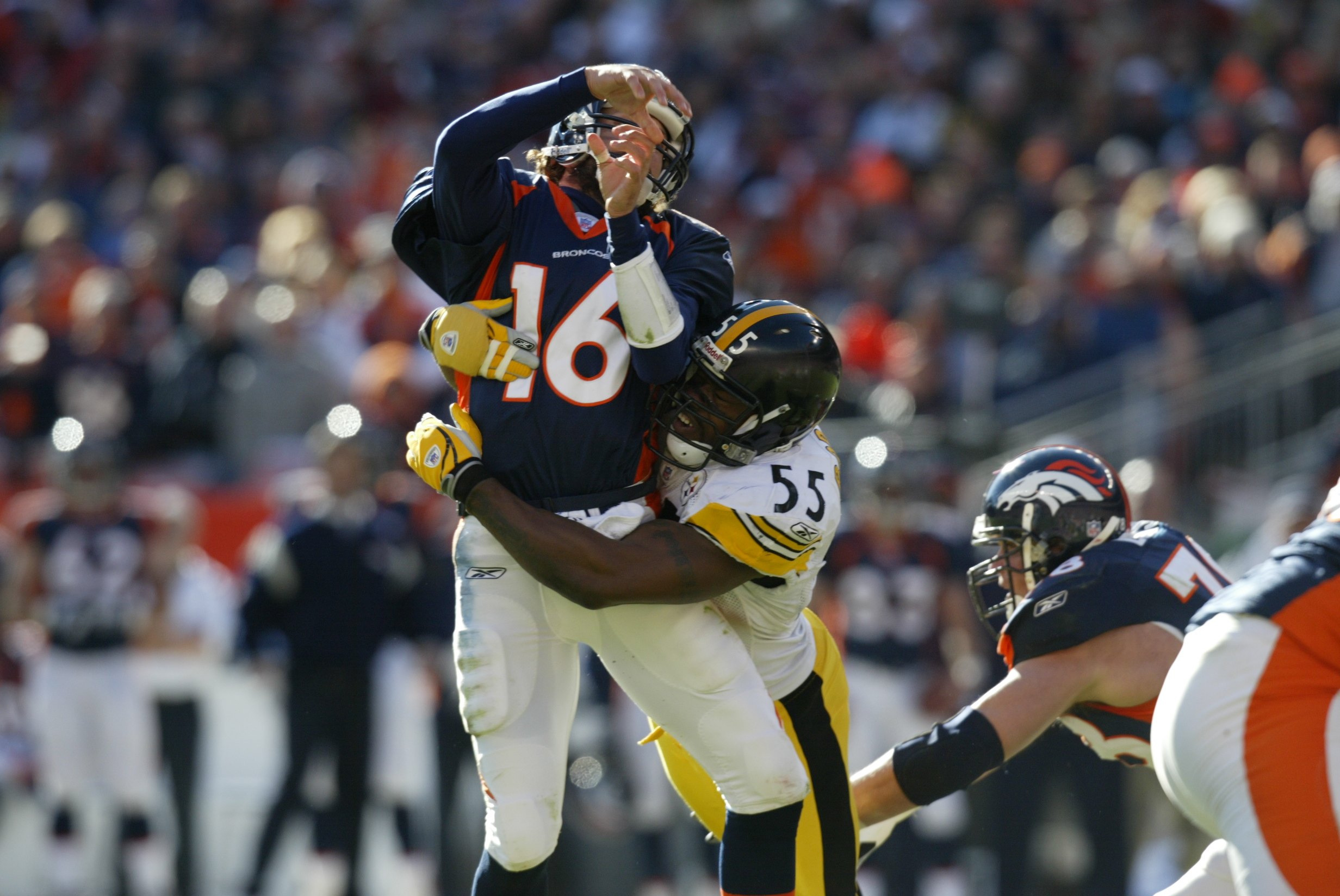
Joey Porter hits Jake Plummer in 2006, Plummer's final NFL season (Photo by Sporting Newsvia Getty Images).

The pain was in Plummer's throwing shoulder, lower back and, most noticeably, his hips. He tore both hip labrums at some point during his NFL career. He required major surgery. Plummer was nearly immobilized for eight weeks, hobbling a few steps per day on crutches. He started to have what he calls "deep thoughts."
"I was miserable," he says. "I was mad, pissed off. Questioning:Why the hell did I play football?
"That's when I started to understand the medical side of marijuana and cannabis: to help with the pain. And also with a lot of the deep thoughts when lying in bed."
"I WAS MISERABLE. I WAS MAD, PISSED OFF. QUESTIONING: WHY THE HELL DID I PLAY FOOTBALL?"

— Jake Plummer

During his playing career, Plummer tried to avoid opioids and other painkillers. He wanted the feedback that pain provided as his body recovered. He also distrusted opioids and hated the bloating and stomach discomfort that came from the steady stream of anti-inflammatories in his body.
"Then I'd get off of them for the bye week and I could barely walk," he says.
After hip surgery, he avoided the Percocet and other painkillers prescribed to him as much as possible, not to mention the side-effect medications (anti-constipation drugs, for instance) prescribed with them.
Eventually, a former teammate introduced him to a cannabis-based chemical called Charlotte's Web, a substance that purportedly had anti-inflammatory properties without intoxication or other side effects.
Plummer prefers to not go into specifics about whether he used marijuana during his playing days. A product of the "Just Say No" '80s, he says he saw people close to him use the drug occasionally without becoming hopeless addicts.
"I thought, 'Wow. They're not dumb. They're not criminals. They are intelligent, polite and nice,'" he says. "I knew there was a misconception about what a user was."
And the substance recommended to him did not promise or threaten a buzz.
So Plummer, who even avoided over-the-counter supplements as a player, began taking the cannabis-derived oil. He didn't make any other lifestyle change
I haven't gone gluten-free or sugar-free or started meditating five hours a day or doing yoga," he says. "I do everything I always have, except I take Charlotte's Web."
And as a result, he says, his muscle and joint pain is mostly gone. So are most of the random headaches he used to suffer.
"I don't have those creaky five or six first steps anymore," he says. "I can get down on the ground and play Legos with my kids. I can sit down on my feet with my knees bent, jump up and take off."
No wonder Plummer became an apostle to the medical marijuana cause. Though the term "medical marijuana" can be misleading. Despite its potential health benefits, the substance he takes cannot legally be called "medicine." And it's not precisely marijuana, either.

Feral Hemp

Long ago, the "cool" kids who smoked behind the rec center called it "ditch weed." It grew in roadside culverts and fallow fields across America, its leaves blooming into seven-pointed glory as if it were posing for a close-up on a Grateful Dead album cover. But a choir boy could smoke a Macanudo-size blunt of it and feel nothing more than a headache.
It was feral hemp, country cousin to the stuff cultivated in basement hothouses for maximum intoxication, surprisingly (and, for some, frustratingly) low in the chemical THC, which can make Scooby-Doo cartoons and stale Oreos seem like a productive Friday night.
"That's where Charlotte's Web comes from, my friend," says Joel Stanley, CEO of CW Hemp.
Stanley and his brothers, founders of the company that makes Plummer's cannabis-derived supplement of choice, come from a conservative Christian family in Texas. Stanley's CW Hemp (and some other Colorado cannabis product manufacturers/dispensaries) established a nonprofit research and advocacy organization called Realm of Caring. Realm of Caring produced a promotional campaign entitled "When the Bright Lights Fade" to illustrate how medical marijuana can help retired NFL players. Plummer is the primary spokesperson for When the Bright Lights Fade, as well as a general advocate for the cause.
Image title

Joel Stanley (in the middle of the first row) poses with his brothers (Photo courtesy of CW Hemp).

Stanley—who does not smoke marijuana, saying he does not enjoy its effects—laughed when his brothers left home to establish one of Colorado's first dispensaries.
"I always thought the prohibition was ridiculous," he says. "The amount of people going to jail over possession of a plant was hysterical. But I laughed at the idea of marijuana as medicine."
When Stanley visited his brothers and met chemotherapy patients whose quality of life had improved significantly because of marijuana's anti-nausea, appetite-stimulant and pain/anxiety alleviation properties, he left the Texas oil industry and began selling marijuana.
The search for new uses for cannabis led the brothers to investigate government patent 6630507, which classifies cannabidiol, or CBD, a molecule that can be extracted from cannabis plants, to be "useful" or have "particular application as neuroprotectants, for example in limiting neurological damage following ischemic insults, such as stroke and trauma, or in the treatment of neurodegenerative diseases, such as Alzheimer's disease, Parkinson's disease and HIV dementia."
That's right, the U.S. government simultaneously classifies marijuana as a Schedule I illicit drug with no medicinal value and issues patents (to the U.S. Department of Health and Human Services, no less) saying it can help treat some of society's most troubling diseases.
No wonder the NFL is a little confused and cautious.
But the problem with isolating CBD for its medical potential is that most of the marijuana sold at concerts for 50 years was bred to maximize THC, the "fun" molecule that would intoxicate patients instead of helping them.
To create a neuroprotectant substance that didn't get you high, the brothers would have to buck both market trends and half a century of selective breeding. So it was off to America's roadside ditches in search of raw materials.
"It was all the weed that no one wanted," Stanley says. "If someone told a story about seeing feral hemp while driving, we drove out and found it."
Image title

Bulk hemp like this can be shipped legally to all 50 states, but it cannot get you high (Photo by Matt Nager / Special to Bleacher Report).

One of the first stops on a tour of the CW Hemp laboratory—the one beside the meadow where Jake Plummer issued his wake-up call—is a room filled with bags of hemp the size of bags of topsoil.
The aroma in the room is unmistakable for anyone who has led a varied life. The juvenile portion of the subconscious does a cartwheel at the sight of the bags.
But Vijay Bachus, director of lab operations at CW Hemp, warns that the hemp in the bags has a THC level of 0.3 percent, making it a bulk agricultural product. If you are seeking a buzz, you would be better off smoking a hunk of rope.
"It's orders of magnitude below what you're getting from a recreational dispensary," Bachus says.
The hemp is tested for everything from molds to pesticides. Then the CBD is extracted chemically and mixed with an olive- or coconut-oil base in a series of carefully partitioned labs. The CW Hemp employees wear hairnets and safety goggles, with the extraction and packaging process set up to meet Food and Drug Administration standards.
"You're not going to find this anywhere else in the medical marijuana industry," Bachus says. "You're going to find guys in a garage or a warehouse listening to reggae."
The resulting CBD oil is mixed with mint-chocolate flavoring to make it palatable and then bottled by hand. Asked what would happen if one chugged a whole bottle of the stuff, Bachus says it is so harmless the person would only risk "maybe a little diarrhea from drinking all of that olive oil."
et this substance cured Plummer's post-NFL aches and pains. It could treat Alzheimer's. And the possible connections to CTE (chronic traumatic encephalopathy) and concussion-based ailments are too obvious to belabor.
It all sounds a little too good to be true. Plummer wouldn't be the first famous quarterback to get snookered by some voodoo science and a touch of the placebo effect.
It would be easy to write this all off as minty Jake the Snake Oil—except Plummer isn't the one making the most compelling claims.

Powerful Statement

Heather Jackson is a medical marijuana activist, the mother of a child with a disability and a woman who is anything but shy about stating her agenda.
"To be very honest with you, I'm capitalizing on this national conversation," she says, "not only to help football players but to help kids like my son."
Jackson's son Zaki was born with Doose syndrome, a deadly form of early-childhood epilepsy. He began having seizures at four months old. He was soon having hundreds of them per day. He had them through the night. During the worst of them, he would stop breathing.
"The first thing I did in the morning for years was check on my son and make sure he was alive," Jackson says.
Image title

Zaki Jackson (left) has been seizure-free for three years (Photo courtesy of Realm of Caring).

By age nine, Zaki was on hospice. Developmentally, he was still a toddler: incontinent, only able to speak a few words, unable to identify colors. The steroids Zaki took as epilepsy treatment caused cataracts and bone loss.
A hospice professional discreetly steered Jackson toward Charlotte's Web. The Stanley brothers had just had their first major success treating childhood seizures with Charlotte Figi, after whom their company is now named.
Jackson was a skeptic and researcher by nature.
"I needed to know that this could be tested," she says.
The Stanley brothers, meanwhile, were understandably cautious about their second foray into pediatric treatment.
Eventually, the marijuana grower who doesn't smoke marijuana and the skeptical mother with no other options decided Zaki had nothing left to lose. They administered a tincture of CBD oil to a child who had been suffering brief, violent seizures every two to 10 minutes for days before the treatment.
Zaki was seizure-free for the next 48 hours.
When the seizures returned, Jackson began adjusting the doses.
"I was doing my own little personal clinical trial on my kid," she says.
After three months on no other drugs but CBD oil, Zaki had his last seizure on Oct. 3, 2012. Now 13 years old, Zaki can ride a bike, knows the alphabet and can write.
Zaki and Charlotte are not alone. Thousands of families have moved to Colorado in search of CBD treatment. Jackson, through Realm of Caring, helps subsidize families who are relocating and paying for substances not covered by health insurance. CW Hemp claims a 70 to 75 percent success rate for seizure treatment.
There's an irony to Plummer, or any NFL player, being the spokesman for what's going on here—for what these scientists and mothers/activists are trying to do.
"IF THE NFL DOESN'T WANT TO FUND THIS RESEARCH, THEY WILL HAVE TO LOOK ME IN THE EYE AND TELL ME. THAT'S HOW THAT'S GOING TO GO DOWN."

— Heather Jackson

"Ultimately, the moms are the ones that kept this thing alive," Plummer says. "Now, us overpaid, privileged athletes come in to benefit from it but also to bring awareness to it.
"These kids are basically on hospice. They're done. 'Sorry, we can't help you.' But you bring the NFL in and people are like: 'The NFL? Oh my God—these poor football players.'
"If we have to bring current players, former players, mothers with their sick children in front of the powers that be...that's a powerful statement."
If that happens, the football players aren't the ones the powers that be need to worry about.
"If the NFL doesn't want to fund this research, they will have to look me in the eye and tell me," Jackson says. "That's how that's going to go down."

Both Sides of the Coin

The research Jackson is referring to is a series of studies designed by Dr. Ryan Vandrey, a behavioral pharmacology expert at Johns Hopkins University and one of the nation's leading marijuana researchers.
The most critical study is now underway. It is an anonymous yearlong survey of all the drugs current NFL players take, from over-the-counter pain relievers to prescription medications to recreational drugs, which could then be used to isolate how often a cannabis-related substance is used, its effectiveness as a painkiller, any other medical benefits, its drawbacks, its side effects and so forth.
No standoff between Jackson and the NFL proved necessary. Monroe provided the primary funding for the research. "The stress you put your body and minds through during a season can have detrimental side effects that can last the rest of your life," reads the introductory letter, co-signed by Monroe and Plummer. "If your health and well-being are important to you please sign up for this monumental study on substance use and player health."
"We want to find out: What all drugs do these players take? Alcohol, opioids, cannabis, anti-inflammatories?" Plummer says. "How it helps them. How it affects their sleep. How clearheaded they are. How it affects their healing during the week. We want to see how all of this affects them."
For such a study to be scientifically valid, Vandrey needs a large and diverse sample of players.
"There's no value in recruiting a bunch of people who think weed is great and asking them to take part in a cannabis study," Vandrey says.
That means current NFL players who use cannabis must know participation in the study won't immediately place them on the NFL's drug-testing fast track and NFL players who don't use cannabis must know they won't be assumed to be cannabis users if they take part in the study.
The questionnaires sent to players in late August contain detailed assurances of privacy from Vandrey.
"Your information is protected by federal privacy laws," he writes. "We have obtained a Certificate of Confidentiality preventing disclosure of your name or survey responses, and the research team will make no disclosures about who participated in the research study."
Vandrey is as far removed from the stereotypical tie-dye legalization advocate crowd as the minty non-psychoactive CBD oil is from Pineapple Express. An internet search of Vandrey produces a blog post calling him an "anti-pot professor" who may be a "lap dog" for anti-legalization lobbyists.
Vandrey's research tells pro-legalization extremists things they don't want to hear. Despite the "100 percent harmless" drumbeat often sounded in the cannabis community, marijuana dependence, habituation and withdrawal are possible for heavy smokers. Dispensaries around Colorado are dangerously cavalier aboutlabeling the contents and potency of their products (imagine thinking you are drinking a light beer only to discover you've been guzzling something as strong as 12-year-old Scotch). And nearly all medicinal claims about marijuana are premature, if they are substantiated at all.
Vandrey, in other words, speaks the NFL's language.
"If you're not out in the streets running around saying that everyone should be smoking weed all of the time, some people take that as meaning you're a hater," he jokes. "My purpose is to do objective research and to look at both sides of the coin."
According to Vandrey, medical marijuana exists in a "regulatory negative space." Twenty years of legalized medical marijuana in California and elsewhere has produced many case studies indicating cannabis products are useful pain relievers and have other medicinal properties. But there have been few rigorous double-blind scientific studies.
Is cannabis really more effective and less harmful than a prescription opioid? If so, is CBD or THC doing the heavy lifting? What's the recommended dosage rate? Do CBD or THC interact dangerously with other compounds?
Many NFL players have self-medicated with marijuana for pain or anxiety. But perhaps they just need anti-inflammatory CBD, not intoxicating THC. Or perhaps a dollop of THC in the recipe can ease depression or anxiety without impairing the user. And maybe one dosage rate of such a substance can be helpful while a higher rate leads to a dependence risk.
Those are the questions Vandrey wants to answer.
"We're starting with a sledgehammer," he says. "And we want to refine it down to a fine chisel."
Vandrey and the Plummer/Realm of Caring crowd would appear to be strange bedfellows at first, but they are working toward a common cause.
"I need Ryan, because I am biased," Jackson says. "I think the plant's amazing. And I can tell you what the results are going to be right now."
Says Vandrey: "Some advocates only want to hear good news. The folks at Realm of Caring want to hear news."
Plummer himself understands the NFL's cautious approach.
"Let's find evidence," he says. "Let's research this. Let's make sure the claims are legit.
"Who knows? Maybe there will be a marijuana doctor for each team who makes sure these guys are taking these things correctly."

Monday, August 29, 2016

Sport: Arsenal, the Unravelling

So, the Gunners now have a win under their belts, and the seemingly disastrous transfer window now shows some glimmers of hope, with help form la Liga (and the Spanish economy).

Hooray.

Forgive this writer for not jumping and cheering. Underneth the sighs of relief, there is that feeling of "same crap, different season"

Another opening day. Another loss. Comprehensively beaten 4-3 by a marauding Liverpool side that included a familiar bane to Gunners in the form of Sadio Mane. Then on to a drab, scoreless stalemate at Champions Leceister City that might well have had a different result had a penalty been awarded for Bellerin's "professional" foul late in the game.

The truth is, Arsenal, for its seeming upswing, in in the throes of a long unravelling that is especially painful for fans. Season after season, the team underachieves, losing games that it ought to win, and i n some cases embarrassingly so.

And things are about to get worse. Old Wenger nemesis Jose Mourinho has taken the reins at Manchester united, while his bitter rival Pep Guardiola (who some had as a potential Wenger successor) is settling in for the sheiks at Manchester City. a massive Manchester Derby looms in about two weeks. Italian maestro Antonio Conte is leading a revitalized Chelsea squad untethered from the toxic relationship with Mourinho that torpedoed their title defense last season.

And Arsenal? Still plodding along with a manager stuck in the past, and propped up by a Board too busy milking the cash cow that the club has become.

Has Wenger been great for Arsenal? Without doubt. And the club has clearly benefitted form his tenure, both i n the footballing and the financial sense.

But Wenger has been making a string of inexcusable tactical errors ove the past few seasons. The most egregious being against Liverpool i nthe season past; Wenger, with a 3-2 lead and minutes left to play, he inserts Arteta into a game that we ought o have taken full points form; Arteta almost immediately gets caught out, allowing Joe Allen to run on to the loose ball and slot past a helpless Cech. And the less said about the Champions league tie against Barcelona, the better.

its easy to call for a manager's head i n the Premier League; money's being sprayed left right and centre like water treatment on a grass pitch, but it should be clear to even the most hardened loyalists that the end of the Wenger era is at hand.

to the Board: do it now, when there's less pain and there can - unlike the departure of Pellegrini at City - be some dignity; a proper farewell.

let's not let the team disintegrate before we do something

Sunday, August 28, 2016

Sport: Mucho mas for Roberto Duran

- from the UK Guardian
’m sitting in the lobby of the Smyth Hotel in downtown Manhattan waiting for Roberto Durán, the man they call El Cholo, when I get a phone call from his assistant. “We’re on our way,” he says. “Just to warn you, he’s a little agitated.” This is expected. Since May, Durán has been on a global press tour for Hands of Stone, a new biopic about the boxer’s life and relationship with mentor Ray Arcel by Venezuelan director Jonathan Jakubowicz, which premiered at the Cannes film festival and had its New York premiere earlier this week. He is here with his wife of more than 45 years, Felicidad ‘Fula’ Iglesias, and his children and grandchildren.
Minutes after he arrives Durán pleads with his assistant for some water. “I’m sorry, just give me one moment,” he says in Spanish as he sits down. “I’ve been on my feet since last night.” It’s been a hectic ride for the 65-year-old retired fighter who speaks very little English, contending with the demands of a press junket alongside Robert De Niro, Usher and Édgar Ramírez, the Venezuelan actor who plays him in the movie. Once he finally settles, Durán’s attention diverts once again as he keeps greeting his friends and family passing through the hotel lobby. His biggest concern is now an iPod he lost in his hotel room. “All my music is in that thing! We can’t leave until I find it. It has 3,500 songs.”
Just as I’m thinking the interview might take all day, it occurs to me that, even as a journalist, in order to get what you want from him you have to match his energy. You have to go in the ring with him. At this precise moment it becomes clear: he’s never truly out of it. Durán is always fighting something.
For Latinos, Durán is more than just an athlete or even a sporting legend. He is a mythological figure, a symbol who persists in Latin folklore decades after his fighting career because he represented the will and determination of a community who was fighting the social injustices of the times they were facing. Much like Ali stood up for the civil rights of the African-American movement in a segregated America, Durán was doing the same thing for the poor and underprivileged in Panama. The film, which alternates between Spanish and English, represents one of the rare chances where an American audience can witness a Hollywood movie where a Latino protagonist is not a crime lord or a drug kingpin. “This is an opportunity to change the Latino stereotype – we live in a world where you can call Latinos drug dealers and rapists and criminals and still have a chance at being president of the United States,” said Jakubowicz at the New York premiere. “Those are the stereotypes you see in American movies and TV shows, but now you’re going to see a true legend: a Latino boxer who overcame all his demons and became an inspiration for an entire people.”
Advertisement
Roberto Durán Samaniego was born on 16 June 1951 in Guararé, a four-hour drive south of Panama City, but was raised in El Chorrillo, a poor neighborhood on the water’s edge in the capital and walking distance to the mouth to the Panama Canal. During Durán’s childhood, tensions between the US and Panama were so hostile that authorities decided to build a wall – sound familiar? – between the Canal Zone and the capital in order to alleviate the tumultuous relationship between Panamanian residents and Americans who lived and worked inside the zonal area. Durán, a poor kid from the streets, remembers having to break into the prohibited zone in order to get mangoes from the trees so he could sell them and feed his family. “The best fruit was on the other side, so I would use a pair of pliers, cut the fence and climb up the trees to get the mangoes.” American soldiers, after noticing the eight-year-old breaking in, would fire shots of warning in the air to scare him away. “They knew we were kids so would only shoot blanks just to scare us.”
His mother, Clara, raised him and his siblings as his father, Margarito, a Mexican-American GI from Arizona who was stationed in Panama, left the family and returned to the states in 1954. After living almost his entire childhood without a father, it wasn’t until 1976 in California when they would reunite. In a 1980 interview with the Evening Independent, Margarito Durán recalls the meeting. “We embraced,” said Margarito. “We sat in a room at a hotel and it was no problem.” Durán confirms the meeting and agrees it was an amicable encounter, but when I try to get him to talk more about his estranged father there is a sense of restraint, as if there is still a lot of resentment and pain still unresolved. He takes a photograph out of his wallet and shows it to me. It’s a black and white image of a young Durán with his father from that hotel meeting. In the image, both men are hugging and smiling, as if all was forgotten in one frozen memory. “The only good thing that my father ever did,” he says to me, “was that he once picked up a magazine and recognized who I was.”
Perhaps this is where the fighter was born. Not in the streets where he had to clean shoes, or sell newspapers, or even at Neco de La Guardia gymnasium where he learned how to box thanks to Nestor ‘Plomo’ Espinosa, and later joined by the legendary Arcel, who made him world champion in four different weight classes. These are all vital pieces of the puzzle that created the fighter inside the ring, but the inner rage and the bull-like aggression he possessed, that is something that cannot be taught. It can only be experienced, and for Durán, it all began with his father.
Advertisement
Durán is perhaps best known for the infamous “No Más” rematch with Sugar Ray Leonard in 1980 after he’d won their first meeting. Near the end of the eighth round Durán, clearly losing the fight, turns around and allegedly mutters the words, “no more” to the referee. There have been many pieces on the subject including a 30 for 30 documentary and our own investigation, and Durán himself, as he mentions in the ESPN doc, denies he ever said those words, but instead it was the ref, Octavio Meyran, who muttered them after Durán put his hands up and refused to fight. Either way, it was Manos de Piedra who was mentally beaten and stopped the fight, regardless whether the words were said or not. The movie also goes into detail, including the fact that he was in poor physical condition, had little time to make weight due to his ferocious appetite and that the fight was poorly scheduled between Don King and his promoter, the millionaire Carlos Eleta.
Perhaps something that is more important and is often forgotten in the memory of the boxing fan is the close bond that Durán and Leonard have built since their bouts and how they became close friends. There was a beautiful moment at the New York premiere when right before the screening, Durán and Leonard embraced each other and the entire audience stood up and applauded. “This is something that people forget,” says Durán. “I never said ‘no más’ and me and Sugar are great friends.”
Durán wanted me to know that he was extremely proud of the film as it’s a testament to how much people validate what he has done for the sport, but there are certain parts which he was less keen on. “I’m very happy with the movie and Edgar Ramirez did a fantastic job. He’s a great actor,” he says. “But I didn’t always like the way they made me and my wife (powerfully played by Cuban-Spanish actress, Ana de Armas) look sometimes. There are scenes when she is smoking and drinking and she doesn’t do either, she never has. Also, they often made me look like a womanizer and that I insulted Sugar’s wife in front of her before our first fight. None of that happened.”
I asked the director Jonathan Jakubowicz about these concerns. “First of all, there are stories about Jake La Motta and how he hated Raging Bull after seeing it for the first time, so if Durán’s biggest problem with the movie is that Fula was smoking and drinking, I’ll take it,” jokes the 38-year-old director. “But to address the point, this movie is not just about Roberto Durán, it also examines Fula’s story, specifically after that fight in New Orleans and how she had to deal with a depressed man, someone who didn’t want to leave the house for three months or do anything. So it wasn’t just Durán who was broken, it was also his wife. So for us, the smoking and drinking was a creative choice that was made because it showed the distance and depressed state that she was in at the time.”
Advertisement
Regarding the insults aimed at Leonard’s wife which Durán categorically denies, Jakubowicz stands firm. “Listen, I want people to know that aside from a filmmaker I am also an investigative journalist and I interviewed Sugar Ray Leonard on this very subject. We talked about it on more than one occasion and every time he tells me this story you can see the anger building within him. I also talked to Angelo Dundee (Leonard’s renowned trainer, who died in 2012) a few months before he sadly passed away and he also confirmed the story. I think Durán is perhaps repenting what happened and wishes to forget about it as it can’t be easy to see your entire life – the good and the bad – on the big screen.”
We may never know the exact details of what happened nor we may truly be able to fully understand the complexities of a fighter who has been through so much both inside and out of the ring. One thing is for sure, Roberto Durán, the kid from the slums of Panama who became the greatest lightweight on the planet, has never been perfect as his temperament has always represented a double-edged sword, both his greatest ally and most dangerous enemy. “Durán is a man made of flesh and bones,” says Jakubowicz. “And all his demons are part of what made him a great boxer and in beating them is what specifically makes him a human being and a hero. And this is what Latin Americans need, we need someone who’s made of flesh and bones, a hero who knows what it’s like to also be imperfect. We need real heroes just like him.”
Just as we finish talking, Durán enters the room, elated because he has just found the famous iPod with 3,500 songs. ‘You have no idea how happy I am to have found this,” he tells us. “Do you know how many songs it holds?” he asks.
I do know, but I still want him to tell me.

Tuesday, August 16, 2016

Sport:Biles owes Belize, the full uplifting story

Following Al Trautwig's stupid ("senior"?) moment in commentary, it was nice to come across the following, on multiple gymnastics champion Simone Biles, showing yet again, the huge footprint of the Caribbean (even by proxy) on Us and global sports.

One o’clock arrived. Relatives gathered at a hotel bar to watch Olympic gymnastics on television. So did the first lady of Belize and 11 contestants in the coming Miss Belize pageant, wearing their sashes and carrying tiny flags. But where was Simone Biles?
The women’s individual all-around competition had begun 4,000 miles away on Thursday afternoon at the Rio Games. Biles, 19, was the heavy American favorite, but there was also anticipation in an unlikely place, the tiny Central American country of Belize, where she holds dual citizenship.
Phone calls were made. Television channels were changed. Beauty contestants were perplexed. Still no live gymnastics.
 Finally, after 30 minutes, the live feed began on Caribbean television. Biles had already performed her vault routine, but the delayed start did not mute the ecstatic cheering that greeted her second gold medal at the Rio Games.
There are big stories unfolding in Belize, including a Supreme Court ruling that affirmed gay rights and the cleanup from Hurricane Earl, which churned through last week. But interest in Biles also has resonated here, in the country’s economic capital, as evidenced everywhere from the prime minister’s residence to the shade of a local plum tree, painted purple and gold, where tour guides talk politics and play dominoes.
“We are taking all the gold medals she is going to win,” Kim Simplis Barrow, 44, the first lady of Belize, said with a smile.
Biles’s connection to Belize is as complex and ultimately elevating as the flips, jumps and windmill spins that have made her the best gymnast of her generation, perhaps ever.She was born in 1997 in Columbus, Ohio, to a mother who struggled with addiction to drugs and alcohol, and to a father who was not part of her life. In 2002, Biles’s birth mother lost custody of her four children, who were placed in foster care and faced the possibility of being scattered by adoption.
 Instead, Simone, then 6, and her younger sister Adria, then 4, were adopted in 2003 by their maternal grandfather, Ron Biles, and his second wife, Nellie Cayetano Biles, who is from a prominent Belizean family of teachers and nurses and government officials. (Nellie is not Simone’s biological grandmother; Simone’s other two biological siblings were adopted by Ron’s older sister.)
Before, Ron and Nellie were known to Simone and Adria as Grandpa and Grandma. Now they are Mom and Dad.
Nellie’s mother, Evarista Cayetano, was a teacher and an owner of a grocery store. Her father, Silas Cayetano, also began his career as a teacher, then became an official in Belize’s fishing and agricultural cooperatives, and, later, a senator.
The original family home, at 118 Neal Penn Road, was made of wood. The family lived upstairs and the store was downstairs. It was a gathering place, where Silas Cayetano held court on weekends, settling neighborhood disputes, telling jokes, spinning stories.“It was community central, especially on Saturdays, when the chickens were fresh,” said Opal Enriquez, a cousin of Simone’s and the director of the Miss Belize pageant.
The Cayetano home had opened its doors to the nine Enriquez children, whose family came to Belize City from the southern town of Punta Gorda. Silas Cayetano had skipped high school, worked at a seminary and passed his teacher’s exam at age 19, relatives said. He encouraged his nieces and nephews, as he had his own four children, telling them that education was the most reliable way to escape poverty.
“Our uncle set the bar high,” Enriquez said. “Failure was never an option. He embedded in our brains that we were destined for greatness. Simone listened. We weren’t afraid to dream.”
When Ron and Nellie Biles adopted Simone and Adria, they had two sons of their own who were about to graduate from high school and leave for college. The couple wanted to travel. It would not be easy raising two young girls. But the girls needed parents, and adopting them was a “no brainer,” said Nellie, 61.
"When you grow up, I firmly believe that you see what goes on in the family, what your father and mother do,” she said. “And you tend to mimic what you see. It’s innate. It wasn’t even a question.”
 The extended Biles family is watching Simone compete at the Olympics across two continents and four time zones. Ron and Nellie and a dozen other relatives are in Rio. Others are in Spring, Tex., north of Houston, where the Bileses live and own a gymnastics center. Still more are scattered in Belize, New York, Los Angeles, Chicago.
"We’re trying to put Belize on the map as much as we can,” Nellie, a retired nurse, said. “Simone is competing for the U.S., and we’re not taking any credit away from that. But the fact that she has dual citizenship, I don’t see why we cannot celebrate her second country also.”
 And Belize seems happy to celebrate Biles. Formerly known as British Honduras, it gained its independence only in 1981. Belize has never produced an Olympic champion since it began competing in the Summer Games in 1968. A small contingent of three athletes was sent to Rio to compete with modest ambitions in track and field and judo.
During the 2000 Sydney Olympics, Belize did have a big moment, celebrating and claiming three gold medals won in sprinting by the American Marion Jones, whose mother was born here.
After winning the 200 meters, Jones held up a Belizean flag. Its coat of arms features two woodcutters, one with light brown skin carrying an ax, the other darker skinned and holding an oar, who symbolize the country’s ethnic diversity, history of slavery and its mahogany industry.
 Jones’s gesture brought international attention to Belize and widely endeared her to its citizens. The country later named her a sports ambassador.
Though Jones’s victories were nullified and her career disgraced by doping and a check-fraud scheme, which brought a prison sentence of six months, she remains popular and appreciated here. Belize’s national stadium, long being refurbished, is called the Marion Jones Sports Complex.
Belize’s relationship with Simone Biles is less entrenched so far, but also less complicated.
She is a bubbly teenager who has traveled here regularly to visit and to go fishing and snorkeling on vacation. Last summer, she attended the wedding of her brother here, posed for a newspaper photographer, and was spotted doing back flips off a pier. Upon arriving in Rio, she traded Olympic pins with a Belizean athlete.
“Simone said, when she gets married, it’s going to be in Belize,” Nellie Biles said.Ron Biles paused as he sat on a sofa at a hotel near Rio’s Olympic Park on Monday, his 67th birthday.
“It’s going to be a while longer,” he said as a group of relatives broke into laughter. “Another 16 years.”
12BELIZEweb01-superJumbo.jpg
As the Olympics approached, Simone was acknowledged by Belize’s ministry of youth and sports, interviewed on the popular Love FM radio, featured in the country’s largest-selling newspaper and followed widely on social media.
“People are very excited, because she has Belizean parentage, she’s a great athlete and she acknowledges her Belizean roots,” Adele Ramos, the assistant editor of Amandala, Belize’s largest-circulating newspaper, said of Biles. “She is the next best thing for us after Marion Jones.”
Yet some feel conflicted, not about Biles, but about the way Belize, in their view, does not fully support its homegrown athletes.
Karen Vernon, the theater director of Belize’s Institute of Creative Arts and the mother of two of the country’s top cyclists, said she was happy for Biles but did not “like the fact that Belize is waiting for her to win to claim her.”
 “We need to support our own athletes and artists,” Vernon said. “We have talent here.”
The Cayetano family was not athletic, Nellie Biles said the other day with a laugh, though her father did claim ornately to have been a gymnast and the source of Simone’s versatile skills.
“Everybody knows that Nellie’s father was a comedian,” said Florita Avila, 59, a cousin of Simone’s.
 As a girl, Nellie Biles said she played tennis and did the hop, skip and jump.
Ron, her husband, shook his head.
 “You played hopscotch,” he said.
His wife did not play sports but watched them on television, Ron added, before correcting himself and saying, “You didn’t have a television.”
It is a true story, Nellie said. In 1973, at 18, she left Belize to attend nursing school at the University of the Incarnate Word in San Antonio. Until then, she said, she had never seen a television in person, used a phone or flown on a plane.
“It was, needless to say, culture shock,” she said.
In 1976, she met Ron, who was stationed at Randolph Air Force Base outside San Antonio. (He is retired from the military and from his career as an air traffic controller.) In 1977, they married, and they have the playful banter of a couple who has been together for 40 years.
Was it love at first sight?
“No, oh no,” Nellie Biles said. “It was his good luck.”
Ron replied, “She’s still here, isn’t she?”
 When the adoption of Simone and Adria, now 17, became official in November 2003, the Bileses returned home from meeting with a family judge outside Houston. Nellie told the girls that they could continue to call her and Ron Grandma and Grandpa, or they could call them Mom and Dad.
Simone has said that she went upstairs, practiced in the mirror, then came down and said “Mom.” Nellie remembers Simone running back upstairs, probably giggling because it seemed funny. It was Mom from then on.
“I think these girls did more for us than we did for them,” Nellie Biles said. “Simone centralized us as a family. We come together and do things and go places because of Simone.”
While on a day-care field trip, Simone became interested in gymnastics. Her relatives in Belize remember her from those days as “little Simone,” a tiny girl in perpetual motion, a “spring chicken” and “a firecracker.”
And they say she came to possess the same discipline, insistence, confidence and expectation as Nellie, the eldest sibling in her own family, who with three partners came to own 14 nursing homes in Texas before selling them last year and turning her attention to operating a gymnastics center.
“She is Nellie’s child all over,” said Felix Enriquez, 47, Opal’s brother, who is scheduled to become the second in command in Belize’s ministry of defense. “A fair but stern personality. Always demanding that things be done in a proper way. A very big thinker. She doesn’t think small.”
Ron and Nellie Biles have lived in their current home in Spring, Tex., for six years. Ron, a native of Cleveland, said he had never been in the pool until he jumped in when the Cavaliers won the N.B.A. title in June, the city’s first major championship since 1964.
Would he jump in the Atlantic in Rio if Simone won gold in the women’s individual all around?
“I’ll probably just cry,” he said.
Nellie said she would watch nervously in the arena, grabbing someone to hold onto. Here, at the hotel bar, there was little tension, only clapping and cheering except for during Simone’s wobble on the balance beam.
“I was panicking at that one,” Felix Enriquez said.
Not to worry. Biles had a huge lead, which she secured on the floor exercise with elegance, strength and the stunning ability to land like a dart.
“Oh my God!” Simplis Barrow, Belize’s first lady, said, putting her hands to her face, pumping her fists, and photo bombing a family picture. “Woooh.”
“She has inspired us all,” Simplis Barrow said. “No matter where you come from, you can succeed. It is all right there in that small package.”
lisaparavisini | August 12, 2016 at 11:11 am | Categor

Thursday, August 11, 2016

Watches: How Omega Does Rio

- from A Timely Perspective


This year marks the 28th year that Omega acts as the Official Timekeeper of the Olympics. As an Olympic Partner, the brand’s vital role is to provide such precise timing and imaging of every event so that there is no question to the athletes and judges about who the winners are. To do this, Omega continually evolves its state-of-the-art technology.
This year alone, the brand has developed a host of new, innovative scanners, scoreboards and timing solutions.   Among them:
Omega Scan’O’Vision Myria camera: A combination of time detector and a chronograph. It takes up to 10,000 digital images per second at the critical finish of track and field races.
Omega Photocell Technology: A high-tech photocell reader with four cells instead of two to detect more body movement and patterns.
Omega Electric Photocells system.
Omega Scoreboards: New scoreboards that display timing and line up faster and bolder. There is also a new scoreboard developed for the golf and archery games.
In fact, Omega brings with it to Rio 2016, 450 tons of equipment including 355 scoreboards, hundreds of cameras, thousands of sensors and timing that measures to 1/10,000th of a second. More than 500 trained professionals accompany this effort, and another near 1,000 people are employed on site to assist.
Omega Seamaster Diver 300M Rio watch
Omega Seamaster Diver 300M Rio 2016 watch
Naturally, to celebrate its role in timing the Olympics, Omega also has brand ambassadors participating in the Olympic Games – including golfing great Sergio Garcia. Finally, the brand unveils a line of Rio 2016 Official watches.
Omega Seamaster Bullhead Rio 2016 watch