Showing posts with label records. Show all posts

Thursday, October 27, 2016

Music: The "Twin Towers" of the Record Biz

- from Quartz
Lyor Cohen and Jimmy Iovine.

Cohen, who’s about to take over a crucial part of YouTube’s business, and Iovine, now Apple’s music guru, by all accounts should have crashed to the ground alongside the music industry’s antiquated business model—the way the executives who ran Nokia and Blackberry have been tossed aside by the smartphone revolution. But they did the opposite. So who are these two men, and how’d they pull off the near-impossible?

Apple’s true music genius

In-House Mentor Jimmy Iovine takes part in a panel discussion for the show "American Idol" at the Fox Broadcasting Company Winter Press Tour 2011 for the Television Critics Association in Pasadena, California January 11, 2011.  REUTERS/Lucy Nicholson (UNITED STATES - Tags: ENTERTAINMENT) - RTXWG5M
“Pharrell even told me go with the safest bet, Jimmy Iovine offered a safety net.” (Reuters/Lucy Nicholson)
Jimmy Iovine’s name is instantly recognizable to most hardcore music fans—and not just for its oddly off-beat catchiness.

The record-producer-turned-executive began his career as a recording engineer back in the 1970s, occasionally getting to work with acts like Bruce Springsteen, Patti Smith, and John Lennon. He collected enough cred to eventually found the label Interscope Records in 1990, which was about to go under until it decided to release an album by a small-time producer named Dr. Dre. Soon, Interscope would have acts like Snoop Doggy Dogg and Tupac Shakur on its books.

Along the way, the words “Jimmy Iovine” became somewhat synonymous with the music industry itself. (In 2012, Macklemore and Ryan Lewis recorded a song about record labels and artist exploitation that was literally titled “Jimmy Iovine.”)

But Iovine didn’t sit contently as the head of Interscope, watching the traditional industry’s profits crumble. In 2008, Iovine made his next big move—forming the designer headphones brand Beats with Dr. Dre, selling oversized headphones when minimal earphones were the trend.

Beats, by selling its products as trendy fashion statements, promptly took over nearly half of the entire headphone industry’s market share, and it also pushed into the online music space in 2013. Then, the company—headphones and nascent streaming service and all—was swallowed up by Apple in 2014 in its biggest-ever acquisition.

And that’s when Iovine took his most significant career leap.

Apple didn’t just snag a headphones business; the tech giant scored Iovine’s special knack for making smart bets in the business as a whole. For it was years prior—way before Beats was even put together—that Iovine had already started trying to convince Apple founder Steve Jobs to move into the relatively new field of all-you-can-eat music streaming, where players like Swedish service Spotify (but not many others) had nestled in. Said Iovine in a 2013 interview:

I was always trying to push Steve into subscription. And he wasn’t keen on it right away. [Beats co-founder] Luke Wood and I spent about three years trying to talk him into it.
Iovine’s hunch proved solid. Streaming is now the biggest revenue-driver in the US music industry, and globally, profits from digital platforms have officially overtaken physical ones for the first time. It was last summer that Apple finally took Iovine’s long-nagging advice, unveiling its own subscription streaming service Apple Music–headed, of course, by Iovine, who is now one of the company’s top executives.

Tuesday, October 4, 2016

Music: Ganja trumps Jazz (for now) t legendary California record store

Founded in Berkeley, California, Amoeba Music has established itself as one of America's most iconic music store chains. With three locations across the state, co-founder David Prinz says its Los Angeles store alone brings in $20 million in annual revenue.
It's original location on Telegraph Avenue, however, has seen revenues plummet by 50 percent over the past decade. Thanks to the initial rise of pirating services like Napster and LimeWire, and then legal streaming services like Spotify, students in the local area stopped buying records and CDs.
But financial trouble is not unique to Amoeba; Telegraph Avenue is blighted and its local economy has been in decline for years. Since the 1990s, sales at stores along Telegraph have dropped over 40 percent, Dave Fogarty, Berkeley economic development project coordinator, told San Francisco Chronicle in 2013. Prinz, who started Amoeba with Marc Weinstein in 1990, said they needed to create a new revenue stream to prevent the Berkeley shop from closing. It's rescuer? Medical marijuana.

Four and a half years ago, as the medical marijuana business started to show its muscles in California, Prinz and Weinstein decided to convert its once-popular 3,000 square foot jazz room into a marijuana dispensary. After submitting an application last fall, the founders finally received approval last week from the city of Berkeley for a license to sell medical marijuana. Prinz says the dispensary, which will be a totally separate space with its own entrance, will open by May 2017. "Marijuana will save Amoeba Music in Berkeley," says Prinz.
This isn't Amoeba's first foray in marijuana. Since April 2014, its San Francisco location has been running a medical marijuana recommendation clinic with Dr. Samuel Dismond. The clinic, which does not sell marijuana, sees about 50 patients a day who consult with the doctor and leave with a recommendation to use cannabis.
"The clinic helps us continue to pay the rent and helps us pay our employees," Prinz said. "But the dispensary is going to be more lucrative."

The Berkeley location will sell marijuana and THC-infused products. Because Prinz and Weinstein have never sold marijuana before, they partnered with longtime advocate and marijuana entrepreneur Debby Goldsberry. She's also a founder of Berkeley Patients Group, a respected cannabis supplier and dispensary operating since 1999. (BPG is seen as a model for the industry--it pays millions in taxes, follows rules and regulations, and donates to the poor.)
"I don't think we could've kept Amoeba Berkeley going without this. Our store in Berkeley took the biggest hit; college kids are the first to find out how to get music for free," says Prinz. "I think we'll see the college kids come back again once the dispensary opens."

Prinz says they invested about $500,000 in total for the license, and to keep the store open. The dispensary will not grow its own marijuana, but instead purchase the cannabis from farmers in Northern California. He says he's been flooded by interest from growers who want to help stock Amoeba's shelves with weed.
Twenty years ago, Rolling Stone said we built the best record store," says Prinz. "We think we'll be able to do that for this industry--my goal is to build the best dispensary in the world." He hopes to bring the "Amoeba experience" to the dispensary, which will be called the Berkeley Compassionate Care Center. (If the shop ever becomes recreational, Prinz says they will call it "AmoeBuds.")

The impetus for the dispensary was to save the business, but Prinz and Weinstein say there was another motivating factor: Rasputin Music has been on Telegraph Avenue since 1971, decades before Amoeba Music moved in across the street. Founded by Ken Sarachan, Rasputin watched record store after record store bite the dust.
To honor the fallen record shops, the store made a tote bag with a cemetery illustration, featuring tombstones with the names of every record stores that went out of business in the area: Tower Records, Sam Goody, Odyssey Record, Music Land, Peach's, Moby Disc, Rough Trade, Rainbow "Twenty years ago, Rolling Stone said we built the best record store," says Prinz. "We think we'll be able to do that for this industry--my goal is to build the best dispensary in the world." He hopes to bring the "Amoeba experience" to the dispensary, which will be called the Berkeley Compassionate Care Center. (If the shop ever becomes recreational, Prinz says they will call it "AmoeBuds.")
The impetus for the dispensary was to save the business, but Prinz and Weinstein say there was another motivating factor: Rasputin Music has been on Telegraph Avenue since 1971, decades before Amoeba Music moved in across the street. Founded by Ken Sarachan, Rasputin watched record store after record store bite the dust.
To honor the fallen record shops, the store made a tote bag with a cemetery illustration, featuring tombstones with the names of every record stores that went out of business in the area: Tower Records, Sam Goody, Odyssey Record, Music Land, Peach's, Moby Disc, Rough Trade, Rainbow tombstones with the names of every record stores that went out of business in the area: Tower Records, Sam Goody, Odyssey Record, Music Land, Peach's, Moby Disc, Rough Trade, Rainbow Records, Star Records, Aron's, and more.
"I care about Berkeley, I care about Telegraph, I care about the kids, the patients, but we will not end up on that bag," said Prinz, half joking. "I paid over half a million dollars so we don't end up on that bag."
Rasputin and Amoeba have been locked in an epic feud for 26 years--ever since Weinstein quit working at Rasputin and opened up shop across the street. "We are fighting to keep our store open, we are fighting to keep our employees' jobs," says Prinz. "We think marijuana will help us continue the fight."

Saturday, September 17, 2016

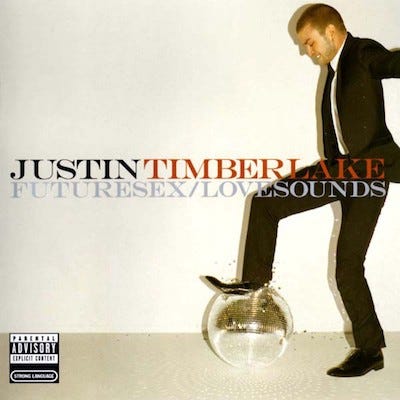
Music: Timberlake's 10th

- from medium.com

10 years ago, Timberlake and Timbaland bridged dance, pop, and hip-hop with ‘FutureSex/LoveSounds’


Consider this: the tempo and style of the hottest record of the moment ultimately has the potential to shift the entire trajectory of pop music and culture. This is twofold; the obvious reason being that when a formula in popular music is hot, it’s replicated over-and-over again until it has been beaten to death. The other, not-so-evident reason is that nightclub DJs will ultimately build their sets around this hot record, saving it for the peak moment in the evening. And if the hottest record is 115 BPM (beats-per-minute), naturally the DJ will have to find other records that are around the same speed or style to precede and follow it.
On a micro level, said DJ might stay at this tempo for the entire evening — or summer — for that matter. On a macro level, many pop artists will then follow the trend, releasing music at that same speed and style, in order to specifically make sure they are included in nightclub playlists across the planet.
That’s exactly what happened when Justin Timberlake released “SexyBack,” the lead single to his 2006 FutureSex/LoveSounds LP,which turns ten this month and has moved over 20 million copies worldwide to date. Commercial hip-hop was ruling the clubs for almost a decade at that point, with the Jay Z & BeyoncĂ© led brand of 100 BPM club-bangers like “Crazy In Love” and “I Just Wanna Love U (Give It 2 Me)” dominating most mainstream dancefloors. This was interspersed with an influx of slowed down Southern rap hits from artists like T.I. and Yung Joc that clocked around 70–82 BPM.
Justin Timberlake had briefly cracked this market two years prior with hisJustified LP, led by the Neptunes-produced, Pusha T-assisted “Like I Love You” and the Timbaland-backed “Cry Me a River.” Both were huge radio hits, but registered lukewarm as club cuts. Hip-hop and open format DJs weren’t quite ready to fully embrace the former boy band singer, who just two years earlier was engaging in over-produced, soulless plastic pop as a member of *NSYNC.
Both Timberlake and Timberland were in a bit of a creative slump in 2004; While Justin had been keeping busy with other projects, such as acting in films like Shrek and Alpha Dog, he was reportedly feeling uninspired musically. “He didn’t like his voice no more, you know what I’m saying? He didn’t like what he was doing,” Timbaland said in 2007. “I was like, ‘Justin, what’s going on?’
Meanwhile Timbaland was also struggling to find inspiration, as albums on his Interscope-distributed Beat Club imprint from Bubba Sparxx and Magoo were failing to make an impact. Some surmised he was still reeling over the death of frequent collaborator Aaliyah in 2001.
“She was like blood, and I lost blood. Me and her together had this chemistry. I kinda lost half of my creativity to her. It’s hard for me to talk to the fans now. Beyond the music, she was a brilliant person, the [most special] person I ever met,” Tim told MTV in 2008.
Yet once they teamed up with collaborator Nate “Danja” Hills, the trio rediscovered their creative spark by deconstructingJustified’s “Cry Me a River.” They attempted to rebuild it from the ground up, changing bits and pieces of it so that it was not a direct copy. The result was “What Goes Around Comes Around,” the first of ten tracks they completed together forFutureSex/LoveSounds. The eventual double-platinum smash “My Love” would follow, reportedly written by Timberlake in two minutes after he heard the beat. The track had signature Timbaland beat-box drums, but very uncharacteristic electronic trance synths layered on top.
“I heard dance and techno and was always interested in it but didn’t really know where to go. But I went to a club one night and saw that people were losing their mind to these dance tracks,” Danja told Vibe in 2011. “It wasn’t really that I wanted to mimic that sound. I just wanted to have that energy and have people going crazy. So I knew the fusion was putting R&B with trance. As soon as I put the ‘boom boom kat,’ I knew it.”
These untapped electronic sounds were used abundantly on the album’s breakthrough single “SexyBack,” really separating the sonics of the entireFutureSex/LoveSounds LP from everything else. Released as the first single from the project, this record marked a turning point for Timberlake. At a speedy 117 BPM, the record was built on a four-on-the-floor house rhythm. It oozed sexuality; Justin’s distorted, muffled vocals sounded almost post-coital in their delivery, as he made references to S&M, dirty babes, and even dropped a “motherfucker” before Timbaland neighed “Take ’em to the bridge!”It showed a dark maturity that was not present on anything he’d done before, the 50 Shades of Grey of pop records of its time.
This faster tempo was employed on several other tracks on the album, such as the cocktail waitress anthem “LoveStoned” or one of the few non-Timbaland tracks, “Damn Girl,” where will.i.am slyly interpolates Flaming Ember’s “Gotta Get Away” drum breakdown, as freaked by Diamond D on “I’m Outta Here.”
And then — naturally — the formula was endlessly copied.
Observing the tenth anniversary of FutureSex/LoveSounds, Danja summed uphis thoughts on its influence this past week: “We shocked the world and shifted the music business. [We] let open the floodgates for EDM to be accepted in the mainstream music world. We changed the game for good, for at least 8–9 years.”

Sunday, May 10, 2015

Live music: "Super" Mario thrills at Redbones

localjoe.myorganogold.com


With searchlights sweeping in the near distance, track records were being tested and bested at the nearby National Stadium.

But at Redbones on Saturday last, records were being given out (to the fortunate few) and transposed into silky vocals and instrumental expositions. Patrons jammed the courtyard of the Kingston eatery to hear and see "singing medic' Mario Evon perform tracks from his debut full-length offering, entitled "ME on Love," a project at least four years in the making.

And the red-jacketed crooner came out in good form from the get-go, announcing the "Reggae-Soul" hybrid that is the backbone of his oeuvre. Standout songs included "Never Let You Know", the breezy "Soul Tek" (adapting the Jamaican expression, my spirit tek you: I instinctively like you"), a dancehall-inflected cover of Babyface's "Whip Appeal" and the declaration of undying love "This Day"

Tuesday, April 14, 2015

Sport: Bellerin Betters Bolt?

Arsenal's Hector Bellerin is obviously quick, but it turns out the young Spanish full-back is actually capable of matching and outrunning 100m world record holder Usain Bolt over a short distance. A feat made all the sweeter for Gunners fans given "Lightning" Bolt's known affiliations to Manchester United

Bellerin clocked a 40m sprint time of 4.42 seconds earlier this season and it has been revealed that this time is actually faster than Bolt ran over the first 40m when he set the current world record at 9.58s in 2009.
The Jamaican icon's split time for the same distance in that race came in at 4.64s, practically sloth-like when compared to the Gunners' speedster.

Bolt set that world record at the 2009 World Athletics Championships in Berlin's famous Olympiastadion, the same week that he also shattered his own record over 200m.

Together with his Jamaican colleagues, he also holds the 4x100m relay world record, set at the 2012 Olympics in London.
It was only a few months ago that Bellerin officially became the fastest player at Arsenal, beating Theo Walcott's previous club record in the 40m sprint. It all came as quite a surprise to Bellerin though, who apparently had little idea quite how fast he is.

"Beating the record was at the beginning of the season and was really unexpected. There was a bit of banter, and he (Walcott) is trying to beat me now, so we will see what happens," the 20-year-old recently said.

"He was really close, I did not beat it by that much, but he still needs to beat me!"

Having played just once for Arsenal before this season, Bellerin has been given his chance in the first-team as a result of the injuries suffered by Mathieu Debuchy and is certainly grabbing the opportunity with both hands.

He's appeared 21 times in all competitions since bursting onto the scene in the Champions League in September - playing 90 minutes against Borussia Dortmund. The defender made his Premier League debut against Hull a month later and has been a regular since January.

Wednesday, February 22, 2012

100 Oscars Facts You Need To Know


Wondering which character is the most Oscar-nominated? Or who the youngest and oldest Oscar winners are? These answers – and 97 more – are handily assembled here in our collection of Oscar facts, figures and fun (fun not guaranteed). EMPIRE Magazine's PHIL DE SEMLYEN  has trawled through 84 years of Oscar history to assemble the most fascinating / weird / outrageous pieces of trivia to emerge from the biggest film awards on Earth...

http://www.empireonline.com/features/100-oscar-facts-you-need-to-know/default.asp