- from The Guardian
Nine months have passed since David Bowie’s death, but his last collaborator, Donny McCaslin,
still has to pause when he talks about it. “There’s so much emotion,”
McCaslin says, the words catching in his throat. “It’s devastating.”
McCaslin speaks about his experience with Bowie sitting in 55 Bar,
the micro Greenwich Village jazz club where Bowie first heard the
musician perform back in 2014. Shortly after seeing that show, Bowie
chose McCaslin’s band to back him on his final album, the acclaimed,
jazz-fusion leaning Blackstar.
McCaslin vividly remembers the night Bowie came to the club to check
him out. “I was definitely nervous,” the saxophonist said. “I glanced up
and saw where he was sitting. I just tried to keep myself grounded and
not think about it. But the pressure was on.”
Even so, McCaslin says his band “were going for it. It wasn’t a
watered-down version of what we do. Afterwards Bowie said: ‘Wow, that
was really loud!’”
Clearly, he liked it that way, because a few days later, Bowie
emailed the musician to ask if his band would work with him on what
would be his last release, an album that turned out to be one of his
most adventurous. The experience of creating music with Bowie proved so
deep, and its aftermath so jarring, that McCaslin decided to turn his
new album, Beyond Now, out 14 October, into a tribute. It includes
several transformative covers of Bowie songs, including Warszawa from
Low, and A Small Plot of Land from Outside, along with a song McCaslin
wrote inspired by a piece Bowie left off Blackstar. (That track, plus
two other cuts that didn’t make that release, will come out on 21
October on the cast album from the musical Bowie wrote in his last year,
Lazarus).
McCaslin
knew his Bowie salute had to be special. “I wanted the depth of my
experience with him, and the impact on my life, to be reflected,” he
said. “I was digging deep on every take to get the gravitas I felt it
should have.”
For Blackstar, that meant giving McCaslin’s band nearly free rein.
“He set the tone from the beginning,” the saxophonist said. “He told us:
‘Whatever you hear, I want you to go with it.’ He said ‘great’ to
everything.”
At the same time, McCaslin couldn’t tell anyone outside of his
immediate family about the project. Bowie had the band sign
non-disclosure agreements, the better to keep the album a secret until
he was ready to release it. At the same time, Bowie was aware he had
cancer, which was an even more closely guarded secret. McCaslin politely
demurs when asked if he knew the star was sick during the recording
process. “He was so private,” he said. “I want to honor his wishes that
we not talk about it.”
At the time, McCaslin wasn’t even sure the music he cut with Bowie
would come out or, if it did, how much of his band’s efforts would make
the ultimate cut. It wasn’t until late last fall, when a British
journalist asked to interview the musician for a story about a new Bowie
album, that he found out about its impending release and heard its
final form.
On 8 January, Blackstar finally appeared. Two days later came news of Bowie’s death and, suddenly, everyone wanted to talk to McCaslin. “I wasn’t prepped,” he said. “I didn’t know what to say.”
He gave a few interviews, talking only about the music. Then,
journalists started to get nosier about the details of Bowie’s illness
and demise, and McCaslin shut down. He also began to fully experience
his grief. “We had this amazing connection,” he said, “and then he was
gone.”
Showing posts with label pop. Show all posts
Showing posts with label pop. Show all posts
Wednesday, October 5, 2016

Saturday, September 17, 2016
Music: Timberlake's 10th
Consider this: the tempo and style of the hottest record of the moment ultimately has the potential to shift the entire trajectory of pop music and culture. This is twofold; the obvious reason being that when a formula in popular music is hot, it’s replicated over-and-over again until it has been beaten to death. The other, not-so-evident reason is that nightclub DJs will ultimately build their sets around this hot record, saving it for the peak moment in the evening. And if the hottest record is 115 BPM (beats-per-minute), naturally the DJ will have to find other records that are around the same speed or style to precede and follow it.
On a micro level, said DJ might stay at this tempo for the entire evening — or summer — for that matter. On a macro level, many pop artists will then follow the trend, releasing music at that same speed and style, in order to specifically make sure they are included in nightclub playlists across the planet.
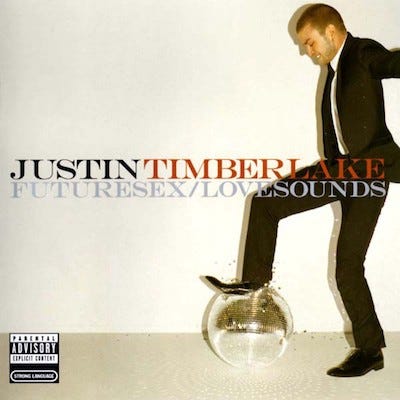
That’s exactly what happened when Justin Timberlake released “SexyBack,” the lead single to his 2006 FutureSex/LoveSounds LP,which turns ten this month and has moved over 20 million copies worldwide to date. Commercial hip-hop was ruling the clubs for almost a decade at that point, with the Jay Z & Beyoncé led brand of 100 BPM club-bangers like “Crazy In Love” and “I Just Wanna Love U (Give It 2 Me)” dominating most mainstream dancefloors. This was interspersed with an influx of slowed down Southern rap hits from artists like T.I. and Yung Joc that clocked around 70–82 BPM.
Justin Timberlake had briefly cracked this market two years prior with hisJustified LP, led by the Neptunes-produced, Pusha T-assisted “Like I Love You” and the Timbaland-backed “Cry Me a River.” Both were huge radio hits, but registered lukewarm as club cuts. Hip-hop and open format DJs weren’t quite ready to fully embrace the former boy band singer, who just two years earlier was engaging in over-produced, soulless plastic pop as a member of *NSYNC.
Both Timberlake and Timberland were in a bit of a creative slump in 2004; While Justin had been keeping busy with other projects, such as acting in films like Shrek and Alpha Dog, he was reportedly feeling uninspired musically. “He didn’t like his voice no more, you know what I’m saying? He didn’t like what he was doing,” Timbaland said in 2007. “I was like, ‘Justin, what’s going on?’
Meanwhile Timbaland was also struggling to find inspiration, as albums on his Interscope-distributed Beat Club imprint from Bubba Sparxx and Magoo were failing to make an impact. Some surmised he was still reeling over the death of frequent collaborator Aaliyah in 2001.
“She was like blood, and I lost blood. Me and her together had this chemistry. I kinda lost half of my creativity to her. It’s hard for me to talk to the fans now. Beyond the music, she was a brilliant person, the [most special] person I ever met,” Tim told MTV in 2008.
Yet once they teamed up with collaborator Nate “Danja” Hills, the trio rediscovered their creative spark by deconstructingJustified’s “Cry Me a River.” They attempted to rebuild it from the ground up, changing bits and pieces of it so that it was not a direct copy. The result was “What Goes Around Comes Around,” the first of ten tracks they completed together forFutureSex/LoveSounds. The eventual double-platinum smash “My Love” would follow, reportedly written by Timberlake in two minutes after he heard the beat. The track had signature Timbaland beat-box drums, but very uncharacteristic electronic trance synths layered on top.
“I heard dance and techno and was always interested in it but didn’t really know where to go. But I went to a club one night and saw that people were losing their mind to these dance tracks,” Danja told Vibe in 2011. “It wasn’t really that I wanted to mimic that sound. I just wanted to have that energy and have people going crazy. So I knew the fusion was putting R&B with trance. As soon as I put the ‘boom boom kat,’ I knew it.”
These untapped electronic sounds were used abundantly on the album’s breakthrough single “SexyBack,” really separating the sonics of the entireFutureSex/LoveSounds LP from everything else. Released as the first single from the project, this record marked a turning point for Timberlake. At a speedy 117 BPM, the record was built on a four-on-the-floor house rhythm. It oozed sexuality; Justin’s distorted, muffled vocals sounded almost post-coital in their delivery, as he made references to S&M, dirty babes, and even dropped a “motherfucker” before Timbaland neighed “Take ’em to the bridge!”It showed a dark maturity that was not present on anything he’d done before, the 50 Shades of Grey of pop records of its time.
This faster tempo was employed on several other tracks on the album, such as the cocktail waitress anthem “LoveStoned” or one of the few non-Timbaland tracks, “Damn Girl,” where will.i.am slyly interpolates Flaming Ember’s “Gotta Get Away” drum breakdown, as freaked by Diamond D on “I’m Outta Here.”
And then — naturally — the formula was endlessly copied.
Observing the tenth anniversary of FutureSex/LoveSounds, Danja summed uphis thoughts on its influence this past week: “We shocked the world and shifted the music business. [We] let open the floodgates for EDM to be accepted in the mainstream music world. We changed the game for good, for at least 8–9 years.”
Tuesday, September 6, 2016
Music: Sean Paul is Still Busy, and not 100% sold on Drizzy et al
will have some of dat green juice.” Sean Paul has barely stepped over the threshold of Westlake Recording Studios, located in the sprawl of West Hollywood, when he politely makes the request. Knowing of Paul’s life-long love affair with marijuana, his muse for many a club hit over the years, I presume this is a smoke-free way to enjoy the herb. But when Ritchie his security guard comes back moments later, it is with a cold-pressed kale concoction in hand.
-from the Guardian
That’s quite the clean-living transformation, I remark. Sean Paul grins and leans back, relaxed, against a grand piano. Gone are his signature cornrows (or, later, his not-so-
signature mohawk), and he has given up smoking weed due to asthma. It turns out that
I wasn’t far wrong after all. “Oh, I still like to get high, it helps with the creativity,” he says. “Except now I just have it in tea.”
Life has clearly changed since the early 2000s, when Sean Paul Henriques brought the booty-bouncing rhythms of dancehall out of the Kingston clubs and onto the world stage. The Jamaican artist was once the go-to man for dancefloor dynamite, songs that urged us all to “shake that booty non-stop, when the beat drops just keep swinging it”. Get Busy, Gimme The Light, the Beyoncé-featuring Baby Boy, Breathe with R&B singer Blu Cantrell – these songs became commonplace, at carnival, in a bougie Chelsea bar or a suburban Oceana club. Back then he was among the world’s pop elite.
But while his 2002 album Dutty Rock launched dancehall into the mainstream, musical tastes inevitably moved on. And though Paul himself has been critical of some of dancehall’s homophobic content, there was outcry over the derogatory lyrics of contemporaries like Beenie Man and Elephant Man. Soon the genre fell out of favour and out of the charts. Paul’s 2005 followup The Trinity was popular among fans but panned by critics, and he recalls his fade from global fame a little remorsefully.

“Since about 2009, I was fighting that worry that I wasn’t relevant no more,” he says, as we sit in the windowless womb of a studio. “It does stress you out at times. I was like, ‘I was up here and now I’m nothing to people.’” His last album, 2014’s Full Frequency, sold fewer than 5,000 copies in the US. In 2015, the Grammy award-winning performer left his label and became an independent artist for the first time in a decade.
Over the past year, however, dancehall has been dutty wining its way back into the worldwide consciousness. Diplo, long in debt to dancehall’s digital rhythms, brought them to an even wider audience as Major Lazer. Last year, Lazer’s track Lean On became the most streamed single of all time, albeit one that’s since been given the dubious title of “tropical pop”. Then came Justin Bieber’s mega-hit Sorry, which teamed a skeletal dancehall beat with pure pop and was a accompanied by dancehall moves in the dancing video. Never one to be left out, Drake openly drew on dancehall throughout Views From The Six. Dancehall talent Assassin, meanwhile, made his mark both on Kanye’s Yeezus and, more recently, Kendrick Lamar’s To Pimp A Butterfly.
It’s an international resurgence that Sean Paul has witnessed with both amusement and scepticism. He’s even detected dancehall influences in artists who might be considered unlikely adopters of Jamaican riddims. “You can definitely hear it in Taylor Swift,” he says. “You know that song…?” He launches into a high-pitched rendition of the chorus of Shake It Off. “See, there’s definitely dancehall in there.”
One thing was for sure, though: if dancehall was coming back, so was he. Sean Paul still lives in Jamaica, but we meet in LA because this is where he has come to work on his new album. The surprise success of Cheap Thrills, his recent chart-topper with one-woman pop hit machine Sia– which not only reacquainted the star with the top of the charts but also landed Sia her first Billboard number one – has spurred him to finish his new material quickly. As the 43-year-old says himself, no one is better placed to “bring back some authentic dancehall”.
He is outspoken about the new generation of artists who’ve appropriated the sound of dancehall without acknowledging its roots. “It is a sore point when people like Drake or Bieber or other artists come and do dancehall-orientated music but don’t credit where dancehall came from and they don’t necessarily understand it,” he says, shaking his head. “A lot of people get upset, they get sour. And I know artists back in Jamaica that don’t like Major Lazer because they think they do the same thing that Drake and Kanye did – they take and take and don’t credit.”
While Paul says he’s a fan of Drake (“I love some of his songs but I don’t think he’s the best rapper”) the bashment hooks and patois phrases used in Views From The Six are seen by Paul as less of a homage to dancehall and more of an exploitation. He’s not alone. In May, respected dancehall figure Mr Vegas openly attacked Drake as a fake for not fully crediting his Jamaican influences.
A major problem, Paul adds, is that many of the authentic dancehall artists in the Caribbean who gain popularity online can’t get visas to travel in the US, both to tour and work with producers, because they have convictions on their records. One crossover artist Popcaan, for example, who appeared on Views From The Six and has also worked with Jamie xx, has, according to Billboard, struggled to work in America because of past marijuana-related offences.
Sean Paul is equally dismissive of “tropical house”, a music genre which began as a way to describe the soft, Balearic-infused synth of DJs like Kygo but has since been attached to tracks which clearly draw from dancehall. Rolling Stone’s review of Rihanna’s Work described it as “a tropical house-flavored track featuring Drake” while a Wall Street Journal article described how Bieber’s What Do You Mean? was pioneering the “Caribbean, beach-party vibe” of tropical house in the mainstream. It’s no surprise that the genre has been accused of whitewashing Jamaican influences out of popular music.
But Paul does acknowledge that major label artists have adapted the dancehall sound for current tastes, and those are styles he has to look to, too, if he wants relevancy again. “Dancehall is back but this time it’s also infused with Afrobeat, with hip-hop, with trap, and that’s fine with me,” he says. “Sure, I would like what we do in Jamaica, that authentic dancehall, to be on top, but it simply isn’t. So I want this album to bridge that gap.”
Over the past year, he’s penned more than 200 tracks, both on his own and in collaboration with musicians and producers back in Jamaica, and recruited a series of starry producers, such as Blood, who was behind Bieber’s Sorry. There’s a track with Wiz Khalifa as well as another with one of this year’s breakthrough pop stars, yet to be announced. It doesn’t sound too far off familiar Sean Paul territory, only with more EDM drops.
Paul’s attitude is more one of pragmatism than puritanism when it comes to making sure this album repeats his successes of a decade ago. He’ll seemingly work with anyone who is up for it. “I just worked with Clean Bandit, and another English pop group… what are they called?” There is an awkward pause as he tries to remember. “Oh yeah, Little Mix.”
The one constant is Paul’s ole purpose to make people dance: he’s the first to admit he makes party music because it was one of the few levellers he had as a child. Growing up in a middle-class suburb in Kingston, Paul was just 13 when his dad was sentenced to 15 years in jail for drugs offences. As a result, his mum worked two jobs to keep the family afloat.
Friday, April 22, 2016
Music: Black Curtains, Purple Rain, RIP Prince, 1958-2016
-from Fast Company
Prince died today. That alone probably has you digging through your record collection and/or iTunes playlists to tear through Sign o' the Times andAround the World in a Day—and all number of tributes to the importance of Prince as an icon have already been crafted in response to the Artist’s death. And while we’re certainly sitting at our keyboards having just changed clothes so we’re dressed head-to-toe in purple and figuring out where exactly to get our "Love Symbol" tattoos as we reflect on what having drawn breath at the same time, on the same planet, as one of the most vital and transformative pop culture figures in memory—we’re also remembering that in addition to what he meant as a personality, he was also maybe the best guitar player to ever live.

That’s tall praise, of course, but don’t take our word for it: Eric Clapton, who would certainly be in the discussion for that title, bestowed it upon him in an interview (the sourcing of which may be apocryphal, but what kind of monster would bring that up today, of all days), when, after being asked the question, "What’s it like to be the best guitar player alive," he responded, "I don’t know, ask Prince." His prowess on the guitar is legendary. Sheryl Crow, who collaborated with him on the Rave Un2 The Joy Fantastic album in the late ’90’s, told Billboard that "I’ve heard him play piano like Chick Corea or Herbie Hancock, move over to bass and play like Larry Graham, then play guitar like Jimi Hendrix or Buddy Guy."
But the definitive proof, as they say, is in the pudding, and holy cow, what pudding it is. (Or whatever metaphor is appropriate—we’re in mourning.) Prince’s performance at the Rock and Roll Hall of Fame in 2004 might be the definitive confirmation of his absolute brilliance as a guitar player. While inducting George Harrison, he participated in a supergroup including Tom Petty, Steve Winwood, and Jeff Lynne, and emerged to transform the rendition of "While My Guitar Gently" from a nice tribute to the Beatle into a transcendent, utterly magical experience with a solo that stretched well over two minutes and made even the legendary talent on the stage with him seem like they were lucky to just be in the same room as the guy.
Prince didn’t just drop in on the performances of his fellow rock heroes like a guitar-slinging angel in order to demonstrate his virtuosity—but even at his own headline performances, he was fundamentally collaborative. That was on display in 2007, when he played the Super Bowl halftime show in Miami. The entire performance was epic in ways that befit the legend, but which couldn’t possibly be planned—Prince emerged to a downpour unprecedented in Super Bowl history (production designer Bruce Rodgers recalls that, when asked if he was okay to play in the rain, Prince asked "Can you make it rain harder?") and performed a stunning medley. That medley didn’t just include his own hits, though—he also played a version of "All Along The Watchtower" that took the bluesiness of Hendrix and turned it into something that all of America wanted to hear, then seemingly randomly picked then-current Foo Fighters hit "The Best of You" to play, with a solo that presumably made Dave Grohl feel about two feet tall. Still, the performance of "Purple Rain" that night probably contained the most compelling Super Bowl halftime show moment in history (sorry, Left Shark)—when, as a marching band decked out in neon surrounded him, he asked the world, "Can I play this guitar?" then began to shred as his silhouette was blown up and projected to an audience of almost a hundred thousand people in the stadium, and tens of millions around the world.
Those latter-day Prince moments display plenty of Prince’s talent, but it’s not something he waited to unveil until the 2000s. Those were massive cultural moments that Prince somehow made bigger with his guitar and his very presence—but for pete’s sake, check out this display from a January 1982 show at the Capitol Theatre during "Why You Wanna Treat Me So Bad?" Prince keeps the guitar behind his back for the first three minutes of the song, then slings it forward at about the 3:15 mark, blisters through the song’s next minute like he’s possessed—down on his knees, back to back with his backing band, and utterly captivating.
Basically going through any live Prince performance will find you similar moments, and his own recorded discography will turn up plenty more. Dude opened "When Doves Cry" with a 10-second guitar solo before the track even really gets started, and the recorded version of everything from "I Could Never Take The Place Of Your Man" to friggin’ "Batdance" has at least one "how the hell can anybody be that good?" guitar moment in it. (None of those recordings are available on YouTube, Spotify, or other streaming services, because Prince declared the Internet "over" in 2010, and was able to create a reality for himself where that was true.) His collection of guitars was legendary, from the "cloud guitar" to the surprisingly large number of guitars built to resemble his Love Symbol. While the world lost an iconic cultural figure who taught us a lot about different ways to perform masculinity, the importance of being funky, and how to be a sexy motherfucker—it also lost one of the finest musicians to pick up a guitar, and a creative force we’re unlikely to see paralleled in the near future.
Thursday, December 17, 2015

Saturday, June 6, 2015
Music: Metal Rules the Streaming Waves
Every diehard metalhead alive and breathing knows that A. heavy metal is the law, and B. other genres pale in comparison, but it's always nice to see some quantifiable data to that effect, outside of what you and your friends howl at one another during especially spirited bouts of Kreator worship. Spotify threw heshers a bone recently by releasing a slew of figures that detail by exactly how wide a margin heavy metal is ruling the streaming airwaves. The study sought to determine which genre's fans were the most loyal—i.e. returned most frequently to their favorite artists. As Spotify noted, "To create a measure of genre loyalty, we divided the number of streams each core artist had by their number of listeners. All of the charts are normalized against the genre with the loyalest fans." Surprise! Metal was the clear winner. From Portugal to the United States to (of course) Norway, metal holds down a spot in the top ten—and usually top five—most loyally listened to genres in every country included in the study. Metal also takes the overall global genre loyalty crown, leaving pop to trail behind as a distant second and folk, country, and hip-hop to founder in the dust. As Mashable notes, Spotify calculated their data around sets of core bands for each genre, with metal's champions comprising Metallica, Slayer, Judas Priest, Iron Maiden, Sepultura, Pantera, Cradle of Filth and Anthrax. It's not exactly surprising to hear that a lot of people are using Spotify to listen to classic tunes from Slayer and Papa Het and that metal listeners are especially likely to revisit favorite artists, but what is at least a little jarring to see how thoroughly flummoxed some folks are about it.

Given metal fans' fierce loyalty to their chosen genre and propensity for making physical purchases, it makes perfect sense that they'd be spending the most time pressing replay on old Iron Maiden songs. As the label personnel interviewed in the Mashable piece noted, metal labels have been selling cassettes and vinyl for years, metal shirts and embroidered logo patches are de rigeur attire, metal festivals regularly draw fans from every corner of the globe, and there's still a multitude of metal print magazines and fanzines circulating in a world that's gone mostly digital. While fans of most other genres are drawn to shiny new artists, metal fandom is generational; newRECRUITS are encouraged to appreciate the bands that came before and build up chronological knowledge while still keeping abreast of current developments. That widened musical net funnels directly into more sales; when someone's buying up the new Mefitic record, they're probably also beefing up their Blasphemy collection or finally grabbing that Hellhammer box set. Metalheads are completists, and metal as a genre is incredibly diverse; there are thousands upon thousands of metal bands out there to whom fans may pledge fealty, and they do so with an (economic) vengeance.
are encouraged to appreciate the bands that came before and build up chronological knowledge while still keeping abreast of current developments. That widened musical net funnels directly into more sales; when someone's buying up the new Mefitic record, they're probably also beefing up their Blasphemy collection or finally grabbing that Hellhammer box set. Metalheads are completists, and metal as a genre is incredibly diverse; there are thousands upon thousands of metal bands out there to whom fans may pledge fealty, and they do so with an (economic) vengeance.
This approach isn't entirely unique to metal fans, but they definitely take it further than nearly any other demographic. It's not as easy to be a metal fan as it is to profess your love for Taylor Swift or Makonnen, and metalheads' extreme devotion to their chosen scene is often a response to societal pressure. When the whole world is telling you that the music you love is stupid, evil, or unlistenable, you're either going to tamp down your interest and keep your tastes to yourself... or you're going to deck yourself out in band shirts, go to shows played by and attended by like-minded individuals, and make your allegiances known at every possibleOPPORTUNITY.
.
That same Mashable piece did its best to make sense of the notion that, not only does metal still exist after "the heyday of the genre in the 1980s and 1990s," but more people than ever have fallen under its spell, to which I can only say: big fucking duh, dude. It's tempting to write off pieces like this as mere white noise—as something that doesn't affect our community, and has no bearing on our own relationship to metal—but its implications are grave. In 2015, years after the New York Times started covering doom and car companies started throwing shows with Absu and Napalm Death, mainstream media and mainstream society in general still doesn't take metal seriously as an art form, and we're still seeing articles that introduce the genre with the same kind of condescending marveling with which they'd approach a newly-discovered Amazonian tribe. "Believe it or not, heavy metal fans still exist in this modern age, practicing their strange customs and tribal rituals far from prying eyes..."
Wednesday, November 23, 2011
The Sound - and the Cost - of the Blues: Cadillac Records
The predictably rapid advent of Beyonce as a featured actress (following Dreamgirls) and the casting of Adrien Brody (he of the surprise Halle Berry Oscars smooch) and the likes of Cedric the Entertainer and Mos Def led to a lot of hype around this movie on its release nearly four years ago.
Of course, the hype was not enough and it opened to a middling reception both critically and commercially. But now, with the dust having settled, and with our own ludicrously misnamed "Jamaica Jazz & Blues Festival" again on the horizon, the quasi-documentary feature on the history of the hugely influential Chess Records label is worth a look, or a second look, as the case may be.
Polish immigrant Leonard Chess parlayed his ear for talent, freewheeling nature and general disregard for convention into the powerhouse of blues, rock n' roll, jazz and even gospel, and the home (commercially and otherwise), of such legends as Muddy Waters, Willie Dixon, Howlin' Wolf, Little Walter, Etta James and even Chuck Berry, the latter still duck-walking his way across the stages of the world today some 60 years later.
There are a lot of the expected elements: every third word or so, especially from the men, is "muthaf---"; theres' open and subtle race discrimination and a lot of sex, inter-racial and otherwise. But director and writer Darnell Martin ( a woman, despite the masculine-sounding first name) knows how to mix it together and move it along. And of course, there is the music which, whether simulated or actually played, is a near irresistible force; it just gets into you. One scene, where harmonica genius Little Walter takes vocal duties, on the chart-topper "My Babe" is a sequence of such sheer sonic and visual magic that it hardly needs the cliched inter-cutting showing the record rising up the charts. Similarly, when Berry singlehandedly "integrates" screaming black and whites fans at a concert, the visual narrative really soars.
But while such flights are few and far between, the rest of it is just good enough to earn our sustained attention, and the cast (especially Jeffrey Wright as Muddy Waters, Columbus Short as Walter and Mos Def as Berry) mostly turn in professional-grade performances. Here, we return to Beyonce who, in the role of earthy blues chanteuse Etta James, is really a non-starter. Sure, her musical numbers show an admirable level of restraint, but in her speaking parts and interactions, she comes across as hollow and devoid of genuine feeling.
But despite this, Cadillac Records (the switch may have something to do with the fact that the Chess Records catalog is owned by Universal, while the film was released by Sony Pictures), is primarily the story of how Black music became the pop music of America and the world, and in this respect, its worth taking in, even if you don't know the difference between "Hoochie Coochie Man" and "Smokestack Lighnin'"
Of course, the hype was not enough and it opened to a middling reception both critically and commercially. But now, with the dust having settled, and with our own ludicrously misnamed "Jamaica Jazz & Blues Festival" again on the horizon, the quasi-documentary feature on the history of the hugely influential Chess Records label is worth a look, or a second look, as the case may be.
Polish immigrant Leonard Chess parlayed his ear for talent, freewheeling nature and general disregard for convention into the powerhouse of blues, rock n' roll, jazz and even gospel, and the home (commercially and otherwise), of such legends as Muddy Waters, Willie Dixon, Howlin' Wolf, Little Walter, Etta James and even Chuck Berry, the latter still duck-walking his way across the stages of the world today some 60 years later.
There are a lot of the expected elements: every third word or so, especially from the men, is "muthaf---"; theres' open and subtle race discrimination and a lot of sex, inter-racial and otherwise. But director and writer Darnell Martin ( a woman, despite the masculine-sounding first name) knows how to mix it together and move it along. And of course, there is the music which, whether simulated or actually played, is a near irresistible force; it just gets into you. One scene, where harmonica genius Little Walter takes vocal duties, on the chart-topper "My Babe" is a sequence of such sheer sonic and visual magic that it hardly needs the cliched inter-cutting showing the record rising up the charts. Similarly, when Berry singlehandedly "integrates" screaming black and whites fans at a concert, the visual narrative really soars.
But while such flights are few and far between, the rest of it is just good enough to earn our sustained attention, and the cast (especially Jeffrey Wright as Muddy Waters, Columbus Short as Walter and Mos Def as Berry) mostly turn in professional-grade performances. Here, we return to Beyonce who, in the role of earthy blues chanteuse Etta James, is really a non-starter. Sure, her musical numbers show an admirable level of restraint, but in her speaking parts and interactions, she comes across as hollow and devoid of genuine feeling.
But despite this, Cadillac Records (the switch may have something to do with the fact that the Chess Records catalog is owned by Universal, while the film was released by Sony Pictures), is primarily the story of how Black music became the pop music of America and the world, and in this respect, its worth taking in, even if you don't know the difference between "Hoochie Coochie Man" and "Smokestack Lighnin'"
Subscribe to:
Posts (Atom)