By the time you read this, the 2 US Presidential candidates will have completed the second, and arguably most pivotal, debate of this already remarkable Election Cycle.
To those of my countrymen, and others, who would insist on asking what the US Election has to do with us here in Jamaica - there are many simple answers: More than half the Jamaican diaspora resides in the US, more than half of Jamaica's nearly 3 million visitors bear a U.S. passport, and the US is still our largest export market - including for one commodity in particular that won't show up on the official trade balance computations of economists.
Weed. Marijuana. Cannabis. Ganja. Pot. Chronic. Hallowed. Storied. Plant of many names. Much travelled and, until fairly recently, much maligned in the Government circles of both the US (where it is still classified at the Federal level as a dangerous drug) and Jmaica, where legislation passed last year rremoved the "dangerous drug" classification and gave fiato to a butrgeoning medical marijuana industry spurred in large part by developments in the US. All this notwithstanding the pioneering work of Dr Calvin Lockhart and the late Dr Manley West in developing Canasol (and asthmasol).
Interestingly, but perhaps unsurprisingly, the question of "Mary Jane" has scarcely come up during this bitter battle for the White House, and the very latest bombshell of Trump's impertinent (but frankly , familiar) comments a decade ago about being able to force himself on women by virtue of his position (then) as a "star" is just the latest in a string of personality and character questions for both candidates that - with the help of the media - have crowded out a lot of the less "soundbite-worthy" issues if you will.
And make no mistake, dealing with the "new dispensation of marijuana" is a serious issue, on many fronts. On the purely economic side, marijuana is THE proverbial elephant in the
US political room. Legal marijuana revenues to private interests topped
US$4billion in 2015. Beginning with Colorado, four states plus the US Federal capital (Washington DC) have already made the recreational use of marijuana legal. Altogether, nine more states have marijuana Propositions on their ballots for next month, five specifically addressing recreational use. These include California, the most populous state in the US, as well as neighbouring Nevada - home to arguably the world's recreational hub in Las Vegas.
Clearly, the greater the spread of legalization, the greater the opportunities for Jamaican marijuana- even though its generally accepted that the plant is grown, and used, in every US state (including Alaska, one of the four to already have legalization). At a time when the Jamaican Government desperately needs a solid income source, the Prime Minister, the Minister of Finance and the Minister of Tourism must undoubtedly be watching this "Green Revolution" in the US with considerable glee.
But the implications go way beyond trade and the Government. In this nascent period of "legal weed" the socio-cultural outcomes of marijuana acceptance are just being seen, much less examined. Will this men an end to "sniffer dogs" greeting Jamaicans deplaning at US airports? (of course. cocaine trafficking remains a serious problem). Will it mean an end to jail time for countless Jamaicans, and other minorities and foreign nationals previously held on possession and "attempting to export" or "dealing in"as worded in the Police Communications press releases? Will non-smokers accommodate the spliffs to any lesser or greater degree than they do the cigarettes and cigars? These are but a few of the questions that will arise as the use of cannabis, whether for medical or recreational purposes, or any combination thereof, broadens.
So, where exactly do the candidates stand on this issue Clinton, in a 2015 interview with Christiane Amanpour, says she prefers to wait and see what outcomes the existing medical marijuana regimes produce before going any further. New York, which she represented as Senator, has medical marijuana, with restrictions.Arkansas, where her political career began with her husband, who, by his own admission, has at least a passing acquaintance with recreational marijuana use, does not.
Trump meanwhile, has taken a familiar cop-out; no doubt taking note of the wave of support, "the Donald" who initially opposed marijuana legalization said, also in 2015, that it should be a "state-by-state" issue. No doubt, his running mate, Indiana Governor and ultra-conservative Mike Pence will have something to say about that before it comes to his state. Trump surrogate and New Jersey Governor Chris Christie, said in i his own failed Presidential bid, that he would repeal marijuana legalizations if he were to get to the White House. Its anyone's guess as to whether that stance contributed to him now being on the sideline.
Its also anyone's guess, for now, as to how the next President will deal with marijuana once they are in the Oval Office. Hopefully someone in tonight's Town Hall-style showdown will get past the infidelities and the lewd comments and pose the weed question to either candidate.
Whether or not, we here should be watching, with great interest.
Showing posts with label cannabis. Show all posts
Showing posts with label cannabis. Show all posts
Sunday, October 9, 2016

Tuesday, October 4, 2016
Lifestyle: Damian Marley "Frees Up" a former prison as a Pot Farm
Damian Marley has announced that he, in partnership with Ocean Grown
Extracts, is converting a former 77,000 square foot California State
prison into a cannabis grow space that will cultivate medical marijuana
for state dispensaries.
"Many people sacrificed so much for the herb over the years who got locked up," says Marley, 38, noting the poetic justice of turning a prison that once housed non-violent drug offenders into a cannabis cultivation facility. "If this [venture] helps people and it's used for medicinal purposes and inspires people, it's a success."
By that measure, the prison-to-pot farm initiative is already a triumph. With their purchase of the Claremont Custody Center in Coalinga, CA for $4.1 million, Marley and his partners instantly relieved the economically-challenged Central Valley town of its roughly $3.3 million debt. The venture will also generate 100 jobs -- in an economically stagnant region plagued by an ongoing, historic drought and descending oil prices, both of which have damaged the region's traditional farming and oil industries -- and will generate an estimated million dollars in annual tax revenues for Coalinga.
The new business began "in a very organic way," says Dan Dalton, Marley's longtime manager. "Cannabis is something that's around Damian every day with friends, family and with his Rastafarian faith. We've watched people who have sacrificed their lives for it. That injustice has motivated us to be advocates as well as knowing that there are healing properties in cannabis."
Marley today also announced the introduction of Speak Life, a proprietary strain of cannabis he created with Ocean Grown. The strain is based on the company's lauded OG Kush, but altered genetically with the help of a Ph.D trained chemist at who helped cultivate the unique breed.
"The OG has always been my favorite," says Marley, who met with the chemist while making Speak Life. "When they introduced this strain of OG I really loved it and loved its consistency." The bud is a hybrid made of 70 percent indica and 30 percent sativa, and is hand-watered and trimmed.
Marley and his partners are prepared for the "green rush" should California's Proposition 64 -- which would legalize cannabis for adult recreational use -- passes in November, as the polls seem to indicate. And California isn't alone in reconsidering marijuana's legality, either. Voters in seven other states will choose whether to legalize recreational and/or medical marijuana -- Arizona, Maine, Massachusetts and Nevada could approve the use of recreational pot; Arkansas, Florida, and North Dakota will decide on legalizing medical marijuana, which a status the plant has been assigned in 25 states and the District of Columbia.
"Many people sacrificed so much for the herb over the years who got locked up," says Marley, 38, noting the poetic justice of turning a prison that once housed non-violent drug offenders into a cannabis cultivation facility. "If this [venture] helps people and it's used for medicinal purposes and inspires people, it's a success."
By that measure, the prison-to-pot farm initiative is already a triumph. With their purchase of the Claremont Custody Center in Coalinga, CA for $4.1 million, Marley and his partners instantly relieved the economically-challenged Central Valley town of its roughly $3.3 million debt. The venture will also generate 100 jobs -- in an economically stagnant region plagued by an ongoing, historic drought and descending oil prices, both of which have damaged the region's traditional farming and oil industries -- and will generate an estimated million dollars in annual tax revenues for Coalinga.
The new business began "in a very organic way," says Dan Dalton, Marley's longtime manager. "Cannabis is something that's around Damian every day with friends, family and with his Rastafarian faith. We've watched people who have sacrificed their lives for it. That injustice has motivated us to be advocates as well as knowing that there are healing properties in cannabis."
Marley today also announced the introduction of Speak Life, a proprietary strain of cannabis he created with Ocean Grown. The strain is based on the company's lauded OG Kush, but altered genetically with the help of a Ph.D trained chemist at who helped cultivate the unique breed.
"The OG has always been my favorite," says Marley, who met with the chemist while making Speak Life. "When they introduced this strain of OG I really loved it and loved its consistency." The bud is a hybrid made of 70 percent indica and 30 percent sativa, and is hand-watered and trimmed.
Marley and his partners are prepared for the "green rush" should California's Proposition 64 -- which would legalize cannabis for adult recreational use -- passes in November, as the polls seem to indicate. And California isn't alone in reconsidering marijuana's legality, either. Voters in seven other states will choose whether to legalize recreational and/or medical marijuana -- Arizona, Maine, Massachusetts and Nevada could approve the use of recreational pot; Arkansas, Florida, and North Dakota will decide on legalizing medical marijuana, which a status the plant has been assigned in 25 states and the District of Columbia.
Tuesday, September 6, 2016
Sport: A former QB passes the Pot
-from Bleacher Report
Jake Plummer stands in a grassy meadow on a breezy spring afternoon, a Rocky Mountain peak framing his backdrop. He poses heroically, if just a little self-consciously, for yet another medical marijuana-related photo shoot.
The dramatic setting and dramatic pose demand a dramatic pronouncement.
"This is to wake up the whole population, not just the NFL," he says as the photographer snaps away.
The meadow Plummer stands in is behind a laboratory tucked into a nondescript corporate campus in Boulder, Colorado. The laboratory transforms cannabis and hemp into products that—according to preliminary research and a host of testimonials—can do everything from relieve pain to prevent seizures to, just maybe, repair a damaged brain.
Plummer is a leading advocate for the medical marijuana movement. But despite the rugged setting of his photo shoot, he is hardly a lone voice in the wilderness. Players such as former Ravens tackle Eugene Monroe and Titans linebacker Derrick Morgan now stand beside him. So do the mothers of young children whose lives were saved by cannabis-derived chemicals. And former players coping with the debilitating aftermath of their NFL careers. They want the NFL to relax its hard-line stance on cannabis in all its forms and support research into medical marijuana's potential as a neuroprotectant, a substance that can protect (or even repair) a damaged brain.
Standing in Plummer's way? A league slow to change, cautious/suspicious lawmakers and a stigma against marijuana and its stereotypical users.
Those are powerful foes. But with current players starting to speak out and parents shouting from the mountaintops about miracle cures, Plummer has much more than a Rocky Mountain breeze at his back.
"I found myself leading a movement that cannot be stopped," he says. "There is no way you can stop a movement like this."
Deep Thoughts
Plummer considers himself lucky by the standards of retired NFL players. He still has a substantial chunk of his football earnings in the bank. He has a happy family and a cabin on a lake in Idaho. And he still loves football enough to coach it in the Idaho hinterlands, at tiny rural high schools where, he says, "Kids eat Fig Newtons on the sideline."
The 41-year-old Plummer also has his health. Relatively speaking.
"I had pain. That's why I left the game after 10 years," he says. "It was just the beatdown. Having to take anti-inflammatories all year to get through the season. I didn't like the way my body was feeling."
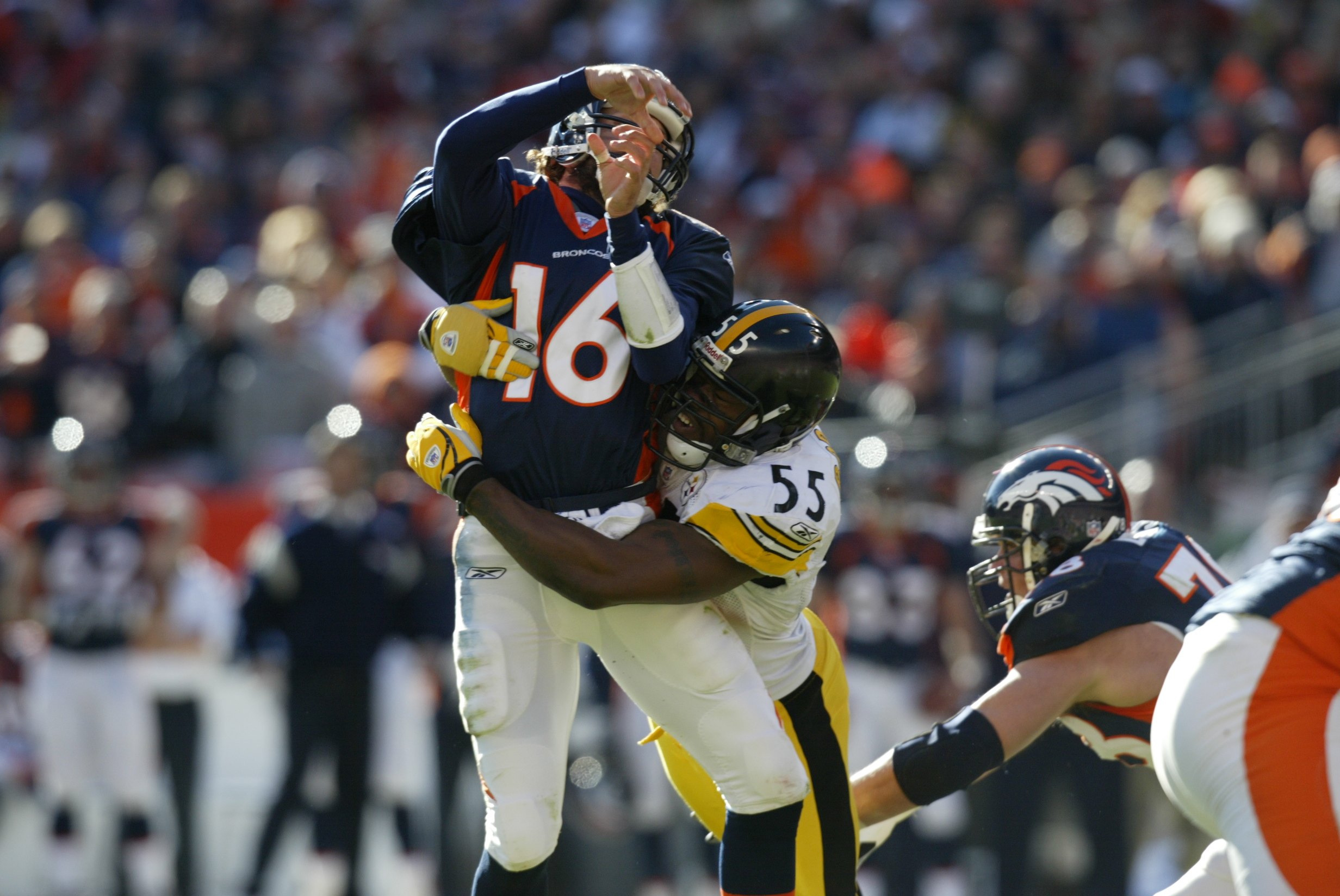
Joey Porter hits Jake Plummer in 2006, Plummer's final NFL season (Photo by Sporting Newsvia Getty Images).
The pain was in Plummer's throwing shoulder, lower back and, most noticeably, his hips. He tore both hip labrums at some point during his NFL career. He required major surgery. Plummer was nearly immobilized for eight weeks, hobbling a few steps per day on crutches. He started to have what he calls "deep thoughts."
"I was miserable," he says. "I was mad, pissed off. Questioning:Why the hell did I play football?
"That's when I started to understand the medical side of marijuana and cannabis: to help with the pain. And also with a lot of the deep thoughts when lying in bed."
"I WAS MISERABLE. I WAS MAD, PISSED OFF. QUESTIONING: WHY THE HELL DID I PLAY FOOTBALL?"
— Jake Plummer
During his playing career, Plummer tried to avoid opioids and other painkillers. He wanted the feedback that pain provided as his body recovered. He also distrusted opioids and hated the bloating and stomach discomfort that came from the steady stream of anti-inflammatories in his body.
"Then I'd get off of them for the bye week and I could barely walk," he says.
After hip surgery, he avoided the Percocet and other painkillers prescribed to him as much as possible, not to mention the side-effect medications (anti-constipation drugs, for instance) prescribed with them.
Eventually, a former teammate introduced him to a cannabis-based chemical called Charlotte's Web, a substance that purportedly had anti-inflammatory properties without intoxication or other side effects.
Plummer prefers to not go into specifics about whether he used marijuana during his playing days. A product of the "Just Say No" '80s, he says he saw people close to him use the drug occasionally without becoming hopeless addicts.
"I thought, 'Wow. They're not dumb. They're not criminals. They are intelligent, polite and nice,'" he says. "I knew there was a misconception about what a user was."
And the substance recommended to him did not promise or threaten a buzz.
So Plummer, who even avoided over-the-counter supplements as a player, began taking the cannabis-derived oil. He didn't make any other lifestyle change
I haven't gone gluten-free or sugar-free or started meditating five hours a day or doing yoga," he says. "I do everything I always have, except I take Charlotte's Web."
And as a result, he says, his muscle and joint pain is mostly gone. So are most of the random headaches he used to suffer.
"I don't have those creaky five or six first steps anymore," he says. "I can get down on the ground and play Legos with my kids. I can sit down on my feet with my knees bent, jump up and take off."
No wonder Plummer became an apostle to the medical marijuana cause. Though the term "medical marijuana" can be misleading. Despite its potential health benefits, the substance he takes cannot legally be called "medicine." And it's not precisely marijuana, either.
Feral Hemp
Long ago, the "cool" kids who smoked behind the rec center called it "ditch weed." It grew in roadside culverts and fallow fields across America, its leaves blooming into seven-pointed glory as if it were posing for a close-up on a Grateful Dead album cover. But a choir boy could smoke a Macanudo-size blunt of it and feel nothing more than a headache.
It was feral hemp, country cousin to the stuff cultivated in basement hothouses for maximum intoxication, surprisingly (and, for some, frustratingly) low in the chemical THC, which can make Scooby-Doo cartoons and stale Oreos seem like a productive Friday night.
"That's where Charlotte's Web comes from, my friend," says Joel Stanley, CEO of CW Hemp.
Stanley and his brothers, founders of the company that makes Plummer's cannabis-derived supplement of choice, come from a conservative Christian family in Texas. Stanley's CW Hemp (and some other Colorado cannabis product manufacturers/dispensaries) established a nonprofit research and advocacy organization called Realm of Caring. Realm of Caring produced a promotional campaign entitled "When the Bright Lights Fade" to illustrate how medical marijuana can help retired NFL players. Plummer is the primary spokesperson for When the Bright Lights Fade, as well as a general advocate for the cause.

Joel Stanley (in the middle of the first row) poses with his brothers (Photo courtesy of CW Hemp).
Stanley—who does not smoke marijuana, saying he does not enjoy its effects—laughed when his brothers left home to establish one of Colorado's first dispensaries.
"I always thought the prohibition was ridiculous," he says. "The amount of people going to jail over possession of a plant was hysterical. But I laughed at the idea of marijuana as medicine."
When Stanley visited his brothers and met chemotherapy patients whose quality of life had improved significantly because of marijuana's anti-nausea, appetite-stimulant and pain/anxiety alleviation properties, he left the Texas oil industry and began selling marijuana.
The search for new uses for cannabis led the brothers to investigate government patent 6630507, which classifies cannabidiol, or CBD, a molecule that can be extracted from cannabis plants, to be "useful" or have "particular application as neuroprotectants, for example in limiting neurological damage following ischemic insults, such as stroke and trauma, or in the treatment of neurodegenerative diseases, such as Alzheimer's disease, Parkinson's disease and HIV dementia."
That's right, the U.S. government simultaneously classifies marijuana as a Schedule I illicit drug with no medicinal value and issues patents (to the U.S. Department of Health and Human Services, no less) saying it can help treat some of society's most troubling diseases.
No wonder the NFL is a little confused and cautious.
But the problem with isolating CBD for its medical potential is that most of the marijuana sold at concerts for 50 years was bred to maximize THC, the "fun" molecule that would intoxicate patients instead of helping them.
To create a neuroprotectant substance that didn't get you high, the brothers would have to buck both market trends and half a century of selective breeding. So it was off to America's roadside ditches in search of raw materials.
"It was all the weed that no one wanted," Stanley says. "If someone told a story about seeing feral hemp while driving, we drove out and found it."

Bulk hemp like this can be shipped legally to all 50 states, but it cannot get you high (Photo by Matt Nager / Special to Bleacher Report).
One of the first stops on a tour of the CW Hemp laboratory—the one beside the meadow where Jake Plummer issued his wake-up call—is a room filled with bags of hemp the size of bags of topsoil.
The aroma in the room is unmistakable for anyone who has led a varied life. The juvenile portion of the subconscious does a cartwheel at the sight of the bags.
But Vijay Bachus, director of lab operations at CW Hemp, warns that the hemp in the bags has a THC level of 0.3 percent, making it a bulk agricultural product. If you are seeking a buzz, you would be better off smoking a hunk of rope.
"It's orders of magnitude below what you're getting from a recreational dispensary," Bachus says.
The hemp is tested for everything from molds to pesticides. Then the CBD is extracted chemically and mixed with an olive- or coconut-oil base in a series of carefully partitioned labs. The CW Hemp employees wear hairnets and safety goggles, with the extraction and packaging process set up to meet Food and Drug Administration standards.
"You're not going to find this anywhere else in the medical marijuana industry," Bachus says. "You're going to find guys in a garage or a warehouse listening to reggae."
The resulting CBD oil is mixed with mint-chocolate flavoring to make it palatable and then bottled by hand. Asked what would happen if one chugged a whole bottle of the stuff, Bachus says it is so harmless the person would only risk "maybe a little diarrhea from drinking all of that olive oil."
et this substance cured Plummer's post-NFL aches and pains. It could treat Alzheimer's. And the possible connections to CTE (chronic traumatic encephalopathy) and concussion-based ailments are too obvious to belabor.
It all sounds a little too good to be true. Plummer wouldn't be the first famous quarterback to get snookered by some voodoo science and a touch of the placebo effect.
It would be easy to write this all off as minty Jake the Snake Oil—except Plummer isn't the one making the most compelling claims.
Powerful Statement
Heather Jackson is a medical marijuana activist, the mother of a child with a disability and a woman who is anything but shy about stating her agenda.
"To be very honest with you, I'm capitalizing on this national conversation," she says, "not only to help football players but to help kids like my son."
Jackson's son Zaki was born with Doose syndrome, a deadly form of early-childhood epilepsy. He began having seizures at four months old. He was soon having hundreds of them per day. He had them through the night. During the worst of them, he would stop breathing.
"The first thing I did in the morning for years was check on my son and make sure he was alive," Jackson says.

Zaki Jackson (left) has been seizure-free for three years (Photo courtesy of Realm of Caring).
By age nine, Zaki was on hospice. Developmentally, he was still a toddler: incontinent, only able to speak a few words, unable to identify colors. The steroids Zaki took as epilepsy treatment caused cataracts and bone loss.
A hospice professional discreetly steered Jackson toward Charlotte's Web. The Stanley brothers had just had their first major success treating childhood seizures with Charlotte Figi, after whom their company is now named.
Jackson was a skeptic and researcher by nature.
"I needed to know that this could be tested," she says.
The Stanley brothers, meanwhile, were understandably cautious about their second foray into pediatric treatment.
Eventually, the marijuana grower who doesn't smoke marijuana and the skeptical mother with no other options decided Zaki had nothing left to lose. They administered a tincture of CBD oil to a child who had been suffering brief, violent seizures every two to 10 minutes for days before the treatment.
Zaki was seizure-free for the next 48 hours.
When the seizures returned, Jackson began adjusting the doses.
"I was doing my own little personal clinical trial on my kid," she says.
After three months on no other drugs but CBD oil, Zaki had his last seizure on Oct. 3, 2012. Now 13 years old, Zaki can ride a bike, knows the alphabet and can write.
Zaki and Charlotte are not alone. Thousands of families have moved to Colorado in search of CBD treatment. Jackson, through Realm of Caring, helps subsidize families who are relocating and paying for substances not covered by health insurance. CW Hemp claims a 70 to 75 percent success rate for seizure treatment.
There's an irony to Plummer, or any NFL player, being the spokesman for what's going on here—for what these scientists and mothers/activists are trying to do.
"IF THE NFL DOESN'T WANT TO FUND THIS RESEARCH, THEY WILL HAVE TO LOOK ME IN THE EYE AND TELL ME. THAT'S HOW THAT'S GOING TO GO DOWN."
— Heather Jackson
"Ultimately, the moms are the ones that kept this thing alive," Plummer says. "Now, us overpaid, privileged athletes come in to benefit from it but also to bring awareness to it.
"These kids are basically on hospice. They're done. 'Sorry, we can't help you.' But you bring the NFL in and people are like: 'The NFL? Oh my God—these poor football players.'
"If we have to bring current players, former players, mothers with their sick children in front of the powers that be...that's a powerful statement."
If that happens, the football players aren't the ones the powers that be need to worry about.
"If the NFL doesn't want to fund this research, they will have to look me in the eye and tell me," Jackson says. "That's how that's going to go down."
Both Sides of the Coin
The research Jackson is referring to is a series of studies designed by Dr. Ryan Vandrey, a behavioral pharmacology expert at Johns Hopkins University and one of the nation's leading marijuana researchers.
The most critical study is now underway. It is an anonymous yearlong survey of all the drugs current NFL players take, from over-the-counter pain relievers to prescription medications to recreational drugs, which could then be used to isolate how often a cannabis-related substance is used, its effectiveness as a painkiller, any other medical benefits, its drawbacks, its side effects and so forth.
No standoff between Jackson and the NFL proved necessary. Monroe provided the primary funding for the research. "The stress you put your body and minds through during a season can have detrimental side effects that can last the rest of your life," reads the introductory letter, co-signed by Monroe and Plummer. "If your health and well-being are important to you please sign up for this monumental study on substance use and player health."
"We want to find out: What all drugs do these players take? Alcohol, opioids, cannabis, anti-inflammatories?" Plummer says. "How it helps them. How it affects their sleep. How clearheaded they are. How it affects their healing during the week. We want to see how all of this affects them."
For such a study to be scientifically valid, Vandrey needs a large and diverse sample of players.
"There's no value in recruiting a bunch of people who think weed is great and asking them to take part in a cannabis study," Vandrey says.
That means current NFL players who use cannabis must know participation in the study won't immediately place them on the NFL's drug-testing fast track and NFL players who don't use cannabis must know they won't be assumed to be cannabis users if they take part in the study.
The questionnaires sent to players in late August contain detailed assurances of privacy from Vandrey.
"Your information is protected by federal privacy laws," he writes. "We have obtained a Certificate of Confidentiality preventing disclosure of your name or survey responses, and the research team will make no disclosures about who participated in the research study."
Vandrey is as far removed from the stereotypical tie-dye legalization advocate crowd as the minty non-psychoactive CBD oil is from Pineapple Express. An internet search of Vandrey produces a blog post calling him an "anti-pot professor" who may be a "lap dog" for anti-legalization lobbyists.
Vandrey's research tells pro-legalization extremists things they don't want to hear. Despite the "100 percent harmless" drumbeat often sounded in the cannabis community, marijuana dependence, habituation and withdrawal are possible for heavy smokers. Dispensaries around Colorado are dangerously cavalier aboutlabeling the contents and potency of their products (imagine thinking you are drinking a light beer only to discover you've been guzzling something as strong as 12-year-old Scotch). And nearly all medicinal claims about marijuana are premature, if they are substantiated at all.
Vandrey, in other words, speaks the NFL's language.
"If you're not out in the streets running around saying that everyone should be smoking weed all of the time, some people take that as meaning you're a hater," he jokes. "My purpose is to do objective research and to look at both sides of the coin."
According to Vandrey, medical marijuana exists in a "regulatory negative space." Twenty years of legalized medical marijuana in California and elsewhere has produced many case studies indicating cannabis products are useful pain relievers and have other medicinal properties. But there have been few rigorous double-blind scientific studies.
Is cannabis really more effective and less harmful than a prescription opioid? If so, is CBD or THC doing the heavy lifting? What's the recommended dosage rate? Do CBD or THC interact dangerously with other compounds?
Many NFL players have self-medicated with marijuana for pain or anxiety. But perhaps they just need anti-inflammatory CBD, not intoxicating THC. Or perhaps a dollop of THC in the recipe can ease depression or anxiety without impairing the user. And maybe one dosage rate of such a substance can be helpful while a higher rate leads to a dependence risk.
Those are the questions Vandrey wants to answer.
"We're starting with a sledgehammer," he says. "And we want to refine it down to a fine chisel."
Vandrey and the Plummer/Realm of Caring crowd would appear to be strange bedfellows at first, but they are working toward a common cause.
"I need Ryan, because I am biased," Jackson says. "I think the plant's amazing. And I can tell you what the results are going to be right now."
Says Vandrey: "Some advocates only want to hear good news. The folks at Realm of Caring want to hear news."
Plummer himself understands the NFL's cautious approach.
"Let's find evidence," he says. "Let's research this. Let's make sure the claims are legit.
"Who knows? Maybe there will be a marijuana doctor for each team who makes sure these guys are taking these things correctly."
Sunday, September 4, 2016
Lifestyle: Coming Soon(?), the "Cannabis Corridor"
By this time, the air over Rose Hall, Montego Bay will be redolent with the scent of various brands of marijuana, and also thick with the sounds of rap meg-mogul (and renowned "canna-phile")Rick Ross, among others.
But before that levity and mental levitation, media, commercial, health and social interests converged on Mobay's Convention Centre for the CanEx Conference and (mini)Expo.

 Inside the convention hall, visitiors were greeted by a branded 55-gallon drum, which event co-ordinator Douglas Gordon revealed contained cannabis oil extract. estimated value of the barrelled liquid? A cool $17 million. US. Kinda puts petroleum to shame.


bit beyond the money, and the high, there was a wide spectrum of issues to air and debate and explore. Not least of them, te link between the medicinal and recreational benefits of marijuanaand the still burgeoning tourist industry. Tourism Minister Ed Bartlett, in attendance, spoek of the vision, set to begin by next year of a kind of "Cannabis Corridor".
Taking advantage of the storied reputation of the weed from Westmoreland and neighbouring St Elizabeth, the vision roughly is to establish and augment a cluster of boutique "rustic chic" resorts, of the type pioneered by the Hennzell family with their iconic Jake's property in Treasure Beach. The resorts will be showcases for Jmaaican culture as well as the many applications of the marijuana plant which, thanks to legislation largely piloted by former justice minister Mark Golding (also in attendance), now includes two ounces for personal use.
The concept is one it is hoped will be replicated across the island, no place more urgently than St Thomas, where Delano Sievwright, JLP candidate for St Thomas eastern and Special Advisor to the Tourism Minister, who certainly wants to bring that type of development to the constituency to compliment the impending road and infarastructure work.
either way, there's lots of potential in the emerging post-legitimate cannabis industry, and players need to get themselves informed and in shape for the next inflection points in the process
Next: the Social Economics of Ganja
But before that levity and mental levitation, media, commercial, health and social interests converged on Mobay's Convention Centre for the CanEx Conference and (mini)Expo.


bit beyond the money, and the high, there was a wide spectrum of issues to air and debate and explore. Not least of them, te link between the medicinal and recreational benefits of marijuanaand the still burgeoning tourist industry. Tourism Minister Ed Bartlett, in attendance, spoek of the vision, set to begin by next year of a kind of "Cannabis Corridor".
Taking advantage of the storied reputation of the weed from Westmoreland and neighbouring St Elizabeth, the vision roughly is to establish and augment a cluster of boutique "rustic chic" resorts, of the type pioneered by the Hennzell family with their iconic Jake's property in Treasure Beach. The resorts will be showcases for Jmaaican culture as well as the many applications of the marijuana plant which, thanks to legislation largely piloted by former justice minister Mark Golding (also in attendance), now includes two ounces for personal use.
The concept is one it is hoped will be replicated across the island, no place more urgently than St Thomas, where Delano Sievwright, JLP candidate for St Thomas eastern and Special Advisor to the Tourism Minister, who certainly wants to bring that type of development to the constituency to compliment the impending road and infarastructure work.
either way, there's lots of potential in the emerging post-legitimate cannabis industry, and players need to get themselves informed and in shape for the next inflection points in the process
Next: the Social Economics of Ganja
Saturday, August 6, 2016
the Word on Weed #5: Mass Roots, cannabis company
- from Fast Company
At first glance, MassRoots is just like any other technology company in America. The Denver-based social platform for marijuana enthusiasts boasts an open-concept, loft-style office filled with 33 talented programmers, developers, and sales staff.
But beneath the surface there’s something unique about working at a pot startup, and it has little to do with the fact that employees are often permitted to consume the substance on the job.
America’s pot entrepreneurs are defining the working culture of the newly budding industry, a culture that exists in the nexus of social mission, financial opportunity, and typical startup life.
"Everyone here believes cannabis should be legalized for economic reasons, for social reasons, for moral reasons, so there's a tremendous amount of passion," says Isaac Dietrich, the company’s CEO and cofounder. "A lot of us also consume, and are very in touch with the cannabis plant, so it's something we're all very passionate about and want to move the cause forward."
Though there is certainly an element of advocacy, innovating in a brand new industry is also a rare and exciting opportunity for employees, explains cofounder Stewart Fortier.
A wide variety of pot-themed tech companies now service the licensed medicinal marijuana users of 23 states, and Washington D.C., as well as residents of the four states that have legalized recreational consumption. There is now a marijuana-friendly short-term home rental company called Bud and Breakfast, as well as a number of websites and applications for reviewing strains and dispensaries, including Leafly and WeedMaps. In 2014 the industry was valued at $2.7 billion, but it is expected to grow to an $11 billion industry by 2019.
Tuesday, August 2, 2016
The Word on Weed #4
The last four presidents, including Barack Obama, have all admitted to smoking cannabis.
as hemp, a source for fibers, oil, and seed. Prior to its prohibition, U.S. politicians known for growing hemp include some of the nation's Founding Fathers and Presidents . Politicians who have admitted to recreational use of the drug during prohibition include mayors, governors, members of the House of Representatives, Senators and presidents.
Includes current president Barack Obama, formerr Presidents Bill Clinton and George W Bush, as well British politicians Boris Johnson and nicola Sturgeon
as hemp, a source for fibers, oil, and seed. Prior to its prohibition, U.S. politicians known for growing hemp include some of the nation's Founding Fathers and Presidents . Politicians who have admitted to recreational use of the drug during prohibition include mayors, governors, members of the House of Representatives, Senators and presidents.
Includes current president Barack Obama, formerr Presidents Bill Clinton and George W Bush, as well British politicians Boris Johnson and nicola Sturgeon
Thursday, July 28, 2016
Te Word on Weed #3
From 1850 to 1942, marijuana was listed in the United States Pharmacopoeia as a useful medicine for nausea, rheumatism, and labor pains and could be purchased from pharmacies and general stores.
n the ancient world, hemp was a common agricultural crop — harvested for its high-protein seeds, oil, and fiber used for rope and clothes. Hemp is one variety of the Cannabis plant, but it doesn’t have the same mind-altering effects as marijuana.
In ancient China and elsewhere in the world, however, hemp was grown for food and had hundreds of other uses — so it was only natural for people to discover that other types of the Cannabis plant could be used medicinally. The spread of medicinal cannabis first started in China, then traveled throughout Asia into the Middle East and Africa. In ancient times, cannabis was used to alleviate pain and treat various conditions. But doctors also warned against using it too much, as they believed it could cause people to “see demons.”
2737 B.C. According to Chinese legend, Emperor Shen Neng was one of the first major leaders in the ancient world to officially prescribe marijuana tea to treat various illnesses — including gout, rheumatism, malaria, and poor memory, according to Understanding Marijuana: A New Look at the Scientific Evidence.
2000-1400 B.C. Compared to the Western world and even other parts of Asia like China and Japan, India had always remained closely tied to cannabis use — medicinally, religiously, recreationally, and spiritually. Cannabis was and continues to be mixed into special drinks that are used for simple enjoyment but also for medical reasons. One of the most popular of these drinks is bhang — a mix of cannabis paste (made from the buds and leaves), milk, ghee, and spices.
MEDIEVAL
Throughout the Middle Ages, cannabis was a widely popular drug in the Middle East. Because wine was forbidden in Islam, many Muslims turned to smoke hashish — the Arab word for marijuana — also known as “grass.” It was also used in traditional Arabic medicine.

100-1000s A.D. During the Middle Ages in Europe, cannabis may not have been a religious or spiritual hallucinogen like it was in India, but it was still integrated in folk medicine. Cannabis was used to treat tumors, cough, and jaundice. Interestingly enough, medieval physicians and herbalists still warned of using cannabis excessively — believing that too much could cause sterility and other harmful conditions.
MODERN
1500s. The Spanish brought cannabis to South America, but during the North American colonization, there was only hemp — used for practical purposes like clothes, bagging, paper, and ropes for the maritime industry. The hemp industry largely relied on slave labor, and cannabis wasn’t introduced to America as a psychoactive or medicinal drug until years later.
Late 1700s. At this point in time, some American medical journals were suggesting using hemp seeds and roots to treat various health problems, including skin inflammation and incontinence. William O’Shaughnessy was an Irish doctor in the British East India Company who touted medical marijuana’s benefits for rheumatism and nausea in England and America.
1906. The U.S. Food and Drug Administration (FDA) is created to prevent another morphine addiction crisis — as many people were becoming addicted to heroin, opium, and morphine, which weren’t properly regulated. The FDA mainly controlled opium and morphine during this time, and not so much marijuana, but its creation signaled a big shift in drug policy in America.
During this time, Mexican immigrants entering the U.S. introduced marijuana to the country (and the word "marijuana" itself likely originated in Mexico), popularizing the recreational use of the drug more. However, many Americans saw those who smoked weed as debaucherous and troublesome, associating cannabis with “lower class” criminality.
1914. Drug use, under the Harrison Act, is officially declared a crime.
1937. By now, 23 states have outlawed marijuana. The government also passes the Marihuana Tax Act, making the use of non-medical weed illegal. Cannabis was still used in various medical treatments, albeit in controlled forms.
1970. Marijuana was categorized as a Schedule I drug along with more dangerous ones, and was listed as having no accepted medical use. Despite the fact that some early American medical journals had begun listing the medical uses of cannabis, the government restricted any further research into it until more recently.
As of April 2015, 23 states in the U.S. have legalized medical cannabis, but only people with certain qualifications can obtain it. That will usually entail children with epileptic conditions, or sometimes cancer patients who use cannabis to ease the side effects of chemotherapy or radiation. Some states allow patients with HIV/AIDs, Parkinson’s disease, multiple sclerosis, or even Crohn’s disease to obtain medical cannabis.
Friday, July 22, 2016
Entertainment: HIGH VIBES SET FOR US LABOUR DAY WEEKEND
Kingston,
Jamaica, – If all goes as planned, Jamaica
looks to welcome the inaugural High Vibes Roots & Reggae
Festival, the first of its kind in the Caribbean, at the Aqueduct in
Montego Bay on US Labour Day weekend, September 3 and 4. Patrons will have the
chance to experience the heart and soul of reggae music while learning about
the pivotal role that cannabis has played in the birth of the Rastafarian
religion and lifestyle. This two-day festival promises to deliver an exciting
weekend celebrating Rastafarian culture, roots and reggae, featuring first
class music events and stage shows alongside an unbeatable vendor exhibition,
delectable culinary experience and the very finest cannabis.
Many
may ask why another music festival? High Vibes Roots and Reggae Festival is
different in its focus, it brings a first-class line up of the very best in
reggae music like Kymani Marley, Beenie Man, Lee Scratch
Perry and Emch Subatomic to name a few.There will be the
best Ital cuisine along with exquisite global specialties, top wholesalers,
growers and retailers, locally and internationally, along with interaction with
the international cannabis movers and shakers as well as VIP service for an
unforgettable elevated experience. High Vibes Jamaica organizers
have gone a step further to make the experience amazing and more convenient to
enjoy by providing affordable accommodation packages in top class hotels with a
range of budget options.
According
to Douglas Gordon of High Vibes Jamaica, the island’s Marijuana Laws are
finally being amended and have been relaxed in a number of areas. “These
changes have opened up new avenues for us to create events that will attract
many people who identify and embrace the Jamaican and Rastafarian culture,”
Gordon said.
“High
Vibes Roots and Reggae Festival goes beyond a live music experience; it will
certainly be entertaining but it will also be educational as we want to share
all aspects of Rastafarian culture and not limit our showcase to just the
music. We want to share the food, craftsmanship and the basic knowledge
about Jamaican culture for the patrons to get an ultimate festival experience,
in the heart of reggae music.” Gordon explained.
The
exhibition space at the Festival is designed to keep patrons flowing through
the event from the time it starts all the way to when the concerts end.
High Vibes Jamaica hopes to deliver to Montego Bay a music festival with
the potential to grow and benefit the local economy. There will be a limit to
the number of booths in each line of business to maximize the benefit to the
exhibitors and patrons, with exhibition packages, sponsorship opportunities and
partnerships that will be tailored to meet business objectives and budget.
“As
a High Vibes Jamaica partner, you will reach a passionate and defined niche in
a booming industry and benefit from our interactive and far-reaching pre-event
marketing campaign. We hope to capture first hand some of the elements of the
local reggae entertainment and music landscape and share that with the world,”
he added.
High
Vibes Jamaica will showcase another aspect of the Jamaican cultural experience
and will impact the economy positively.
-End-
Saturday, June 6, 2015

Subscribe to:
Posts (Atom)