Showing posts with label books. Show all posts

Tuesday, October 18, 2016

Literature: Crossing the "Sea", Jean Rhys' masterpiece at 50

 Originally published in 1966 and just now republished on its 50th anniversary, Wide Sargasso Sea has been described as homage to Charlotte Brontë’s Jane Eyre, the classic nineteenth-century Gothic romance and precursor of the contemporary bodice-ripper. Indeed, Rhys looks at some of Brontë’s characters and then remakes them, though she has no Jane Eyre.

Wide Sargasso Sea is a 1966 postcolonial novel by Dominica-born British author Jean Rhys. The author lived in obscurity after her previous work, Good Morning, Midnight, was published in 1939. She had published other novels between these works, but Wide Sargasso Sea caused a revival of interest in Rhys and her work. It was her most commercially successful novel, benefited as well by feminist exploration of power relationships between men and women.
The novel is written as a prequel and response to Charlotte Brontë's noted novel Jane Eyre (1847), describing the background to the marriage that Jane learns about after going to work for Mr. Rochester. It is the story of Antoinette Cosway, a Creole heiress, from the time of her youth in Jamaica, to her unhappy marriage to a certain English gentleman—he is never named by the author. He renames her to a prosaic Bertha, declares her mad, and requires her to relocate to England. Caught in an oppressive patriarchal society in which she fully belongs neither to the Europeans nor the Jamaicans, Cosway is Rhys' version of Brontë's devilish "madwoman in the attic." As with many postcolonial works, the novel deals with the themes of ethnic inequality and the harshness of displacement and assimilation. It is also concerned with power relations between men and women.

Wednesday, August 31, 2016

Media: The Internet NEVER Killed content

- from MEDIA Redef

Over the past century, technological advancements have massively reduced the cost and time needed to create and circulate content. Though this has liberated artists, consumers are now drowning in a virtually infinite supply of things to watch, listen to and read. The answer to a world where attention is the key constraint, not capital or distribution, isn’t Big Media – it’s the Influencer Curator.
If you read a list of mankind’s most important or influential inventions, there’s not far you could go without coming across those of Thomas Edison. Oddly, however, it’s unlikely you’d ever see the device he so-routinely identified as his favorite: the phonograph. While it didn’t defeat disease, conquer the night skies or take flight, the phonograph was just as Promethean as vaccines, electricity and the Wright Brothers’ ‘Flyer’. For thousands of years, media was a privilege of the elite, concentrated in cities and confined to a single moment in time. With Edison’s phonograph, music had become non-rivalrous, infinitely replicable and indefinite. Yes, it took decades until the average family could afford a record player or radio, but the dawn of democratized consumption had arrived.
Unfortunately, however, this same trend led to an ossification in content creation and distribution. Records, after all, cost money. Production was expensive – as was distribution, marketing and promotion. So expensive, in fact, that almost every artist lacked the capital required to actually release their music – a need that paved the way for record labels (or TV studios, film studios, publishers etc.) that would finance said efforts in exchange for hefty royalty fees and content rights. These money men though wouldn’t and couldn’t afford to invest in every artist with a dream. Given the upfront cost of talent development and distribution, labels invested in “Arts & Repertoire” men, whose job it was to sift through countless musicians in order to identify the select few with “commercial viability”. Potential artists were then further cut down in number when it came time to actually distributing their content – and then again via marketing/promotional support. Underlying this fact was an unavoidable truth: content publishers had scale-related disincentives to support more than a handful of artists. Why record, distribute, market and promote 15 albums if you can achieve the same unit sales with 10?
Though this system was far from ideal, it was the inevitable outcome of a market in which talent was abundant, capital limited, distribution bandwidth (e.g. shelf-space, broadcast spectrum, print layouts) scarce, barriers high, and the cost of failure significant. But as a result, the content industry slowly shaped itself around a mysterious cabal of financiers and executive tastemakers that essentially programmed the national media identity. And anyone who wanted in had to move to New York, LA or Nashville, pay their dues and hope to work their way up until they could call the shots.
REDEF_Curation_1.1
Of course, the music business was far from alone. The more expensive the medium, the more constrained the supply, the smaller the community and more homogenous the content. Local disc jockeys, newspapers and TV affiliates did have the opportunity to repackage and reprogram – to imprint their personality or take, if you will – but this was limited in scope, drew upon only the content that was already distributed, had to fit within an existing corporate identity and, again, depended on access to capital or infrastructure.
Over time, however, technology did what it does best: production costs fell, quality went up and distribution bandwidth increased. Economics, in turn, improved, as did the industry’s carrying capacity – the number of artists, titles, and pieces of content that could be supported. The media business was beginning to loosen up.
REDEF_Curation_1.2
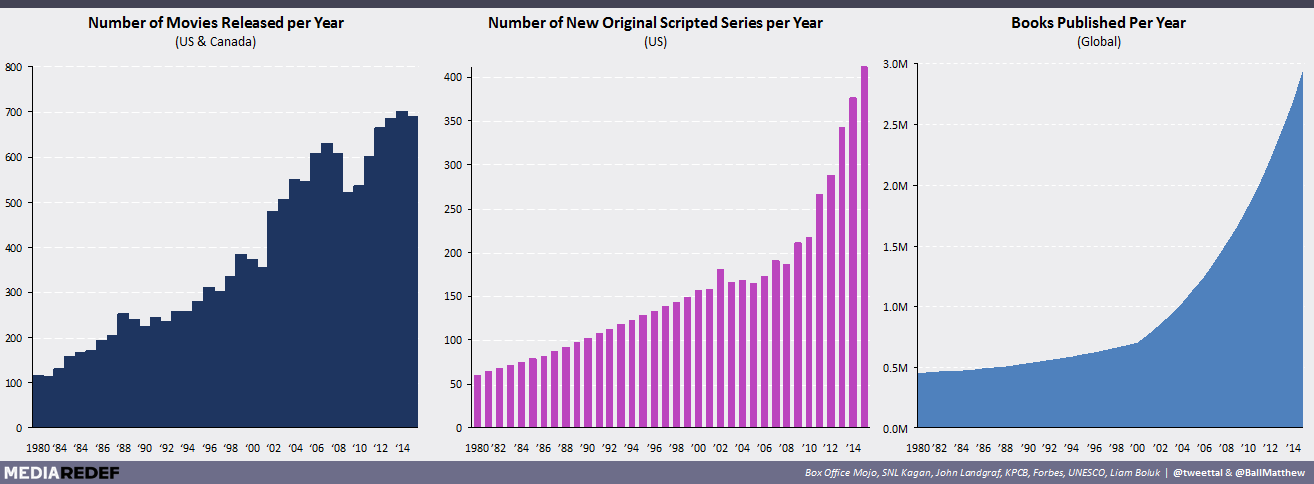
But it took until the late 2000s – more than a century after the phonograph – for creation and distribution to truly democratize. With the Internet, distribution became free and truly non-rival (if a bit non-excludable), while the proliferation of low-cost media equipment, mobile devices, and powerful editing software dramatically lowered the costs of production. The rise of creator-based consumption platforms and crowd-funding platforms, meanwhile, eliminated many of the remaining barriers hindering independent content creation. This meant that content could not only be created by those outside the business, but that commercializing this content became significantly less expensive and risky. This led to a massive increase in available, indexed and distributed content.
REDEF_Curation_1.3
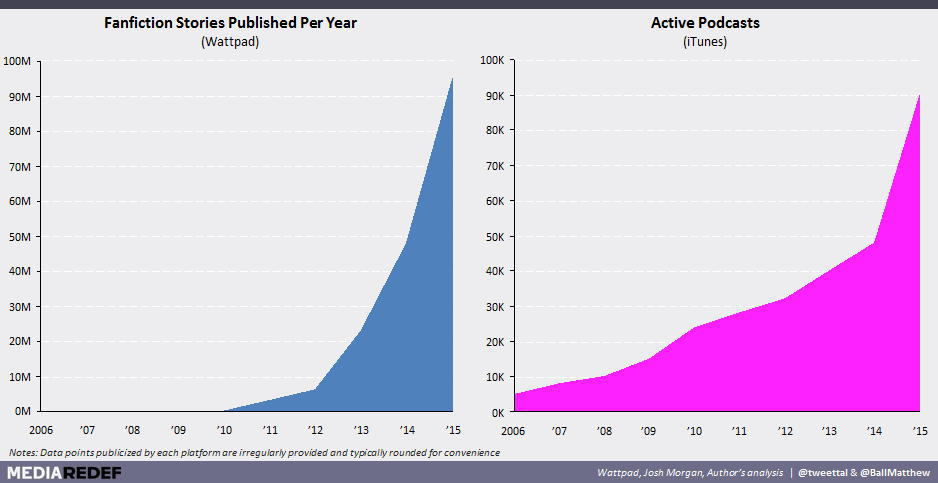
While the media business benefited from many of these changes, the consequences have been fundamentally destabilizing. The television industry has experienced such a surge in original content that annual cancellation rates have quintupled over the past 15 years (twice as many original scripted series were cancelled last year than even aired in 2000). Since 1985, the indie film industry has seen a nearly twentyfold increase in the number of theatrical releases even though ticket sales have remained flat (in 2014, the Head of SXSW’s film festival decried that “the impulse to make a film had far outrun the impulse to go out and watch one”). Plummeting music sales and unprecedented competition have made launching a new artist so expensive that catalogue sales now make up more than 200% of major label profits (in 2014, David Goldberg privately encouraged Sony Entertainment CEO Michael Lynton to essentially halt A&R efforts, as well as investments in actually making new music). With the democratization of media creation, it’s easier than ever to make content but harder than ever to make a hit.
REDEF_Curation_1.4
Ironically, the increasing difficulty in creating hits has not bolstered the “hit maker” system but rather further weakened it instead. In 2013, Macklemore became the first unsigned artist since 1994 to have a number-one single in the United States – a feat he repeated just three months later. Mega-star Taylor Swift has been with an independent label since her debut album and multi-platinum groups such as The Eagles and Radiohead have left the majors to start their own. The struggles of print publishing are well-known, but the uniqueness of some of “print’s” recent successes are worth mentioning. The 50 Shades of Grey trilogy, which has outsold The Harry Potter septet on Amazon in the United Kingdom and made author E.L. James 2012’s highest-earning author, became a viral hit on FanFiction.net long before it was picked up in print (and it’s unlikely a publisher would have bought the rights upfront). Andy Weir’s The Martian is another self-publishing success story.
REDEF_Curation_1.5
This metamorphosis is about far more than ever increasing amounts of content and a handful of stars existing outside the traditional media ecosystem. The entire media business is inverting. For decades, scarce capital and constrained distribution capacity meant that the media’s industry bottlenecks sat in the middle of the value chain. Today, however, the bottleneck has moved to the very end: consumer attention. This shifts the balance of power from determining what should be made to finding a way to convince people what to watch, listen to or read in a world of infinitely abundant content.
The preeminence of this challenge has given to the rise of a new type of aggregator-distributor, including news content sites like Gawker, the Huffington Post and BuzzFeed; video and music aggregation services like Netflix, YouTube and Pandora; and even physical products subscription offerings like Birchbox and Lootcrate. What’s more, it enabled the major social networks to use their customer data to build massive stickiness, launch their own publishing platforms and become traffic kingmakers. More broadly, this shift has swung the balance of power from programmers with the ability to greenlight content to curators with the ability to get that content heard, seen or read. Of course, the old programming and financing guard remain important, but with the democratization of production and the explosion of content creation, the power of 1st party programming is quickly being eclipsed by the ascendance of 3rd party content curation. The gatekeepers are still manning their posts, but the city outgrew the walls and the barbarians circumvented the gates entirely.

The Tastemaker Curator
To date, curation has primarily been delivered in three ways. Most common is algorithmic recommendation powered by behavioral and social graph data – e.g. Facebook’s newsfeed, Spotify’s Discover Weekly, Netflix’s content feeds. Second is hand-picked selections delivered by and through the major distribution platforms – e.g. Twitter Moments, Snapchat stories and Beats Radio 1. Third are one-off recommendations and shares by individual users – posting a Spotify playlist, reblogging a tumblr post, sharing a link or retweeting a tweet. Suffice to say, curation today is dominated by well-capitalized technology-media companies and supported by significant manpower and bandwidth.
REDEF_Curation_1.6
However, the next evolution in the media value chain will be the rise of decentralized curation – with individual tastemakers building up mass followings and driving enormous consumption by recommending various articles, videos, shows, films, albums, exhibits and so on. While there’s no way to effectively do this at scale today, the transition is long in development. Almost everyone today remixes content they’ve created with 3rd party content (just look at any social feed), reviews and engages in media commentary (ditto) and uses the recommendations of others to decide what to watch, see, listen to or even believe. Similarly, every social graph includes a handful of node users whose endorsements proliferate across the social web. The formalization of this influence will therefore represent both a natural and value-add extension of existing user behavior.
To this end, multimedia curation is and will continue to be pioneered by today’s web influencers: YouTube, Instagram and Twitter celebrities such as Connor Franta or Michelle Phan that have already developed, personal and authentic voices that transcend individual verticals, genres and brands and influence millions. But it is not and will not be confined to these digital influencers alone. “Traditional” celebrities that connect with their audiences on a deep level – a Howard Stern, Taylor Swift, Glenn Beck or Kardashian – are positioned to and in some cases already beginning to dive into curation. Mindy Kaling doesn’t have 6M Twitter followers, two books and her own TV show just because she’s funny, but because her taste, endorsements and perspective resonates.
The template already exists: Martha Stewart and Oprah both built extensive, multi-category empires in the pre-digital era largely based on the power of their stamp of approval. With new distribution technologies, the influencers of today, and maybe Martha herself, will be able to build even more comprehensive empires than ever before, all built on the power of their taste and delivered via inexpensive but massively distributed web infrastructure.
This ability for consumers to tap into specific voices will also be critical as more content and more users come online. Consumer time (or “attention”) doesn’t scale with either the volume or ready availability of content at their disposal. Discovery functions, too, have a maximum. The significance of 1,000 likes, 400 ratings or 3.2M plays is very different with 3B Internet users than it was with 500M. Not only does contextualizing these social cues become impossible, but the demographics of the reviewers continues to change – first in terms of age and income, then geography and culture – making it difficult to understand the personal validity of any crowd based metric. That’s not to say that a product on Amazon with 1,400 reviews and a 3.8 star rating isn’t good – just that the common review mechanisms found across the web mathematically soften taste out to the average. This works a lot of the time, but we tend to have very particular tastes in certain categories – and there is a certain staleness created by narrowing these averages down using look-a-like groups and other algorithmic techniques. Not to mention the fact, that such an approach often lacks the element of serendipity and surprise from discovering something you loved but didn’t expect (especially if you would otherwise have avoided it). As a result, curators both solve a media painpoint and enrich consumption.

Where Will this Be Built?
The most likely enablers of the age of curation will be today’s social platforms. Though rarely viewed as such, these companies – Facebook, Twitter, LinkedIn, Pinterest, Instagram – are already in the business of content creation, remixing and distribution. As such, the expansion from one-off filters, albums, shares and vlogs to curation would represent an organic evolution of their existing user toolset. More importantly, however, this change will be critical if these platforms want to continue to grow user engagement and manage the massive influx of user created and user-submitted content.

Tuesday, August 30, 2016

Culture: Our Writers Can....

....be as "big" as in well known and influential internationally as our singers.

There was, in the wake of Marlon James' massive Booker Prize win in 2015-16 (shown above), an expected wave of support for Jamaican writers, whether or not they were /are domiciled in Jamaica. James' win dovetailed neatly into similar triumphs for Claudia Rankine (whose book-length poem, Citizen: An American Lyric copped several major awards and nominations both in the US and UK and Kei Miller (immediately below, right), whose similar book-length epic "The Cartographer Tries To Map a WayTo Zion, earned him the UK's Forward Poetry Prize.

Of course, there are many more victories worth savouring from Roaland Watson Grant (immediately below left) whose sly swap trilogy that began with "Sketcher" and continued with "Skid" will soon reach its conclusion with the impending publication of "Nearly Near But Fairly Far"


and poet Tanya Shirley (left) whose two published volumes of poetry to date, "She Who Sleeps With Bones" and "The Merchant of Feathers" continue to be well received her and abroad.

And new names are continually coming to the fore (or re-emerging) form Nicole Dennis-Benn whose less-than-sunny expose of the underbelly of Jamaican life and tourist culture, "Here Comes The Sun"  has been enjoying raves from diverse international presses.
And yet, even with the preceding (and a whole host more that I admittedly haven't mentioned in this missive) there is the sense that the spark is yet to become a fire; there is the concern that Jamaican literature may yet end up like Jamaican film (with apologies to all the great filmmakers now out there: a little too long in the wind and the rain to build the critical mass so needed and even desired. Calabash, the annual* south coast celebration of Jamaican and global writers in tandem is certainly a worthy element (and undoubtedly a catalyst) in this phenomenon, but its not nearly enough in itself. The singers and players had their Trench Town, and even the dramatists had a visible nucleus in the now decaying Ward Theatre and - further "uptown" the Little Theatre and the now defunct Barn. Even the celebrated athletes, always achievers, went to to another level after the establishment of the MVP facility at the UWI (though MVP is obviously not the only worthy athletics centre)

 It may seem excessively nostalgic to be suggesting a salon in this day and age of digital connection, but with social media itself now in some respects saturated and even stratified, the time has well come to "go back to the future" so to speak and develop some kind of physical centre, incubator, hotspot - who knows what to call it for Jamaican writers, not to gather in isolation, but to present themselves to the public in a frequent and meaningful way beyond an annual  festival or even a book launch at the excellent Bookophilia in Kingston or other venues. The nation deserves this, our writers certainly deserve it and the world can certainly stand to receive more great stuff from Jamaica


Thursday, August 4, 2016

Books: Write rich, the highest earning authors

THESE WELL-HEELED wordsmiths earned a combined $269 million over the last 12 months, proving that the written word isn’t dead–although television and movie adaptations often help drive sales.
To wit: Zoo, a thriller from the inescapable James Patterson, scored a second season on CBS , while Game of Thrones creator George R.R. Martin benefited from clamorous interest in the hit HBO series based on his fantasy novels.
Patterson topped our list for the third straight year, earning $95 million pretax, while children’s author Jeff Kinney placed a distant second, earning $19.5 million.

http://www.forbes.com/pictures/emjl45efgei/the-worlds-highest-paid/#66a837894fd9


Tuesday, July 26, 2016

Celebrity: Left Behind author heads to the hereafter

Tim LaHaye, the author of the apocalyptic Left Behind fiction series, has died at the age of 90. He reportedly passed away a few days after he’d suffered a stroke. LaHaye was a prominent evangelical minister, Air Force veteran, and best-selling author. He’s also famous for convincing Mel Gibson to change the ending of The Passion of the Christ to include a resurrection scene and was known as a longtime spiritual adviser and personal friend of former Gov. Mike Huckabee.

Monday, July 25, 2016

Education: EL Principal charges Jamaican teachers to change

From the moment his extensive bio was being read out, one got the sense that an oratory treat was in store.

And veteran school principal and edication activist" Salome Thomas El did not disappoint as he helped open the JN Foundation's School leadership Summit at the Pegasus in Kingston.
From catch phrases (the revolution will not be televised"; if they act up you got back up") to heartfelt anecdotes, El laid down the law and the challenge to educators to adapt and get children ahead in an increasingly media-heavy yet factless world
The change, he reiterated, has to begin from within, telling his own story as a single-parent raised child of the projects who succeeded from positive modelling
 in a “Every child needs someone to be crazy about them.” These are the words of Salome Thomas-EL, award-winning teacher and principal, and nationally recognized educator. They shape his life-long commitment to answering the question, “How do we ensure that every child achieves their greatest potential?” This question lies at the heart of the national dialogue on education policy, the day in and day out work of school personnel, and the hopes of every parent. Central to this challenge is how we succeed with children who are facing the most serious barriers to success: poverty, violence, neglect, and low expectations.
For over 20 years, Principal EL has taken on this challenge with the absolute belief that every child can and will learn as long as adults in their world care enough to not give up. Starting as a teacher and chess coach at Vaux Middle School and through his years as principal at several traditional public and charter schools, Thomas-EL has transformed the attitudes and strategies of school staff, parents, and members of the community to help hundreds of troubled children not only graduate from high school but go on to earn higher degrees from major colleges and universities. He brings to the process a powerful combination of passion, caring, and leadership to craft a refreshing, common-sense roadmap to help kids achieve their dreams, no matter the odds.
Salome Thomas-EL lives in Delaware County with his wife and two young daughters. He has been a teacher and principal in Philadelphia, PA and Wilmington, DE since 1987. Salome is currently the Head of School at Thomas Edison Charter School in Wilmington. Principal EL received national acclaim as a teacher and chess coach at Vaux Middle School, where his students have gone on to win world recognition as Eight-Time National Chess Champions. Principal EL was a regular contributor on the first season of “The Dr. Oz Show” and the author of the best-selling books, I Choose to Stay, about his Vaux Middle School experience, and The Immortality of Influence (Foreword by Will Smith), which stresses the importance of leadership, mentoring, parenting and service to others. The Walt Disney Company optioned the movie rights to I Choose to Stay. Thomas-EL speaks to groups around the world and frequently appears on C-SPAN, CNN, and NPR Radio. He has studied in Cambridge and London, England and is currently a doctoral candidate. He has received the Marcus A. Foster Award as the outstanding School District Administrator in Philadelphia and the University of Pennsylvania’s distinguished Martin Luther King Award. Educational Leadership and Reader’s Digest Magazine recognized Principal EL as an “Inspiring American Icon”. Principal EL has also appeared on “The Oprah Radio Network”.

Dj Khlaed and Tony Robbins are "The Win Twins"

At 6'7" Tony Robbins stands head and shoulders above DJ Khaled. Robbins—if you know him from infomercials, his books, or a cameo in the movie Shallow Hal­­­—defies Hollywood proportions. He’s taller than you’d think. Bigger. Barrel-chested, with a jawline that resembles Easter Island’s basalt stone statues. It’s not just that Robbins’ hands make an iPhone 6S Plus look like a playing card. It’s that the 56-year-old possesses the type of energy that sucks the air out of a room. You instantly want to please him. If some of us are afflicted with resting bitch face, the best-selling author and pal to Oprah and Richard Branson has resting inspirational face: wide smile, eyes lit up from the inside, a gaze that roves for the shyest person, the one most in need of self-actualization and the least likely to pipe up.
DJ Khaled, however, is not by any stretch of the imagination shy. Dubbed hip-hop’s answer to Robbins, he’s captivated his more than six million followers on Snapchatwith 10-second motivational maxims on professional decorum (“Don’t ever play yourself”), avoiding negativity (the omnipresent haters he calls “They”), and self-care (“It’s simple: Give thanks and use Dove” and, “have a lot of pillows”).
At 40, the Miami-based producer behind team-up mega anthems like “We Takin’ Over” and “All I Do Is Win” is zeitgeisting with astonishing propulsion. The founder of We the Best Records, Khaled—née Khaled Mohamed Khaled—has been a hip-hop mainstay for well over 10 years with a ninth studio album, Major Key, slated for a July 29 release. Khaled is one of those rare figures in hip-hop that is near-universally, multi-generationally beloved. He can happily work with Drake and Meek Mill regardless of their beef. He’s managed by Jay Z but his music is not exclusive to the Roc Nation impresario’s content platform, Tidal; Khaled, to Jimmy Iovine and Larry Jackson’s delight, is a part of the Apple Music family.
There are words used to describe both Robbins and Khaled—passionate, charismatic, blustery. Khaled had been an admirer of Robbins, and in turn Robbins wanted to meet Khaled to see what he was about. Seated at Harmony Gold Theater on Sunset in Los Angeles, the two stare intently into each other’s eyes. They’re talking quietly—having a moment. Khaled would call it cloth talk: the tête-à-tête between two unique, powerful men or “special cloths.” To characterize their interaction as a lovefest would be an understatement; there is also a mission at hand.
“Either you grow or you die,” says Robbins in an impeccably tailored blazer, selvedge jeans, and a crisp white pocket square. Khaled, similarly dapper in a black suit, nods.
Robbins, who calls himself not a motivational speaker but rather a life and business strategist, has flown in to Los Angeles on his private jet from promoting his Netflix documentary, I Am Not Your Guru, and the paperback release of Money: Master the Game: 7 Simple Steps to Financial Freedom. In turn, Khaled is in town after traversing the U.S. on his We the Best Tour bus as part of Beyoncé’s Formation Tour. He hasn’t slept—instead spending the night in the studio—and is completing his own business book, The Keys [Ed. note: Mary H.K. Choi is co-writing The Keys with DJ Khaled]. But despite Khaled’s propensity for “new deal alerts”—social media messages about his innumberable projects—right now he’s focused. To wit: He’s not even Snapchatting.
“We’re achievers and achievers don’t suffer,” says Robbins, leaning in. “We don’t have fear. We just get stressed.”
It’s been years—he guesses it was around age eight or nine—since Khaled has been on an airplane. It’s one of the least publicized aspects of his life, though he’ll talk about it when pressed. He doesn’t like the turbulence. Loathes the anxiety. He’s got enough on his plate: A rapidly growing empire, a kid on the way with his fianceé Nicole Tuck. And though it takes three days on the road to go commune with his fan army—Fan Luv—on the West Coast from his native Florida, he vows that he’ll get on a plane only when he loses a little weight (an ongoing and thoroughly endearing saga on his snaps).
Robbins insists he can help

Khaled: One of my favorite songs is by Mavado. The song is called “Progress.” It’s something that I work out to every day. Progress is definitely the answer. Once you start losing reality, when you start losing reality with yourself, sometimes people just get dizzy. For instance, I’m in Beverly Hills right now at a hotel. I told myself, “Man, it’s so beautiful out here. If I ever moved to L.A., I would probably want to buy a house in Beverly Hills.” The thing is, once I leave Beverly Hills, [I realize] there’s no bodegas in Beverly Hills. Once I leave L.A. and go back to Miami or if I go visit New York, it’s like, “Oh man, there’s the bodega.” What I’m saying is that you can’t forget the reality. Sometimes people take success and forget about reality.


Wednesday, July 13, 2016

Books: Talent only Gives You One Good Book, A chat with writer Garfield Ellis

- FROM susumba.com; Tanya Batson-Savage

Garfield Ellis is possibly one of Jamaica’s best-kept secrets. So, at his reading at Bookophilia, on Hope Road in Kingston, from his latest novel The Angel’s Share (Akashic Books), it wasn’t that surprising when members of the audience queried whether he had any other books. 
Ellis is a reasonably prolific writer (not Kwame Dawes prolific - but then which writer is?) with four novels and a collection of short stories as well as several anthologized short stories to his credit. So while he hasn’t been hidden away, he has not been one of those writers buzzed about, though he should be.
His reading from The Angel’s Share which was shortlisted for the 2015 Una Marson Award is a novel about a father and son reconnecting as they travel across Jamaica, showed that Ellis continues to be a keen discerner of the hearts of boys and men, again presenting the beautifully flawed and textured characters found in For Nothing at All and Such as I Have both published by Macmillan Caribbean.
Like many of our other writers, Ellis left Jamaica’s shores to seek succour in the albeit cooler, but certainly greener pastures of Canada. This was the first time he was coming home in a few years, and his last major reading on the island was at the Calabash International Literary Festival in 2012.
“It’s good to be in Kingston. I haven’t been here in 3-4 years,” Ellis said to the small yet eager audience who had been quietly sating their literary appetites on his words. As soon as he finishes reading one passage he is urged to read another. But good things also come between the readings as Ellis talks about writing and his relationship with Jamaica.
“My friends tell me that after two weeks in Jamaica, you want to come back [to Canada] but obviously they haven’t been here during mango season,” Ellis said as listed mango among the things he has been happily gorging, on along with copious amounts of Red Stripe beer and jerk pork.
He explains, however, that his relationship with the island is deeper than these culinary delights.
“It’s Jamaica that feeds me, so I have to keep coming back,” Ellis says. revealing that most of his writing has taken place here. His next book, titled Land We Love, will be the first one that was largely written in Canada, although his eyes remain firmly trained on Jamaica.
He explains that Land We Love will be his first real look at violence in Jamaica has he has generally tried to steer clear of it.
“When you love the country, and you have a sensitivity, it’s very difficult to face,” Ellis said. Indeed when bursts of violence has appeared in his writing it has been sensitively treated. It’s often visceral while being deeply moving as the emotional carnage is usually a part of the package. 
Garfield Ellis
Garfield Ellis
Ellis revealed that although he has found himself working in numerous nine-to-five jobs, his writing has been a consistent part of his life.

“It is the only thing that does not bore me, that I do every day and it does not bore me,” Ellis said. “Everything else, after 3-4 years it bores me, but writing feeds me.”
Of course, a major part of writing is learning to deal with rejection, especially, if like Ellis, you choose not to go the route of self-publishing.
He notes that even though he has written a lot, he doesn’t send his work to many publishers and the earlier version of The Angel’s Share had earned a 2-page rejection letter from the publisher. On reading that, he put the book aside for a long time then finally he realized what needed to be fixed and that’s when he understood what the publisher had been saying about the work. 
“The truth is that, a lot of times, the rejection makes sense if you can see what the publisher is saying,” Ellis said.
He clearly has no delusions about writing as he says Talent will only take you so far. 
“90% of what makes a novel is hard work,” Ellis said. “Talent only gives you one good book. You have to learn the rest.”

Monday, June 6, 2016

Brands: BMW goes to Britain for its next Art Journey

British artist Abigail Reynolds (represented by ROKEBY, London) as the next BMW Art Journey winner. The international jury selected her unanimously from a shortlist of three artists whose works were exhibited in the Discoveries sector at this year’s Art Basel show in Hong Kong.

Reynolds’ artistic practice is closely linked to books and libraries. Having studied English Literature at Oxford University, she frequently draws inspiration from literary essays and figures to imagine places and moments from the past, present and future. Given this deep connection to libraries and literature, it is no surprise that Reynolds’ BMW Art Journey project for 2016/17, “The Ruins of Time: Lost Libraries of the Silk Road,” will allow her to connect the complex religious and secular narratives of Europe and Asia and to expand her current interests and working methods through an extensive multi-continent series of visits to historic and fabled repositories of books.

The BMW Art Journey is a global collaboration between Art Basel and BMW, created to recognize and support emerging artists worldwide. This unique award is open to artists who are exhibiting in the Discoveries and Positions sectors in the Hong Kong and Miami Beach shows of Art Basel, respectively. Two judging panels comprised of internationally renowned experts meet first to select a shortlist of three artists from the sector, who are then invited to submit proposals for a journey aimed to further develop their ideas and artistic work. The jury reconvenes to choose a winner from the three proposals. The next round of selections for the BMW Art Journey will take place during Art Basel in Miami Beach.  
BMW is a global partner of Art Basel and has supported Art Basel’s three shows in Basel, Miami Beach and Hong Kong for many years. 

Monday, December 21, 2015

Books: Grahame's "Jacks Hill Road" worth the trip

This book (one of three recently launched by the author) opens with a domestic helper lamenting the arduous nature of trudging uphill to the well-to-do home in which she works. That is the Jacks Hill Road of the title.

But in author Jennifer Grahame's wry, sly and compassionate hands, there is far more waiting for both character and readers at the summit of that hill.

Jamaica's long-lamented class divisions are delved into, peeled away and revealed to have quite a bit more overlap than hard borders.

Through the character Louise's eyes (she is rendered quite endearingly by Grahame, the painter, on the back cover), we see the foibles, failings and fascinations of an expanding cast that show just how dynamic the Jamaican social rubric really is.

And, its funny. Within its 130 pages are enough shenanigans, sudden revelations, doubts and other happenings to fill two (or three?) books. Grahame's style is direct, but in a disarming way, much in the manner of typical Jamaican conversation; hardly anything takes place on the surface, its in the repetitions that the patterns and the surprises come.

Jacks Hill Road is the work of an author thoroughly versed in her milieu, but still willing to look at  it with a forgiving eye. For that alone, its a worthy investment of your time.

Wednesday, November 18, 2015

Literary: Jammin' Books at Miami Book Fair

Displaying blob:https%3A//mail.google.com/36a22a2b-f025-440d-8925-ba5b331b2eca
Read Jamaica, a book promotions outfit based in Kingston, Jamaica will be bringing literary vibes from ‘yaad’ to the 2015 Miami Book Fair, South FLorida Caribbean Newsreports.
In addition to showcasing and promoting Jamaican books at the eagerly anticipated Miami Book Fair, Read Jamaica will also be collaborating with the Consulate General of Jamaica to Miami to present a Book Party on Thursday, November 19, 2015 at 6:00pm.
The Book Party  line-up includes Florida-based Jamaican authors Geoffrey Philp, David Muir (Pieces of Jamaica) and Judith Falloon-Reid, who recently released her latest novel The Silent Stones. These three will be joined by the Jamiacan-based authors Tanya Batson-Savage (Pumpkin Belly and Other Stories) and Kellie Magnus (the Little Lion Series). The evening will also feature the US soft-launch of iPublishJa, a publishing consultancy specializing in digital books.
According to the organizers, the book party will present a mixture of readings, discussion about the state of Jamaican literature as well as the opportunity to mix, mingle and be introduced to some great Jamaican books.
Read Jamaica is the brainchild of three of the most dynamic women in the contemporary Jamaican publishing scene: Tanya Batson-Savage of Blue Moon Publishing and Blouse and Skirt Books, Kellie Magnus of Jack Mandora and Latoya West-Blackwood of iPublish Jamaica.
“This is an wonderful moment in history for Jamaican books in particular and Caribbean books in general,” Tanya Batson-Savage says. “Read Jamaica wants this to be more than a moment. Our aim is to take Jamaican books, by authors at home and abroad to world. Through Read Jamaica we want to tell the world, not only about the writers they are already aware of, but authors they should be paying attention to.”
The Book Party will take place at the Miami Dade College, North Campus, Building A, 11389 NW27th Avenue during the 2015 Miami Book Fair.

Tuesday, September 8, 2015

Books: Channer "Commits Poetry"

51quePMO7iL._SX338_BO1,204,203,200_

On Thursday, September 10, 2015, at 7:30pm, Colin Channer—in conversation with Paul Holdengraber of the New York Public Library—will present his debut poetry collection, Providential (2015); a reception will follow. The launch takes place at Greenlight Bookstore, located at 686 Fulton Street in Brooklyn, New York.
Event description: Hailed by Junot Diaz as “one of the Caribbean Diaspora’s finest writers,” Colin Channer is one of the most compelling voices of our time: a bestselling novelist, co-founder of the Calabash Literary Festival in Jamaica, and a widely published poet. Channer’s debut poetry collection, Providential, is an intimate, moving portrait of violence, family, love, and loss, and a meditation on the figure of the Jamaican policeman. Channer reads from his book and talks with Paul Holdengraber, host of LIVE From the NYPL. The conversation will be followed by a book signing and reception courtesy of his publisher, Brooklyn’s own Akashic Books.
Channer, Colin 2
In a recent review of Providential, Tallawah magazine writes: [T]he Jamaican-American scribe, chief founder of the Calabash International Literary Festival, is getting set to break his lengthy self-imposed hiatus with the publication of his debut collection of poems, Providential (Akashic), an anthology centred on an unlikely hero: the Jamaican policeman. At the same time, Providential heralds a slight creative departure for Channer, whose fans have come to associate him with razor-sharp prose laced with wit, humour and keen observations. But critics and colleagues of the author say readers needn’t worry, as Providential more than holds its own as a deeply impressive first collection. “Channer has written a fine set of poems that, like classical myth, starts with the search for the lost father and ends with the found son,” reports bestselling author Russell Ebanks, “the poet in the process replacing the lost father with the found self.”
With this anthology, Channer’s writing life makes a quantum leap forward, taking him that much closer to the ranks of Olive Senior, Lorna Goodison, and Kwame Dawes (among others), who are known for bodies of work that move almost seamlessly between the poetic and the prosaic. And, by all accounts, it’s an achievement for Channer attained through creative risk that pays off. “Not since Claude McKay’s Constab Ballads of 1912 has a writer attempted to tackle the unlikely figure of the Jamaican policeman,” proclaim publishers Akashic Books. “These poems manage to turn intimate relationships between a man and his father, a man and his mothers, a man and his country, and a man and his children into something akin to grace.”
What’s more, the diversity of the collection’s offerings is also bound to delight Channer’s loyalists. “The collection achieves an intimate and lyrical meditation on family, policing, loss and violence,” Akashic further notes. “But the work is enlivened by humour, tenderness and the rich possibilities that come from honest reflection.”

Friday, April 17, 2015

Live Muisc; Bent x 2 +1 = Great musical experience

Its not all t hat often that members of a musical family this talented appear in the same venue at once (the title equation refers to Rupert Bent Sr and Jr and Jana Bent (daughter of one, brother to the other), who played to an appreciative audience at Redbones last Wednesday. The "official" occasion was to mark the start of a new Wednesday residency by Bent Sr at Redbones (once a month; he also has regular gigs at Morgan's Harbour and at the Pegasus) and unofficially to join Jr in celebrating 15 years of marriage to wife Michelle. With such a pleasant confluence of occasions, spirits were bound to be high and no one left disappointed
Fittingly, Bent Sr started off the evening, in Marley mode with "Redemption Song" thereafter proceeding amiably through covers spanning the gamut of rock and pop. He hit an early high on Bobby Caldwell's "What You Won't Do (You Do For Love)" and I say this because on that piece, his playing not seemed more robust, but the balance between his guitar and the accompanying track seemd more harmonious than in the earlier selections, when it appeared that he was almost drowned out at times. Bent Sr. would scale even greater heights with a one-two punch of Santana - "Black Magic Woman" and "Oye Como Va" that kept him on his feet and had the audience tapping theirs.

After a brief intermission, it was family time. Despite having two full-length albums to her credit, songs placed in international TV shows ('The Hills") and a bonafide hit in "You So Fine", Jana Bent has spent more of her time and energy in recent years in the corporate (or statutory) world, working with gaming regulator the Betting gaming and Lotteries Commission. Musically, she has put her abilities and experience ot a very notable "side project" - the Shaggy Parrot series of enviro-themed children's books, which are proving very popular. So she has been busy. But when Dad asks, one can hardly say no, so there she was, belting out "Natural Woman" with much gusto, this accompanied by Bent Jr, who wento on to his own dynamic guitar exposition (was it Sting's "Fragile"?) before playing in tandem with his father.
Famalail duties of my own called me away at that point, but not after having had a very welcome refresher on the musical gifts of the family Bent.


http://www.amazon.com/Turbo-Donkeycart-Michael-D-Edwards/dp/1495999475/ref=sr_1_1?ie=UTF8&qid=1429183880&sr=8-1&keywords=Turbo+Donkeycart

Thursday, April 16, 2015

Kids' Books: A Rousing "Reggae Rescue' Reading Session

Singer.Author. Organizer. Parent. Enviro-activist. Motivator. Jana Bent checks all those boxes, and during her recent Saturday reading session at Bookophilia in the Kids section, she had moments to incorporate them all.

Using her popular Shaggy Parrot series of enviro-themed children's books, Bent led a colourful and vibrant read-along and sing-along that easily included several of the parents on hand as well as their young charges. Well- prepared with instruments and props, Bent encouraged the youngsters to play their part in preserving our shared natural heritage, even as they revelled in the adventures of the Shaggy character and his marine, riverain and land-based pals.

More recently, Bent, who also "squeezes in" a day job with regulator the Betting Gaming and Lotteries Commission, stated that she had reached an agreement with charitable organization the American Friends of Jamaica, to purchase a significant quantity of the books for distribution to schools across the island. Additionally, she's working on addressing another critical social issue through story-telling: violence against children/minors.

More to come on both those developments, but in the meantime, to recreate the magic of Shaggy, Swimpy, Edda and the rest of the cast, you can pick up the books at local stores, or visit www.reggaepickney.com for more info

Wednesday, April 15, 2015

Culture: Getting (Kinda) Serious about Comedy

Do we laugh to hide the sadness within ("tek kin teet kibba heart bun")?; do we poke fun at figures, public (mostly) and private for the good of the many, or the mirth of the few? How linked are comedy and music in the hearts and minds of Jamaicans, and do Jamaican comics get the respect they deserve viz-a-vis other creative types as well as opposed to foreigners?

The above was just a sample of the questions addressed in a robust, free-wheeling and individualized session at the N1 Lecture Theatre (Humanities) at the UWI on Sunday last.

Entitled "Put Fun and Joke Aside" (another prime Jamaican expression), the session was led by Tanya Batson-Savage of Blue Moon Publishers - Blouse and Skirt Books, and featured two of the more firmly established and widely beloved comedic talents.

For some years, Dr Michael Abrahams (above, left) has been balancing his ob-gyn specialist "day job" with poetic comedy expositions both live and and on television. Hie oeuvre is largely satirical, cataloging the many current social ills and skewering public figures form many quarters.

Between his duo work with Winston  "Bello" Bell, his teaching duties at the School of Drama and his own dual-resident comedy schedule (Jamaica and Canada, with other stops in between) there are hardly any trails that Owen "Blakka" Ellis has not blazed, although he did take time earlier this year, to launch a poetry collection, "Riddim and Riddles" under the Blue Moon/Blouse and Skirt imprint ( copies were, of course, sold at the  event).

the two are not only well known to the public, but to each other, despite Ellis' seniority as a performer, and their unforced rapport and readiness with an ad-libbed zinger or phrase made for an enjoyable but also illuminating morning's exploration into the seriousness of  comedy - of doing it, and of living it.

As could be expected the moderated sessions and the Q & A covered almost every topic and sub-topic imaginable, ably interspersed with "readings" - Ellis from the book, and Abrahams, as is his wont, performing ex tempo, and accompanying himself on guitar for a scathing send-up of the recent (and ongoing?) social and environmental debacle that is the Riverton landfill fire(s).

At the ned of it all, the large audience were left with a greater appreciation for the sentiment summed up in the words of actor Edmund Kean: "dying is easy, comedy is difficult"

If only they didn't make it look so easy

http://www.amazon.com/Turbo-Donkeycart-Michael-D-Edwards/dp/1495999475/ref=sr_1_1?ie=UTF8&qid=1429183880&sr=8-1&keywords=Turbo+Donkeycart

Saturday, March 7, 2015

Books: Nine from Five for Bocas Long list


Authors from five territories have made the longlist for the 2015 OCM Bocas Prize for Caribbean Literature, sponsored by One Caribbean Media.


The Prize longlist includes three genre categories: poetry, fiction, and literary non-fiction. The winners in each category will be announced on 1 April, and the Prize will be presented on Saturday 2 May, during the fifth annual NGC Bocas Lit fest in Port of Spain. The overall winner will receive a US$10,000 award with smaller awards for the other winners.

The 2015 OCM Bocas Prize Longlist:

POETRY

Sounding Ground, by Vladimir Lucien (Peepal Tree Press)
The Cartographer Tries to Map a Way to Zion, by Kei Miller (Carcanet)
The Merchant of Feathers, by Tanya Shirley (Peepal Tree Press)

FICTION

A Brief History of Seven Killings, by Marlon James (Riverhead)
House of Ashes, by Monique Roffey (Simon and Schuster)
Land of Love and Drowning, by Tiphanie Yanique (Riverhead)

NON-FICTION

Not for Everyday Use, by Elizabeth Nunez (Akashic)
King Short Shirt: Nobody Go Run Me, by Dorbrene E. O’Marde (Hansib)
Dying to Better Themselves: West Indians and the Building of the Panama Canal, by Olive Senior (UWI Press)