I spent over ten years as a film reviewer for various media; I also spent 3 1/2 years on the Jamaican equivalent of the Ratings Board, assigning ratings to films to be shown by the monopoly exhibitor, the Palace Amusement Company, whose existence dates back to 1921.
Altogether, that's a lot of hours spent in dark rooms, watching movies and making judgements about them. Add to that at least two films a week viewed from about the age of say, 8 or 9 years old, and cumulatively, I have some kind of platform for determining the worthiness of films.
Given that depth of interest and close association, I naturally follow the release schedules of the local monopoly exhibitor very closely. I'd been tracking Nate Parker's "Birth of a Nation" ever since that big deal at the Sundance Film fest, and, when I saw a poster of the film in the "Coming Soon" standee outside the company's Sovereign Cineplex (in reality, 2 adjoining rooms holding about 100 viewers each), I was in a state of high anticipation.
But with the passage of several weeks and no move from "Coming Soon" to "Now Showing" I began to have some concerns. These were heightened when the poster, which had been there for at least three solid weeks, was summarily removed, replaced by, among others, Tyler Perry's latest Madea misadventure.
I have nothing against Tyler Perry - his story is well documented and he deserves his success, even in so formulaic a vehicle as Madea.
My issue, is the the monopoly exhibitor (are you getting the pattern here?) after advertising a particular film to be screened for local audiences, has summarily yanked said film - with no explanation whatsoever - this despite several phone calls placed by myself, and a direct visit to the Cineplex - where a woman at the box office, after waffling for a few minutes on the question, finally blurted out "I don't believe there a lot of people who want to see a movie like that."
Like what?
Well, for starters, "The Birth of A Nation" (whose title boldly references D W Griffiths' blatantly racist "masterpiece" of 1915) is based on the pivotal 1831 slave revolt led by American Nat Turner. That revolt left over people dead and helped pave the way for the eventual legal end of slavery in the US some 30 years later, amid the U.S. Civil War.
It parallels a similar revolt, the Christmas Day uprising, led in St James by Samuel "Daddy" Sharpe, a Baptist minister (like Turner), whose memory is immortalized in the main square in Jamaica's second city of Montego Bay. Like Turner's revolt, Sharpe's Christmas rebellion helped pave the way for the eventual end of slavery in Jamaica and Britain's colonies throughout the Caribbean - first in 1834, with the institution of the Apprenticeship system, and the eventual dissolution in 1838.
Parker's film then, is important, not so much as an historical document, but as a symbolic document of resistance to oppression on the part of Africans and African-descended people in the New World. It's cinematic release in North America has been dogged by the controversy of a 1999 rape trial involving Parker and his roommate, Jean Celestion. Parker was initially acquitted, his friend convicted, and then, on a second trial, the case thrown out, with the accuser deciding not to appear as a witness.
However, I seriously doubt that the spectre of writer-director-star as an accused rapist is what has given the monopoly exhibitor in Jamaica cold feet. Its more likely that Parker's teeth-baring battle cry and bloodstained shirt have halted their plans. Not because such content is too graphic for local viewers (horror movies with far more blood and gore frequently make it to the local box office). I suspect the Grahams, the principals of Palace Amusement are loathe to show a movie depicting a slave uprising, especially one as pivotal as Turner's, and especially one told by a black writer and from a distinctly black perspective.
If the above charge is unfounded, then I urge the directors at Palace to furnish us with a fulsome explanation for the withdrawal of the film form their slate. Truthfully though, I won't be holding my breath for that. The Grahams have not been the most forthcoming owners in the past, and there's no reason to expect a change in their modus right now.
So, I'll content myself with seeing Parker's piece outside of the cinema (this is part of the reason why bootlegging will never die) and hope that somehow, Jamaicans will develop a taste for demanding more from the monopoly exhibitor, not in welcoming more indigenous content (like the new Lennie Little-White production that just opened), but more those films which might make the vestiges of the planter class a little uncomfortable.
Fond hopes, but then, I'm the eternal optimist.
Showing posts with label movies. Show all posts
Showing posts with label movies. Show all posts
Sunday, October 30, 2016

Wednesday, August 31, 2016
Media: The Internet NEVER Killed content
- from MEDIA Redef
Over the past century, technological advancements have massively reduced the cost and time needed to create and circulate content. Though this has liberated artists, consumers are now drowning in a virtually infinite supply of things to watch, listen to and read. The answer to a world where attention is the key constraint, not capital or distribution, isn’t Big Media – it’s the Influencer Curator.
Tal Shachar with Matthew Ball
If you read a list of mankind’s most important or influential inventions, there’s not far you could go without coming across those of Thomas Edison. Oddly, however, it’s unlikely you’d ever see the device he so-routinely identified as his favorite: the phonograph. While it didn’t defeat disease, conquer the night skies or take flight, the phonograph was just as Promethean as vaccines, electricity and the Wright Brothers’ ‘Flyer’. For thousands of years, media was a privilege of the elite, concentrated in cities and confined to a single moment in time. With Edison’s phonograph, music had become non-rivalrous, infinitely replicable and indefinite. Yes, it took decades until the average family could afford a record player or radio, but the dawn of democratized consumption had arrived.
Unfortunately, however, this same trend led to an ossification in content creation and distribution. Records, after all, cost money. Production was expensive – as was distribution, marketing and promotion. So expensive, in fact, that almost every artist lacked the capital required to actually release their music – a need that paved the way for record labels (or TV studios, film studios, publishers etc.) that would finance said efforts in exchange for hefty royalty fees and content rights. These money men though wouldn’t and couldn’t afford to invest in every artist with a dream. Given the upfront cost of talent development and distribution, labels invested in “Arts & Repertoire” men, whose job it was to sift through countless musicians in order to identify the select few with “commercial viability”. Potential artists were then further cut down in number when it came time to actually distributing their content – and then again via marketing/promotional support. Underlying this fact was an unavoidable truth: content publishers had scale-related disincentives to support more than a handful of artists. Why record, distribute, market and promote 15 albums if you can achieve the same unit sales with 10?
Though this system was far from ideal, it was the inevitable outcome of a market in which talent was abundant, capital limited, distribution bandwidth (e.g. shelf-space, broadcast spectrum, print layouts) scarce, barriers high, and the cost of failure significant. But as a result, the content industry slowly shaped itself around a mysterious cabal of financiers and executive tastemakers that essentially programmed the national media identity. And anyone who wanted in had to move to New York, LA or Nashville, pay their dues and hope to work their way up until they could call the shots.

Of course, the music business was far from alone. The more expensive the medium, the more constrained the supply, the smaller the community and more homogenous the content. Local disc jockeys, newspapers and TV affiliates did have the opportunity to repackage and reprogram – to imprint their personality or take, if you will – but this was limited in scope, drew upon only the content that was already distributed, had to fit within an existing corporate identity and, again, depended on access to capital or infrastructure.
Over time, however, technology did what it does best: production costs fell, quality went up and distribution bandwidth increased. Economics, in turn, improved, as did the industry’s carrying capacity – the number of artists, titles, and pieces of content that could be supported. The media business was beginning to loosen up.
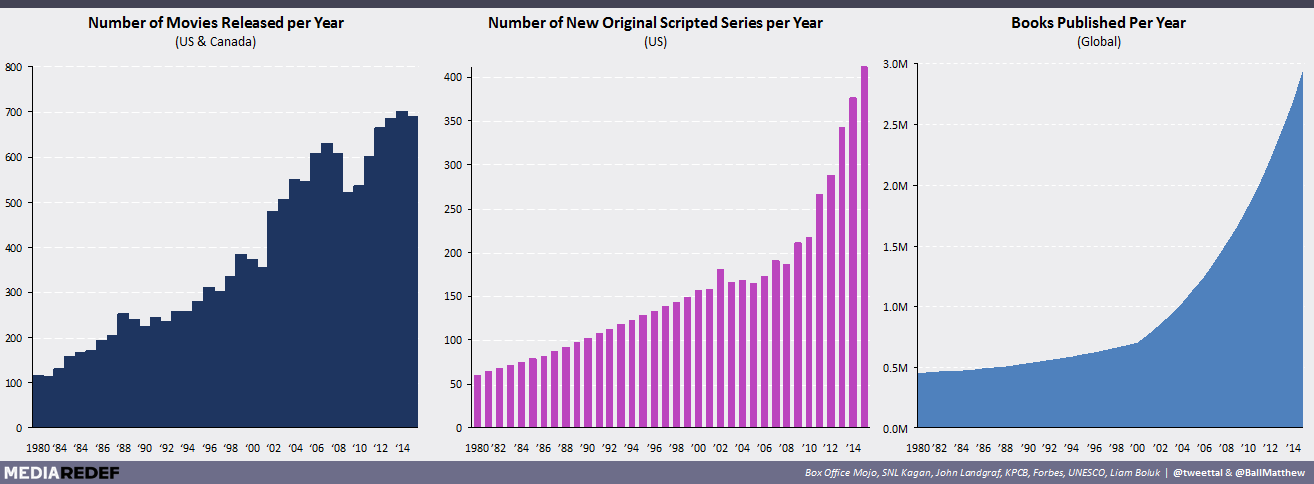
But it took until the late 2000s – more than a century after the phonograph – for creation and distribution to truly democratize. With the Internet, distribution became free and truly non-rival (if a bit non-excludable), while the proliferation of low-cost media equipment, mobile devices, and powerful editing software dramatically lowered the costs of production. The rise of creator-based consumption platforms and crowd-funding platforms, meanwhile, eliminated many of the remaining barriers hindering independent content creation. This meant that content could not only be created by those outside the business, but that commercializing this content became significantly less expensive and risky. This led to a massive increase in available, indexed and distributed content.

While the media business benefited from many of these changes, the consequences have been fundamentally destabilizing. The television industry has experienced such a surge in original content that annual cancellation rates have quintupled over the past 15 years (twice as many original scripted series were cancelled last year than even aired in 2000). Since 1985, the indie film industry has seen a nearly twentyfold increase in the number of theatrical releases even though ticket sales have remained flat (in 2014, the Head of SXSW’s film festival decried that “the impulse to make a film had far outrun the impulse to go out and watch one”). Plummeting music sales and unprecedented competition have made launching a new artist so expensive that catalogue sales now make up more than 200% of major label profits (in 2014, David Goldberg privately encouraged Sony Entertainment CEO Michael Lynton to essentially halt A&R efforts, as well as investments in actually making new music). With the democratization of media creation, it’s easier than ever to make content but harder than ever to make a hit.
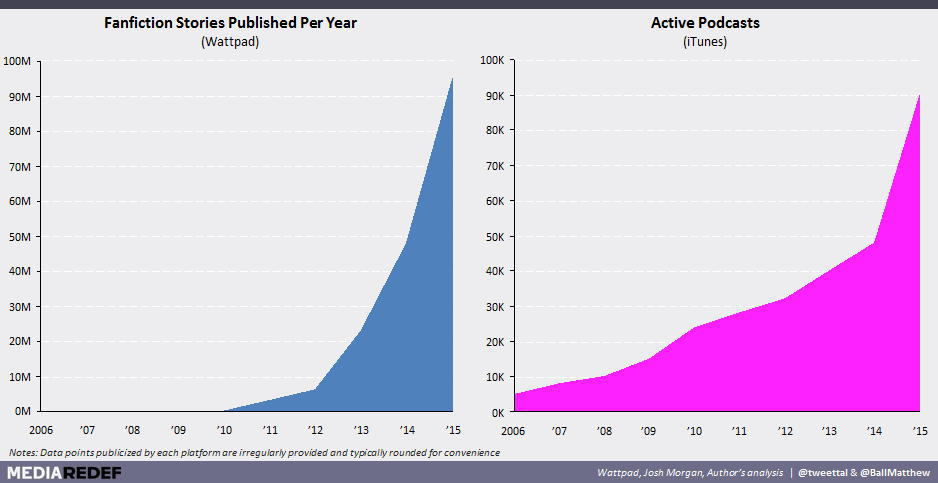
Ironically, the increasing difficulty in creating hits has not bolstered the “hit maker” system but rather further weakened it instead. In 2013, Macklemore became the first unsigned artist since 1994 to have a number-one single in the United States – a feat he repeated just three months later. Mega-star Taylor Swift has been with an independent label since her debut album and multi-platinum groups such as The Eagles and Radiohead have left the majors to start their own. The struggles of print publishing are well-known, but the uniqueness of some of “print’s” recent successes are worth mentioning. The 50 Shades of Grey trilogy, which has outsold The Harry Potter septet on Amazon in the United Kingdom and made author E.L. James 2012’s highest-earning author, became a viral hit on FanFiction.net long before it was picked up in print (and it’s unlikely a publisher would have bought the rights upfront). Andy Weir’s The Martian is another self-publishing success story.

This metamorphosis is about far more than ever increasing amounts of content and a handful of stars existing outside the traditional media ecosystem. The entire media business is inverting. For decades, scarce capital and constrained distribution capacity meant that the media’s industry bottlenecks sat in the middle of the value chain. Today, however, the bottleneck has moved to the very end: consumer attention. This shifts the balance of power from determining what should be made to finding a way to convince people what to watch, listen to or read in a world of infinitely abundant content.
The preeminence of this challenge has given to the rise of a new type of aggregator-distributor, including news content sites like Gawker, the Huffington Post and BuzzFeed; video and music aggregation services like Netflix, YouTube and Pandora; and even physical products subscription offerings like Birchbox and Lootcrate. What’s more, it enabled the major social networks to use their customer data to build massive stickiness, launch their own publishing platforms and become traffic kingmakers. More broadly, this shift has swung the balance of power from programmers with the ability to greenlight content to curators with the ability to get that content heard, seen or read. Of course, the old programming and financing guard remain important, but with the democratization of production and the explosion of content creation, the power of 1st party programming is quickly being eclipsed by the ascendance of 3rd party content curation. The gatekeepers are still manning their posts, but the city outgrew the walls and the barbarians circumvented the gates entirely.
The Tastemaker Curator
To date, curation has primarily been delivered in three ways. Most common is algorithmic recommendation powered by behavioral and social graph data – e.g. Facebook’s newsfeed, Spotify’s Discover Weekly, Netflix’s content feeds. Second is hand-picked selections delivered by and through the major distribution platforms – e.g. Twitter Moments, Snapchat stories and Beats Radio 1. Third are one-off recommendations and shares by individual users – posting a Spotify playlist, reblogging a tumblr post, sharing a link or retweeting a tweet. Suffice to say, curation today is dominated by well-capitalized technology-media companies and supported by significant manpower and bandwidth.

However, the next evolution in the media value chain will be the rise of decentralized curation – with individual tastemakers building up mass followings and driving enormous consumption by recommending various articles, videos, shows, films, albums, exhibits and so on. While there’s no way to effectively do this at scale today, the transition is long in development. Almost everyone today remixes content they’ve created with 3rd party content (just look at any social feed), reviews and engages in media commentary (ditto) and uses the recommendations of others to decide what to watch, see, listen to or even believe. Similarly, every social graph includes a handful of node users whose endorsements proliferate across the social web. The formalization of this influence will therefore represent both a natural and value-add extension of existing user behavior.
To this end, multimedia curation is and will continue to be pioneered by today’s web influencers: YouTube, Instagram and Twitter celebrities such as Connor Franta or Michelle Phan that have already developed, personal and authentic voices that transcend individual verticals, genres and brands and influence millions. But it is not and will not be confined to these digital influencers alone. “Traditional” celebrities that connect with their audiences on a deep level – a Howard Stern, Taylor Swift, Glenn Beck or Kardashian – are positioned to and in some cases already beginning to dive into curation. Mindy Kaling doesn’t have 6M Twitter followers, two books and her own TV show just because she’s funny, but because her taste, endorsements and perspective resonates.
The template already exists: Martha Stewart and Oprah both built extensive, multi-category empires in the pre-digital era largely based on the power of their stamp of approval. With new distribution technologies, the influencers of today, and maybe Martha herself, will be able to build even more comprehensive empires than ever before, all built on the power of their taste and delivered via inexpensive but massively distributed web infrastructure.
This ability for consumers to tap into specific voices will also be critical as more content and more users come online. Consumer time (or “attention”) doesn’t scale with either the volume or ready availability of content at their disposal. Discovery functions, too, have a maximum. The significance of 1,000 likes, 400 ratings or 3.2M plays is very different with 3B Internet users than it was with 500M. Not only does contextualizing these social cues become impossible, but the demographics of the reviewers continues to change – first in terms of age and income, then geography and culture – making it difficult to understand the personal validity of any crowd based metric. That’s not to say that a product on Amazon with 1,400 reviews and a 3.8 star rating isn’t good – just that the common review mechanisms found across the web mathematically soften taste out to the average. This works a lot of the time, but we tend to have very particular tastes in certain categories – and there is a certain staleness created by narrowing these averages down using look-a-like groups and other algorithmic techniques. Not to mention the fact, that such an approach often lacks the element of serendipity and surprise from discovering something you loved but didn’t expect (especially if you would otherwise have avoided it). As a result, curators both solve a media painpoint and enrich consumption.
Where Will this Be Built?
The most likely enablers of the age of curation will be today’s social platforms. Though rarely viewed as such, these companies – Facebook, Twitter, LinkedIn, Pinterest, Instagram – are already in the business of content creation, remixing and distribution. As such, the expansion from one-off filters, albums, shares and vlogs to curation would represent an organic evolution of their existing user toolset. More importantly, however, this change will be critical if these platforms want to continue to grow user engagement and manage the massive influx of user created and user-submitted content.
Wednesday, July 20, 2016
Film: RIP Garry Marhsall, the guy who made Julia Roberts a star, dies at 81
Famed director and producer Garry Marshall has died. He was 81 years old.
Marshall, who created some of the most popular 1970's TV shows -- including "Mork and Mindy" and "Happy Days," and directed hit films like "Pretty Woman" and "The Princess Diaries" -- died yesterdayin a Burbank hospital, his publicist Michelle Bega confirmed.
Marshall passed away from complications of pneumonia following a stroke at a hospital, Bega said in a statement Tuesday.
The Hollywood legend directed, produced and starred in films and TV shows since the late 1950's.
He directed 18 films, including big screen hits like "Beaches," "Overboard," "Runaway Bride," "Valentine's Day" and 1990's "Pretty Woman," which made a star of Julia Roberts and gave Richard Gere his first hit in years.
Lifestyle: Fox descends with "Empire" team for repeat of Mobay birthday bash

Montego Bay, Jamaica - 15 July 2016- July 30 marks the birth date of the
accomplished and dynamic, Vivica Fox. The American actress, producer and
television host is open about her love for Jamaica, the cuisine, and the beauty
of the island, which has drawn her back on a number of occasions to relax and
rewind. This year she has chosen, for the third consecutive year, to celebrate
her birthday in the Caribbean’s tropical paradise. Vivica will ring in her 52nd birthday at the exquisite Secrets
Resort in Montego Bay, where both the white sands of the beach and simplistic
dress code of all white will be a sight to behold.
About her decision to return Fox stated: “I truly love
Jamaica. In fact, I feel like I have earned the title Jamerican with my many
visits here in the past few years. I appreciate the culture, the people,
the food, simply everything about this wonderful island. It’s a real joy
to be able to share this special day with my many family and friends how come
do and celebrate with me and this year we’re looking to turn up the heat on the
celebration!”
It’s a star-studded affair that will feature live
performances by the highly acclaimed Yazz the Greatest of Empire fame and
industry icon MC Lyte. The turntables will be controlled by DJ Jermaine
Russell from LA with the evening being hosted by popular Jamaican personality
and designer Denyque.
Fox has partnered with OCEAN Style, once again, to
bring this event to life, which promises to be like no other. OCEAN Style’s
Douglas Gordon, who said the company has a great relationship with the star,
going back a number of years, expressed how pleased they were to be on board to
celebrate yet another milestone.
“It is always great fun working with Vivica.
She’s a consummate, yet fun-loving professional. We’re delighted she is
coming back to Jamaica and are working with the team at Secrets to put together
a most memorable evening.” Gordon promises.
Fox celebrated her 51st birthday in Montego Bay last year, with
family and friends at the elegant Club House at White Witch Golf Course. It was
a highly anticipated event, bringing out locals and tourists alike.
The expectancy is growing as guests wait to see if
this year will top last. The event kicks off at 8pm and the party is slated to
go until 2am.
Wednesday, June 29, 2016
Movies: Oscars "Not So White"? record number of invitations to Academy
Actors Michael B. Jordan and Oscar Isaac and directors Ryan Coogler and Cary Fukunaga are among the record 683 people who will be invited to join the Academy of Motion Picture Arts and Sciences as part of the largest and most diverse class of new invitees ever.
The list of names invited to join was released on Wednesday by the Academy, after the Board of Governors met on Tuesday night to review and vote on the slates of prospective new members submitted by committees from each of the Academy’s 17 branches.
Other actors invited to join the Academy include Anthony Anderson, Adam Beach, Kate Beckinsale, Chadwick Boseman, John Boyega, Carmen Ejogo, Idris Elba, America Ferrera, Greta Gerwig, Carla Gugino, Tom Hiddleston,Regina King, Patti LuPone, Rachel McAdams, Nate Parker,Anika Noni Rose, Emma Watson and Marlon Wayans.
Monday, May 16, 2016
Brands: Hamilton and the Movies
- from a Blog to Watch
On this, the 87th Anniversary of the first presenation on the Academy Awards (we have Academy Awards librarian Margaret Herrick to thank for the name 'Oscar" which she coined in 1931), we look at the role of watchmaker Hamilton in the movies, which it celebrates with its own awards show - the Hamilton Behind the Camera Awards
there may not be a definitive list of all the movies and shows Hamilton has been involved with, but there is a rather extensive list of many of them on the watch brand's website. Most of those are from the last 20 years, but it is a good list to look at because it indicates the movie, the actor, and the watch. For more images and info there are fan sites out there with more details - though nothing super comprehensive.
The Hamilton Behind the Camera Awards drew quite a list of guests and presenters. Hamilton works with a series of consultants and industry insiders to choose the categories, the nominees, and award recipients. The event was fun, and what I really liked was the intimate nature of it. It was more dinner party style rather than formal event. Plus, since it wasn't televised, the award presenters and recipients were more free to speak frankly, apply humor, and just generally have a good time. Guests I was happy to see there included JJ Abrams, Michael Bay, Jon Favreau, John Hamm, Antonio Banderas, Christoph Waltz (super cool guy), and of course Harrison Ford (who has a long standing relationship with Hamilton and was there wearing his own Khaki watch).
Monday, April 4, 2016
Movies: Needy paramount snags Leo after "12-year courtship"
It took 12 years, but Paramount Pictures boss Brad Grey finally got his man.
Hollywood’s hottest actor Leo DiCaprio announced last week that his production company, Appian Way, was breaking up with Warner Bros. after more than a decade and moving over to Paramount.


While the news was the talk of Hollywood, few knew that Grey has been working behind the scenes for years to woo the Oscar-winning actor and well-known playboy.
The two men first worked together on Martin Scorsese’s “The Departed,” which put DiCaprio on the map in 2004. They have since partnered on other movies to include Scorsese’s “Shutter Island” and “The Wolf of Wall Street.”
Despite obvious chemistry and on-again, off-again talks, Grey didn’t seal the deal until after DiCaprio nabbed his first Best Actor Oscar in late February for his performance in “The Revenant.”
“They started talking again after Leo won the Oscar, but he also came to Brad’s birthday party at Sunset Towers on the Golden Globes weekend,” said a source close to the two parties, explaining how Grey worked to nail the deal. “This is a great coup for Paramount.”
The news is a big shot in the arm to the Viacom-owned studio, which Grey has run for more than a decade. DiCaprio’s deal will give Paramount a three-year, first-look deal at his projects.
Those include four already under way:
Those include four already under way:
- “The Devil in the White City,” an adaptation of the non-fiction book by Erik Larson about the dramatic events surrounding the 1893 Chicago World’s Fair.
- “Sandcastle Empire,” a book about the world on the brink due to climate change.
- An untitled movie about the Volkswagen emissions scandal.
- A TV series based on a biography of famed aviator Charles Lindbergh.
Paramount, which is heading into the critical summer movie season, has had its fair share of ups and downs.
After taking the No. 1 spot in 2011, Parmount’s share of the domestic box office has trailed that of the other big studios, including Warner Bros., Sony, Universal, 21st Century Fox and Disney.
For 2015, Paramount ranked sixth, with just 5.9 percent of the market.
Wednesday, June 10, 2015
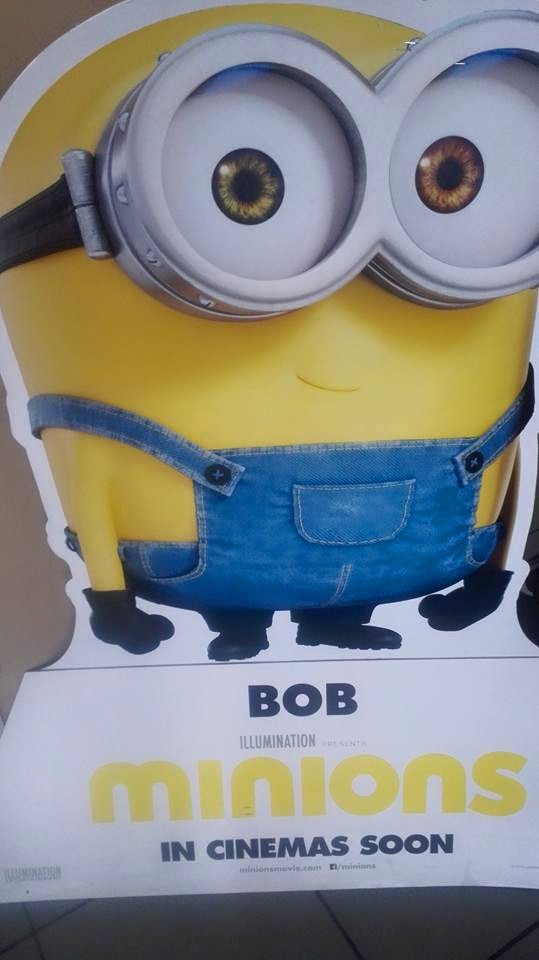
Movies: 3Summer Movies, 3 Different promos


 localjoe.myorganogold.com
Saturday, February 14, 2015
Movies: remembering "Crouching Tiger's" spring to success
fter marking his arrival in Hollywood with a string of English-language films, includingSense and Sensibility (1995), The Ice Storm (1997) and Ride with the Devil (1999), the Taiwanese film director Ang Lee decided to return to his roots for his next picture, which he intended largely for Chinese-language audiences. Ironically, the result--Crouching Tiger, Hidden Dragon--would become by far his biggest hit to date. On February 13, 2001, the film earned 10 Oscar nominations, becoming the first Asian film and only the seventh foreign-language offering to get a nod for Best Picture.
Based on the traditional Chinese martial-arts genre known as wuxia, Crouching Tiger, Hidden Dragon starred Chow Yun Fat and Michelle Yeoh as warriors in 19th-century China, during the Qing dynasty. Kept apart by honor, the two yearn for each other even as they become involved with a heated drama surrounding two younger lovers, played by Zhang Ziyi and Chang Chen. Aside from the touching love story at its center, the film boasted incredibly beautiful scenery, haunting music and--last but by no means least--elaborate battle sequences, with fighters flying through the air and performing other impossibly acrobatic feats. The film’s fight choreography was by Yuen Wo-Ping, who directed the action sequences in the blockbuster hit The Matrix (1999).
In addition to the heaps of critical praise and awards--including a Golden Globe Award for Best Director for Lee, an Academy Award for Best Foreign-Language Film and three more Oscars in technical categories--Crouching Tiger, Hidden Dragon was an unqualified hit at the box office. After first gaining notice on the film festival circuit, it was released in December 2000 on six screens in New York City. Encouraged by its success, the film’s distributor, Sony Picture Classics, widened its release, and it was eventually shown on some 1,200 screens throughout the country. Raking in more than $60 million at the U.S. box office (as well as $100 million worldwide), Crouching Tiger became the highest-grossing foreign-language film in American history, surpassing Roberto Benigni’s Life is Beautiful to claim the distinction.
Tuesday, January 13, 2015
Amazon Studios gets a "Woody"
Amazon orders a full season of Untitled Woody Allen Project, which will premiere exclusively on Prime Instant Video
Episodes will be written and directed by Allen
SEATTLE--(BUSINESS WIRE)--Jan. 13, 2015-- (NASDAQ: AMZN)--Amazon Studios today announced it has signed the critically-acclaimed Director Woody Allen to write and direct his first television series ever. Untitled Woody Allen Project, a half-hour series, has received a full season order and episodes will be written and directed by Allen. Customers will be able to see the series exclusively on Prime Instant Video in the US, UK and Germany. Additional details, including casting information, will be made available in the future.
Woody Allen is a visionary creator who has made some of the greatest films of all-time, and it's an honor to be working with him on his first television series," said Roy Price, Vice President of Amazon Studios. "From Annie Hall to Blue Jasmine, Woody has been at the creative forefront of American cinema and we couldn't be more excited to premiere his first TV series exclusively on Prime Instant Video next year."
Woody Allen added, "I don't know how I got into this. I have no ideas and I'm not sure where to begin. My guess is that Roy Pricewill regret this."
Allen is represented by ICM Partners.
About Amazon Studios
Amazon Studios most recently debuted its dramatic comedy Mozart in the Jungle from Roman Coppola, Jason Schwartzman, Paul Weitz, John Strauss and Alex Timbers, as well as Jill Soloway's multi-Golden Globe Award-winning dark comedy Transparent; its first live-action series for kids 6-11, Gortimer Gibbon's Life on Normal Street; and a second season of the Garry Trudeau political comedy Alpha House. The studio has also launched three additional children's series, the Annecy International Animated Film Festival Award-winning and Annie Award-nominated Tumble Leaf from Bix Pix Entertainment; Creative Galaxy from Angela Santomero and Out of the Blue Enterprises, the creators of Blue's Clues; and Annedroids, from Emmy nominated Sinking Ship Entertainment.
Amazon Studios has also announced five additional, original series to debut in 2015 including Michael Connelly's Bosch; Hand of God from Marc Forster and Ben Watkins; Red Oaks from Steven Soderbergh, David Gordon Green, Greg Jacobs and Joe Gangemi; and kids series Wishenpoof! from Angela Santomero and Out of the Blue Enterprises; as well as a second season of Transparent.
Amazon Studios launched in 2010 as a new way to develop feature films and episodic series--one that's open to great ideas from creators and audiences around the world. Anyone can upload a script online and Amazon Studios will read and review all submissions. Those who choose to make their projects public can also receive feedback from the Amazon Studios community.
Comprehensive cast and crew information, including bios and filmographies, is available on Amazon's IMDb (www.imdb.com), the world's most popular and authoritative source for movie, TV and celebrity content.
Monday, December 8, 2014
Will UMC be the "New Black" [Netflix]?
Robert L Johnson, founder of BET and RLJ Entertainment, has been planning his entry into digital technology since his days at BET.
In an interview last week, Johnson explained that it had long been his vision to provide African American audiences in particular with targeted programming and entertainment. It was the formation of the cable industry in the 70s and 80s, which not only ushered in a new way we received content (through satellite and cable), but helped to loosen the monopoly both the studios and networks had on its content distribution. This transformation also paved the way for BET to serve a niche audience (I.e Black people) that both the networks and studio ignored or didn’t even believe existed.
Johnson said that this shift is happening again. “And so because I had the knowledge and experience of seeing what happened when cable satellite came about, I recognize that digital was going to transform the media landscape in much of the same way,” he said.
And just like BET, Johnson is hoping his latest venture, the Urban Movie Channel, will again be at the forefront of this new technological transformation of how we receive cultural-centered content. The UMC, which is available at www.urbanmoviechannel.com, is digital subscription video-on-demand (VOD) channel that caters to a largely urban and African American audience.
“You can call it the targeted version of Netflix and I think that is a fair analysis but beyond that, there is both a cultural model and a business model to consider,” he said.
As the name suggests UMC has feature length films including sentimental dramas like All Things Fall Apart and blaxploitation classic like Sweet Sweetback’s Baadasssss Song. But there are also live concert music and comedy films like Kevin Hart’s I’m A Grown Little Man, and Welcome To Death Row. And there are also documentaries like Dark Girls and stage play productions like David E. Talbert presents: What Goes Around Comes Around.
Currently, the Urban Movie Channel is up and operational, and as Johnson touts, it can be seen from Newark to Nigeria. In an effort to attract audience, the VOD site is offering free service with membership subscription through February 2015. After that, the plans will start at $4.99 a month, which Johnson notes is significantly lower than what many people pay for subscription to HBO or Showtime on their cable packages.
He also notes that is a solid price for content that Black households have longed pined for. “Basically, this is universal distribution without any gatekeeping,” he said.
In addition to providing on-demand and live streaming market for Black and urban audiences, which rivals the like Netflix or Hulu or Amazon Prime, Johnson said that the UMC provides a great opportunity for Black and urban content creators to not only have access to a platform but tell stories without limitations.
As Johnson points out: Hollywood makes the decisions of the kinds of films that get made and cable channels make decisions about the kind of channels it wants to distribute. Likewise, advertisers, who hold the most control in the current content creation distribution structure, only advertise on programs with compatible values with its brand.
“Using digital platforms or digital media, is a direct way to do it without having to go through lots of gatekeepers, who would either control your access to the consumers, or your audience, or in some way censor or filter it in a way that may not be consistent information you want to give to your consumer,” said Johnson.
The Urban Movie Channel is not RLJ Entertainment’s first foray into digital content distribution. Two years ago, Johnson purchased two companies: Image Entertainment and Acorn Media Group to formed RLJ Entertainment. Through the acquisition, RLJ Entertainment became the holder of licenses to over 160 urban or African American oriented movie titles.
Last year, RLJ Entertainment announced the creation of two other VOD digital channels: OnCueNetwork, which also showed movies, documentaries and other programming targeted to African American and Acorn TV, which exclusively shows British dramas and mysteries.
After a successful test run and partnership with YouTube, OnCue is being phased out to make way for UMC, which will be hosted on its own digital platform. However Acorn TV will still operate separately. Unlike Netflix, which still offers DVD rentals, UMC will be strictly be video-on-demand. However Johnson said that he is looking to distribute some of UMC’s content on both DVD and Blu-Ray to other distribution networks like Red Box, Target and Wal-Mart.
Tuesday, November 18, 2014
The Death of the Jamaican movie house
So, had a discussion Friay night last with Sasha Bowie and host Simon Crosskill on CVM-Tv's "Live@7" programme on the topic of Jamaica's disappearing movie houses. One might believe its hardly worth comment, in that the economics of the entertainment biz (and of cinema in particular) has changed drastically all over the world.
But when you consider that we've gone from no less than 4 theatres in a 400-yard radius as recently as the 1980s, to 2 locations for the entire city of Kingston, then one can see the merits of discussing the issue Its interesting to learn that he Palace Amusement Co that today operates as a virtual monopoly exhibitor, was itself originally in a competitive situation and is in fact now owned by persons, the Graham family (and the 150 or so shareholders) who were in competition with the original Palace
But when you consider that we've gone from no less than 4 theatres in a 400-yard radius as recently as the 1980s, to 2 locations for the entire city of Kingston, then one can see the merits of discussing the issue Its interesting to learn that he Palace Amusement Co that today operates as a virtual monopoly exhibitor, was itself originally in a competitive situation and is in fact now owned by persons, the Graham family (and the 150 or so shareholders) who were in competition with the original Palace
The quote from Melanie Graham is taken from a Gleaner article by Tanya Batson-Savage.
The Palace Amusement Company (1921) Limited was formed by Audley Morais, and operated as a Private Company prior to 1921 (silent movie days). He re-formed the company and offered shares to the public in 1921.
The Palace Amusement Company (1921) Limited was formed by Audley Morais, and operated as a Private Company prior to 1921 (silent movie days). He re-formed the company and offered shares to the public in 1921.
Over the years the Company operated Movies, Rose Gardens, and Palace Cinemas. Gaiety and Majestic was subsequently acquired, Odeon (Mandeville) was leased, and other cinemas ( urban and rural) were built. It operated cinemas and distributed films to many of the independent cinemas that existed in Jamaica and Cayman.
In 1938, Cinema Company of Jamaica Limited built the Carib, in competition to Palace.
In 1947, J. Arthur Rank, from the United Kingdom, bought control in Palace Amusement Company. The Rank Organisation bought out Cinema Company of Jamaica Ltd. owner of the Carib. J. Arthur Rank closed the Movies and built Odeon in Mandeville in 1951, and Odeon in Half Way Tree in 1952.
In l949, Russell Graham built the Tropical Cinema Company, and used it as a centerpiece of the competition that he mounted for the movie audience against Palace.
In 1962, Russgram Investments Limited - a Company owned by Russell Graham - bought the controlling interest in Palace Amusement Company from J. Arthur Rank, and Douglas Graham was appointed Managing Director. The new regime purchased the Majestic Cinema on Spanish Town Road, built the Harbour View Drive In as a partly owned subsidiary, and took control of Tropical Cinema Company, which was a 2-cinema company - Tropical and Rialto.
In 1989, Russell Graham sold his Russgram Investments Company to Douglas Graham, who still has ownership of it.
Palace Amusement Company is listed on the Jamaica Stock Exchange and has approximately 150 shareholders. There are l,437,028 issued stock units. Russgram Investments Limited presently owns 62.05% of the shares in Palace Amusement Company.
So Palace has, in effect, become what they initially fought against. A very typical situation with monopolies, at least in the Jamaican context thus far.
Odeon is by no means unique. A drive through Downtown will also reveal signs on now dilapidated buildings which clearly, if not brightly, state that they were once movie houses. However, not all the old theatre buildings bear reminders of what they once were. It has probably begun to slip from memory that there were actually four cinemas in Cross Roads not too long ago (a perspective which may vary, depending on your age).
Sharing space with Carib was the Regal theatre. It used to be housed in the building which Azan's now occupies. The more recent closing was that of the State theatre. Up to last year it was home to the Kingston Church of Christ and, at the end of last year, the seats were up for sale. Its days as a theatre are long over and there is no sign that they will return.
The other, almost directly across from Courts, now also hosts a church.
Movie buff extraordinaire, Orville Clarke, reflects on the days when there were cinemas in every parish. An avid moviegoer since the 1950s, he names several theatres which existed throughout Kingston. Among them is the very famous Rialto (also of The Harder They Come fame), along with Kings, Gaiety, Queens, Majestic, Ritz, Tropical, Globe and Deluxe. The names of the cinemas seem to reek of the glitz and glamour which they used to hold.
Outside Kingston , The Del Mar (Port Antonio), Empire (Morant Bay) and Capri (May Pen) all added to what helped to create the movie culture in Jamaica. The second city, Montego Bay, had four cinemas strand, The Roxy, Palladium and Coral.
It appears that only Carib is left from that golden era. The grand white building still stands boldly defiant in the middle of Cross Roads. Now Carib 5, the cinema has changed from the single screen set-up that could hold well over 1,000 people at once. Devoured by fire in September of 1996, the cinema managed to arise phoenix-like from the flames. It was also able to do what so many others were unable to do. Change.
Ms. Melanie Graham, marketing manager for Palace Amusement Company, attempted to explain why she believes none of these cinemas were able to last. "They all closed because they were the old type of movie cinemas. Not air-conditioned, very sparse seat, and I think with the advent of video... that added to their demise," she said. She went on to explain that in order to continue to thrive, cinemas needed a lot of investment. "I don't think at the time they were willing to spend to upgrade," she stated, also noting that the admission rates were not very profitable.
Friday, December 13, 2013
"Butler" "Wolf" hit Golden Globes snub
Biggest surprises include Daniel Bruhl and Idris Elba
This year’s Golden Globe nominations were unveiled Thursday and the omissions of Oprah Winfrey, Martin Scorsese and Forest Whitaker from the list of contenders represent the awards’ biggest snubs, according to a Fandango survey of moviegoers.
There were happy surprises in addition to nasty shocks, the online ticketer reports. Among the inclusions that moviegoers hadn’t expected, but were pleased to see were Best Supporting Actor nods to “Captain Phillips”s’ Barkhad Abdi and “Rush”s’ Daniel Bruhl, as well as a Best Actor in a Motion Picture – Drama nomination for Idris Elba in “Mandela: Long Walk to Freedom.”
“Barkhad Abdi must be pinching himself to get a Globe nod over the likes of George Clooney, Harrison Ford, and Tom Hanks for his first film acting job,” Fandango Chief Correspondent Dave Karger toldTheWrap.
See photos: Golden Globes 2013: The Nominees
Fandango polled more than a thousand moviegoers to get its results.
Winfrey, who was widely expected to make the cut for her work as an alcoholic homemaker in “Lee Daniels’ The Butler,” topped the list of snubs, earning 41 percent of the vote. In the second slew, well behind the talk-show icon was Scorsese, who has earned rapturous reviews for directing the high finance bacchanal “The Wolf of Wall Street,” but was passed over this year. He earned 23 percent of the vote.
Other snubs included Whitaker’s upright manservant in “The Butler” (11 percent), Tom Hanks’ channeling of Walt Disney in “Saving Mr. Banks” (10 percent) and the late James Gandolfini’s performance as a sweet-natured divorced dad in “Enough Said” (9 percent). Hanks could at least content himself with the Best Actor in a Motion Picture – Drama nomination he earned for “Captain Phillips,” which should ease the sting from being overlooked.
Abdi, who scored a Globe nod for his debut role as a Somali pirate, was the happiest surprise for 24 percent of voters, followed by Elba, whose nomination for his work as the anti-apartheid icon, was the choice of 22 percent of voters. Bruhl’s arrogant race car driver earned 21 percent of the vote, followed by “Before Midnight”s’ Julie Delpy with 15 percent and “Frances Ha’s” Greta Gerwig with eight percent.
The poll is tied to the launch of the second season of Fandango’s original video series,“Frontrunners,” which features Karger interviewing top awards contenders such as “12 Years a Slave” stars Chiwetel Ejiofor and Lupita Nyong’o, “The Secret Life of Walter Mitty” star and director Ben Stiller and “Fruitvale Station” star Octavia Spencer.
Thursday, September 5, 2013
Rumours of Doom were greatly exaggerated
Well, amid the gloomy reviews of the just ended summer movie season, it turns out that overall, things reeeeeallly weren't too bad for Hollywood after all, as this report from the Atlantic Monthly attests.
http://www.theatlantic.com/business/archive/2013/09/why-sequels-will-never-die-hollywoods-summer-of-flops-was-actually-its-best-year-ever/279352/
http://www.theatlantic.com/business/archive/2013/09/why-sequels-will-never-die-hollywoods-summer-of-flops-was-actually-its-best-year-ever/279352/
Tuesday, July 16, 2013
Testosterone Theatre: the 25 greatest action movies made since Die Hard.
Somem ay wonder why they started with "Die Hard", but then its the movie that single-handedly redeemed Bruce Willis as a feature actor (though we're kinda partial to The last Boy Scout)
From our friends at "Vulture" magazine:
A quarter of a century ago this week, John McTiernan’s action masterpiece Die Hard was released into theaters, and it's not an understatement to say that we're still reeling from the impact. The film turned one Bruce Willis — until then thought of primarily as a comic actor and harmonica player — into a Hollywood action star, a position he's still convincingly holding down 25 years later. It also unleashed armies of imitators: There was Die Hard on a Ship (a.k.a. Under Siege), Die Hard on a Mountain (a.k.a. Cliffhanger), Die Hard at the Stanley Cup Finals (a.k.a. Sudden Death), and so on, all the way up to this year's double dose of Die Hard at the White House movies (a.k.a. Olympus Has Fallen andWhite House Down), not to mention Die Hard Beating a Dead Horse (a.k.a. A Good Day to Die Hard, a.k.a. Die Hard 5). It is, in fact, partly thanks to these imitators (as well as the Willis franchise's lesser sequels) that we often forget how expertly made the original Die Hard is: It's as much a perfectly calibrated character piece as it is a kick-ass action flick.
So what has the action landscape looked like since that fateful day in 1988 when we first met John McClane en route to Nakatomi Plaza? For the past few months, I’ve been watching and/or rewatching almost every major action movie made since then in an attempt to come up with the best ones. The good news is that a lot of awesome action movies have been made over the past 25 years. The bad news? Not all of your favorites will be on this list.
First, some ground rules:
- Not every movie with action in it is an action movie. Believe it or not, it is sometimes very hard to determine just what constitutes an action movie. For the purposes of this list, we decided that an action movie not only had to have a lot of action scenes in it (duh), but that it had to be a film that wouldn’t make any sense if you took all the action scenes out of it — that is to say, the action had to be a key way of moving the plot forward. As a result, we filtered out a lot of great films, masterpieces even, that didn’t quite qualify as true action movies: Michael Mann’s Heat, for example, or Tony Scott’s True Romance, or the entire Lord of the Rings trilogy.
- Only one film per franchise. This is a cheat, sure, because not all franchises are created equal: There’s only one great Matrix movie, but several great Once Upon a Time in China installments. But still, in an effort to keep this list from becoming overwhelmed by certain films and directors, we decided to limit it to one title per franchise.
- No animation. Because it just wouldn’t be fair to the other movies if we suddenly allowed Pixar and Miyazaki in there.
Thursday, January 10, 2013
A Landslide for Lincoln?
From the Los Angeles Times:
"Lincoln," "Zero Dark Thirty," "Argo" and "Les Miserables" earned multiple Oscar nominations Thursday morning, and the announcement of the nods put Steven Spielberg on track to win his third Academy Award for best director.
BEST PICTURE
- "Amour" Nominees to be determined
- "Argo" Grant Heslov, Ben Affleck and George Clooney, Producers
- "Beasts of the Southern Wild" Dan Janvey, Josh Penn and Michael Gottwald, Producers
- "Django Unchained" Stacey Sher, Reginald Hudlin and Pilar Savone, Producers
- "Les Misérables" Tim Bevan, Eric Fellner, Debra Hayward and Cameron Mackintosh, Producers
- "Life of Pi" Gil Netter, Ang Lee and David Womark, Producers
- "Lincoln" Steven Spielberg and Kathleen Kennedy, Producers
- "Silver Linings Playbook" Donna Gigliotti, Bruce Cohen and Jonathan Gordon, Producers
- "Zero Dark Thirty" Mark Boal, Kathryn Bigelow and Megan Ellison, Producers
DIRECTOR
- "Amour" Michael Haneke
- "Beasts of the Southern Wild" Benh Zeitlin
- "Life of Pi" Ang Lee
- "Lincoln" Steven Spielberg
- "Silver Linings Playbook" David O. Russell
LEAD ACTOR
- Bradley Cooper in "Silver Linings Playbook"
- Daniel Day-Lewis in "Lincoln"
- Hugh Jackman in "Les Misérables"
- Joaquin Phoenix in "The Master"
- Denzel Washington in "Flight"
LEAD ACTRESS
- Jessica Chastain in "Zero Dark Thirty"
- Jennifer Lawrence in "Silver Linings Playbook"
- Emmanuelle Riva in "Amour"
- Quvenzhané Wallis in "Beasts of the Southern Wild"
- Naomi Watts in "The Impossible"
SUPPORTING ACTOR
- Alan Arkin in "Argo"
- Robert De Niro in "Silver Linings Playbook"
- Philip Seymour Hoffman in "The Master"
- Tommy Lee Jones in "Lincoln"
- Christoph Waltz in "Django Unchained"
SUPPORTING ACTRESS
- Amy Adams in "The Master"
- Sally Field in "Lincoln"
- Anne Hathaway in "Les Misérables"
- Helen Hunt in "The Sessions"
- Jacki Weaver in "Silver Linings Playbook"
ANIMATED FEATURE FILM
- "Brave" Mark Andrews and Brenda Chapman
- "Frankenweenie" Tim Burton
- "ParaNorman" Sam Fell and Chris Butler
- "The Pirates! Band of Misfits" Peter Lord
- "Wreck-It Ralph" Rich Moore
Subscribe to:
Comments (Atom)