Showing posts with label media. Show all posts

Wednesday, August 31, 2016

Media: The Internet NEVER Killed content

- from MEDIA Redef

Over the past century, technological advancements have massively reduced the cost and time needed to create and circulate content. Though this has liberated artists, consumers are now drowning in a virtually infinite supply of things to watch, listen to and read. The answer to a world where attention is the key constraint, not capital or distribution, isn’t Big Media – it’s the Influencer Curator.
If you read a list of mankind’s most important or influential inventions, there’s not far you could go without coming across those of Thomas Edison. Oddly, however, it’s unlikely you’d ever see the device he so-routinely identified as his favorite: the phonograph. While it didn’t defeat disease, conquer the night skies or take flight, the phonograph was just as Promethean as vaccines, electricity and the Wright Brothers’ ‘Flyer’. For thousands of years, media was a privilege of the elite, concentrated in cities and confined to a single moment in time. With Edison’s phonograph, music had become non-rivalrous, infinitely replicable and indefinite. Yes, it took decades until the average family could afford a record player or radio, but the dawn of democratized consumption had arrived.
Unfortunately, however, this same trend led to an ossification in content creation and distribution. Records, after all, cost money. Production was expensive – as was distribution, marketing and promotion. So expensive, in fact, that almost every artist lacked the capital required to actually release their music – a need that paved the way for record labels (or TV studios, film studios, publishers etc.) that would finance said efforts in exchange for hefty royalty fees and content rights. These money men though wouldn’t and couldn’t afford to invest in every artist with a dream. Given the upfront cost of talent development and distribution, labels invested in “Arts & Repertoire” men, whose job it was to sift through countless musicians in order to identify the select few with “commercial viability”. Potential artists were then further cut down in number when it came time to actually distributing their content – and then again via marketing/promotional support. Underlying this fact was an unavoidable truth: content publishers had scale-related disincentives to support more than a handful of artists. Why record, distribute, market and promote 15 albums if you can achieve the same unit sales with 10?
Though this system was far from ideal, it was the inevitable outcome of a market in which talent was abundant, capital limited, distribution bandwidth (e.g. shelf-space, broadcast spectrum, print layouts) scarce, barriers high, and the cost of failure significant. But as a result, the content industry slowly shaped itself around a mysterious cabal of financiers and executive tastemakers that essentially programmed the national media identity. And anyone who wanted in had to move to New York, LA or Nashville, pay their dues and hope to work their way up until they could call the shots.
REDEF_Curation_1.1
Of course, the music business was far from alone. The more expensive the medium, the more constrained the supply, the smaller the community and more homogenous the content. Local disc jockeys, newspapers and TV affiliates did have the opportunity to repackage and reprogram – to imprint their personality or take, if you will – but this was limited in scope, drew upon only the content that was already distributed, had to fit within an existing corporate identity and, again, depended on access to capital or infrastructure.
Over time, however, technology did what it does best: production costs fell, quality went up and distribution bandwidth increased. Economics, in turn, improved, as did the industry’s carrying capacity – the number of artists, titles, and pieces of content that could be supported. The media business was beginning to loosen up.
REDEF_Curation_1.2
But it took until the late 2000s – more than a century after the phonograph – for creation and distribution to truly democratize. With the Internet, distribution became free and truly non-rival (if a bit non-excludable), while the proliferation of low-cost media equipment, mobile devices, and powerful editing software dramatically lowered the costs of production. The rise of creator-based consumption platforms and crowd-funding platforms, meanwhile, eliminated many of the remaining barriers hindering independent content creation. This meant that content could not only be created by those outside the business, but that commercializing this content became significantly less expensive and risky. This led to a massive increase in available, indexed and distributed content.
REDEF_Curation_1.3
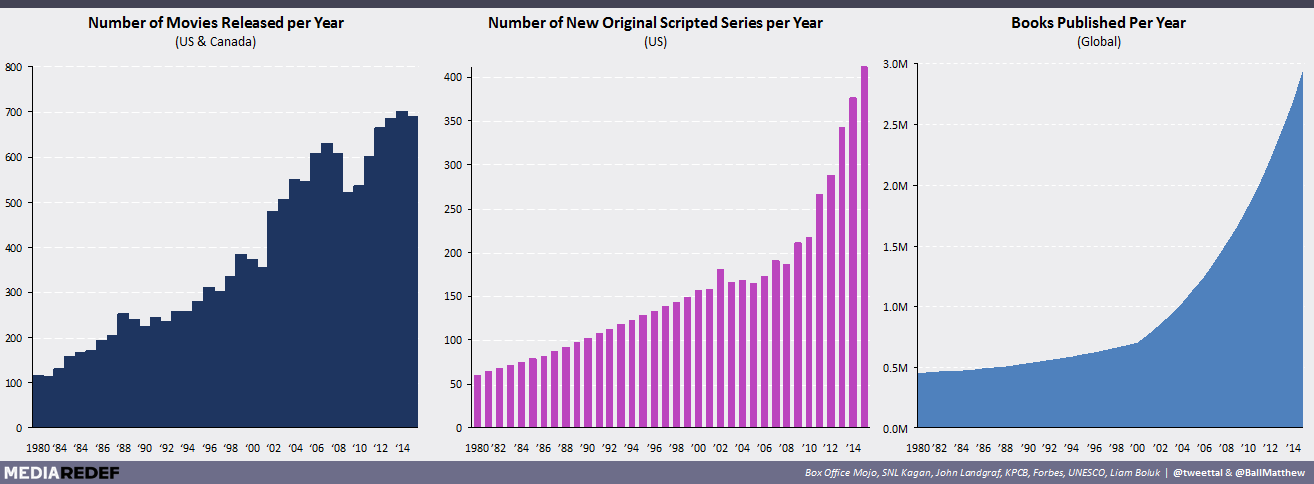
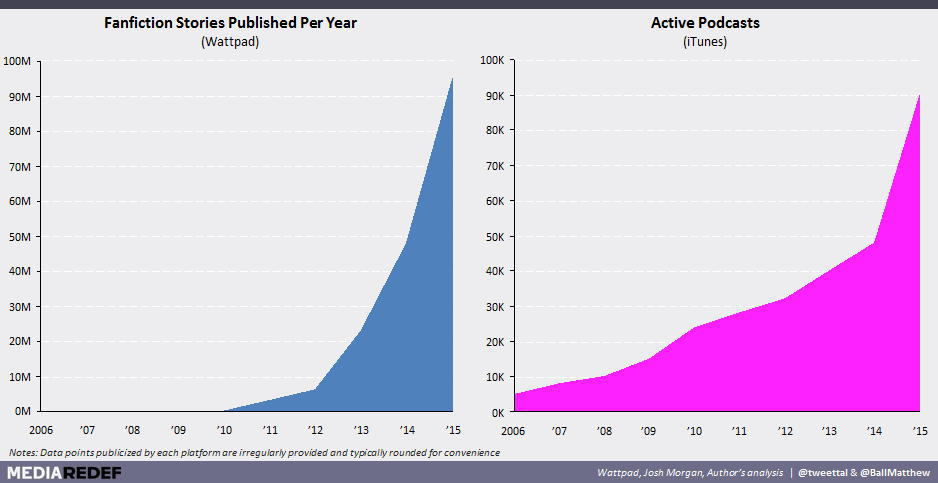
While the media business benefited from many of these changes, the consequences have been fundamentally destabilizing. The television industry has experienced such a surge in original content that annual cancellation rates have quintupled over the past 15 years (twice as many original scripted series were cancelled last year than even aired in 2000). Since 1985, the indie film industry has seen a nearly twentyfold increase in the number of theatrical releases even though ticket sales have remained flat (in 2014, the Head of SXSW’s film festival decried that “the impulse to make a film had far outrun the impulse to go out and watch one”). Plummeting music sales and unprecedented competition have made launching a new artist so expensive that catalogue sales now make up more than 200% of major label profits (in 2014, David Goldberg privately encouraged Sony Entertainment CEO Michael Lynton to essentially halt A&R efforts, as well as investments in actually making new music). With the democratization of media creation, it’s easier than ever to make content but harder than ever to make a hit.
REDEF_Curation_1.4
Ironically, the increasing difficulty in creating hits has not bolstered the “hit maker” system but rather further weakened it instead. In 2013, Macklemore became the first unsigned artist since 1994 to have a number-one single in the United States – a feat he repeated just three months later. Mega-star Taylor Swift has been with an independent label since her debut album and multi-platinum groups such as The Eagles and Radiohead have left the majors to start their own. The struggles of print publishing are well-known, but the uniqueness of some of “print’s” recent successes are worth mentioning. The 50 Shades of Grey trilogy, which has outsold The Harry Potter septet on Amazon in the United Kingdom and made author E.L. James 2012’s highest-earning author, became a viral hit on FanFiction.net long before it was picked up in print (and it’s unlikely a publisher would have bought the rights upfront). Andy Weir’s The Martian is another self-publishing success story.
REDEF_Curation_1.5
This metamorphosis is about far more than ever increasing amounts of content and a handful of stars existing outside the traditional media ecosystem. The entire media business is inverting. For decades, scarce capital and constrained distribution capacity meant that the media’s industry bottlenecks sat in the middle of the value chain. Today, however, the bottleneck has moved to the very end: consumer attention. This shifts the balance of power from determining what should be made to finding a way to convince people what to watch, listen to or read in a world of infinitely abundant content.
The preeminence of this challenge has given to the rise of a new type of aggregator-distributor, including news content sites like Gawker, the Huffington Post and BuzzFeed; video and music aggregation services like Netflix, YouTube and Pandora; and even physical products subscription offerings like Birchbox and Lootcrate. What’s more, it enabled the major social networks to use their customer data to build massive stickiness, launch their own publishing platforms and become traffic kingmakers. More broadly, this shift has swung the balance of power from programmers with the ability to greenlight content to curators with the ability to get that content heard, seen or read. Of course, the old programming and financing guard remain important, but with the democratization of production and the explosion of content creation, the power of 1st party programming is quickly being eclipsed by the ascendance of 3rd party content curation. The gatekeepers are still manning their posts, but the city outgrew the walls and the barbarians circumvented the gates entirely.

The Tastemaker Curator
To date, curation has primarily been delivered in three ways. Most common is algorithmic recommendation powered by behavioral and social graph data – e.g. Facebook’s newsfeed, Spotify’s Discover Weekly, Netflix’s content feeds. Second is hand-picked selections delivered by and through the major distribution platforms – e.g. Twitter Moments, Snapchat stories and Beats Radio 1. Third are one-off recommendations and shares by individual users – posting a Spotify playlist, reblogging a tumblr post, sharing a link or retweeting a tweet. Suffice to say, curation today is dominated by well-capitalized technology-media companies and supported by significant manpower and bandwidth.
REDEF_Curation_1.6
However, the next evolution in the media value chain will be the rise of decentralized curation – with individual tastemakers building up mass followings and driving enormous consumption by recommending various articles, videos, shows, films, albums, exhibits and so on. While there’s no way to effectively do this at scale today, the transition is long in development. Almost everyone today remixes content they’ve created with 3rd party content (just look at any social feed), reviews and engages in media commentary (ditto) and uses the recommendations of others to decide what to watch, see, listen to or even believe. Similarly, every social graph includes a handful of node users whose endorsements proliferate across the social web. The formalization of this influence will therefore represent both a natural and value-add extension of existing user behavior.
To this end, multimedia curation is and will continue to be pioneered by today’s web influencers: YouTube, Instagram and Twitter celebrities such as Connor Franta or Michelle Phan that have already developed, personal and authentic voices that transcend individual verticals, genres and brands and influence millions. But it is not and will not be confined to these digital influencers alone. “Traditional” celebrities that connect with their audiences on a deep level – a Howard Stern, Taylor Swift, Glenn Beck or Kardashian – are positioned to and in some cases already beginning to dive into curation. Mindy Kaling doesn’t have 6M Twitter followers, two books and her own TV show just because she’s funny, but because her taste, endorsements and perspective resonates.
The template already exists: Martha Stewart and Oprah both built extensive, multi-category empires in the pre-digital era largely based on the power of their stamp of approval. With new distribution technologies, the influencers of today, and maybe Martha herself, will be able to build even more comprehensive empires than ever before, all built on the power of their taste and delivered via inexpensive but massively distributed web infrastructure.
This ability for consumers to tap into specific voices will also be critical as more content and more users come online. Consumer time (or “attention”) doesn’t scale with either the volume or ready availability of content at their disposal. Discovery functions, too, have a maximum. The significance of 1,000 likes, 400 ratings or 3.2M plays is very different with 3B Internet users than it was with 500M. Not only does contextualizing these social cues become impossible, but the demographics of the reviewers continues to change – first in terms of age and income, then geography and culture – making it difficult to understand the personal validity of any crowd based metric. That’s not to say that a product on Amazon with 1,400 reviews and a 3.8 star rating isn’t good – just that the common review mechanisms found across the web mathematically soften taste out to the average. This works a lot of the time, but we tend to have very particular tastes in certain categories – and there is a certain staleness created by narrowing these averages down using look-a-like groups and other algorithmic techniques. Not to mention the fact, that such an approach often lacks the element of serendipity and surprise from discovering something you loved but didn’t expect (especially if you would otherwise have avoided it). As a result, curators both solve a media painpoint and enrich consumption.

Where Will this Be Built?
The most likely enablers of the age of curation will be today’s social platforms. Though rarely viewed as such, these companies – Facebook, Twitter, LinkedIn, Pinterest, Instagram – are already in the business of content creation, remixing and distribution. As such, the expansion from one-off filters, albums, shares and vlogs to curation would represent an organic evolution of their existing user toolset. More importantly, however, this change will be critical if these platforms want to continue to grow user engagement and manage the massive influx of user created and user-submitted content.

Wednesday, June 15, 2016

Culture: KOTE 2016 "Connects"

the 2016 Kingston on the Edge (KOTE) Festival, an annual ten-day, multi-venue, non-profit, urban arts festival that supports and promotes positive creative energy in Kingston, Jamaica through artistic exchange and community involvement. This year, the festival runs from June 17 to 26, organized around the theme “Connections.”
Providing a forum outside of traditional spaces, KOTE allows participating artists to express themselves and push the boundaries and definitions of their art.
Each year KOTE embraces an impressive array of visual and performing artists and showcases venues not always thought of as traditional spaces.
The theme this year is “Connections” and will be looking at the contextual relationships in art and the link between cause and effect.
Some of the examples of the connections being explored this year include diversity and artistic exchanges within society through multicultural influences; migration and links to the Diaspora; and the relationship between Jamaica and its neighbors.
Check out http://www.yardedge.net/ for the schedule of events coming soon.

Thursday, May 5, 2016

Media: Newsweek Lives!

Newsweek is returning to hard copy on Friday for the first time since the magazine ended its print edition in 2012.
The magazine, which had been printing since 1933 prior to the cut, announced that it would be returning to print in December 2013 after transitioning to all-digital in 2012. IBT Media will reportedly will only print a small run on Friday of about 70,000 copies.
Newsweek makes it’s promised return to print with a cover story on the secret identity of the creator of Bitcoin, 64-year-old Satoshi Nakamoto worth about $400 million in Bitcoins.

The magazine announced that they would be cutting print and moving to an all-digital format in October 2012 as circulation plummeted and profits continued to struggle. Tina Brown, the then-editor of Newsweek and The Daily Beast, which merged in 2010, said at the time that “we have reached a tipping point at which we can most efficiently and effectively reach our readers in all-digital format.” Newsweek rebranded as “Newsweek Global,” a tablet edition that required a paid subscription.
But the New York Times first reported in December 2013 that the weekly magazine would resume printing sometime in 2014. The Daily Beast confirmed the news stating, “a historic title is back from the dead.”

Friday, October 23, 2015

At age IRIE22, IRIE Jam media looks to broaden its beat


IRIEJam co-founder Bobby Clarke


Having started with the audacious visit of NYC-based founder Bobby Clarke to the studios of Jamaica's IRIE-FM (then a still fledgling yet rising media entity) and the notoriously unaffected and straight-talking founder, Carl Young, broadcaster, content provider and event producer IRIE Jam Media has become the de facto voice of the Jamaican and wider Caribbean diapsora in North America.

having secured agreements to expand its footprint across the Continent and beyond, the founders (Clarke and Louis Grant) returned home  - and specifically to the Jamaica Pegasus in Kingston to host the various supports from corporate Jamaica and to cast their net for even more investment, emphasizing the great interest globally in things Jamaican/Caribbean and the close ties between Diaspora residents and their family/friends/contacts back on the Rock

Friday, September 11, 2015

Media Business: "Who Really Owns Rio?" and other lessons from the RJR-Gleaner merger forum

At one of several high-wattage parties announcing its transition, executives of the former LIME, which is now operating its consumer telecoms biz as FLOW, trumpeted the new entity as " the exclusive broadcaster" of the much anticipated 2016 Summer Olympic Games in Rio, Brazil.

expectedly, this sent no small shocks through the media fraternity as a whole and the conventional broadcast media in particular. CVM and TVJ had consistently battled to secure the rights to such tentpole sporting events (Olympics, World Cup Football tournament) that have clear demand for Jamaican audiences and thus represent a boon in seeking the all-important ad revenues.

Now, the rights to Usain Bolt's possible swan song (and other potential show-stoppers) has gone to what has conventionally been a cable TV provider, an outsider if you will.

But hold on. At a public forum hosted by the UWI's Mona School of Business and Management (MSBM) on Thursday night, it was revealed that while Cable and Wireless Communications, parent of the new entity FLOW/LIME (LIME really no longer exists, at least in the Jamaican context) has actually signed on as broadcast sponsor - and exclusive telecoms partner - to the real rights holders:

CANOC

Who? The acronym essentially pools the national Olympic Committees of the Caricom region, who have formed a unique media entity of their own, dubbed CBI, will managed the feed served through sports powerhouse ESPN to 33 regional territories, including Jamaica. Pollster and veteran Jamaican Olympics official Don Anderson, who 'happens" to be a board member of CBI, made the clarification during the Q & A session that followed five panel presentations (including his own) on the implications of the RJR-Gleaner (Media) alliance.

The deal, which RJR Group CEO (and CEO-designate of the new entity) Gary Allen says is in  the process of clearing regulatory and shareholder approvals hurdles, is expected to be fully ratified by year-end. Even though Extraordinary General meetings will be required on both sides, RJR shareholders will almost certainly raise the issue come next week when they gather at the Pegasus for the Annual General Meeting. 

The papers covered a fair range of issues, from the stock complexities attending the deal, to the audience/consumption picture against which it was contemplated. Former TVJ CEO, now Media Consultant Kay Osborne delivered a sobering framework of the advertising market which had healthy doses of diatribe against the telecoms giants Digicel and FLOW/LIME for wading into what may have been perceived as "hallowed space" . Is it really "proper" for tech-heavy, deep-pocketed telecoms firms, who formerly partnered with free-to-air TV (and still do, to varying extents) to now become direct competitors to conventional broadcast media in a low(no)-growth economy, with ad revenues in flux?

Weighty question and still up for debate. But what's not debatable is that a major shift has taken place in the media landscape, the effects of which will surely be felt through the remainder of this decade.

As they'd say in Rio, "Ate breve" 

Wednesday, May 13, 2015

Film Biz: More wind, little action (yet) on proposed Goodyear film lot

As the following from the Observer indicates, there's still a lot of prelim surrounding the already much talked-about proposal to develop a film production lot on the former Goodyear Jamaica factory iin the eastern parish of St Thomas.

A lease is yet to be signed, for the property, on which sits the old tyre factory, shuttered now for some 18 years:

 "The project has been moving forward and the investors/project developers have recently concluded negotiations on the terms of a lease agreement with the Factories Corporation of Jamaica (FCJ)," Anthony Hylton, Minister of Industry, Investment and Commerce, told the recently concluded sectoral debate.
"It is anticipated that the design phase of the project will be completed in the second quarter of the financial, allowing for the handover," Hylton continued.
David Mullings, chairman of the RealVibez Group, confirmed that his company has an interest in the project. He said he chose Jamaica because of its historical links with film-making and its central location in the Caribbean.
"It was an easy choice to have the facility here," he said.
Born in Kingston, Mullings started his first company at 20, while studying for his MBA at he University of Miami. That project was RealVibes.net later renamed Realvibez.tv, a leading online destination for reggae, dancehall and soca videos.
Mullings also heads Random Media, an integrated media and entertainment firm, which is focused on Caribbean entertainment and culture.
He said he is hoping to sign a long-term lease with the FCJ for the 23 acres of land on which the old Goodyear factory sits to construct the facility. The plant has been closed since 1997.
He said that it will have post-production and audio facilities, workspaces, live music venues, rehearsal spaces for theatre and space for movie sets.

Thursday, February 12, 2015

Sports: The Axe Swings and the "Fat Lady" warms up her throat

Its undoubtedly crunch time in the English Premier league, that point in the season when the race for the top and the race to escape bottom hits warp speed.

Its also the time when new media deals are finalized and, not coincidentally, when club managers deemed non-performers are sacked. Leceister's Nigel Pearson seems to have dodged for now (his, though bottom of the League,still have a shot at the FA Cup) but Villa's Paul Lambert did not. With back-to-back embarrasing losses, a local paper campaigning for his sacking and the huge spectre of no goals, it was all too much for Villa owner Randy Lerner, and the announcement came swiftly after the mid-week defeat to fellow-strugglers Hull (who have found a bit of wind in their sails at the moment).

At the top though, its a different story. The Chelsea juggernaut may have taken a few licks and scrapes (and dished out some on the field too) but with the win over admirable Everton, the Blues have virtually locked in the title. yes, we know its February but, quite simply, we don't expect this team to lose the number of games it would take for Man City or Man U to overhaul them.

Monday, October 29, 2012

Just Right for November: The Ides of March


  1. The Ides of March
  2. Production year: 2011
  3. Country: US
  4. Runtime: 100 mins
  5. Directors: George Clooney
  6. Cast: Evan Rachel Wood, George Clooney, Jeffrey Wright, Marisa Tomei, Max Minghella, Paul Giamatti, Philip Seymour Hoffman, Ryan Gosling
George Clooney made this, his second film dealing specifically with politics in 2011, a critical juncture for both real-life US political combatants as they head toward this year's Decision Day.
Clooney's film is altogether more brutal than The Candidate, which, if only for Redford's presence, retains a core of idealism, as indeed to an even greater extent do Redford's post-Watergate thrillers, All the President's Men and Three Days of the Condor. In fact the informed cynicism that The Ides of March brings to mind is that displayed in Gore Vidal's play and film about a presidential election, The Best Man, when Vidal himself was deeply involved as a Jack Kennedy supporter, as well as his sequence of political novels that began in 1967 with Washington, DC.
Co-scripted by Clooney with Beau Willimon (on whose play Farragut North the film is based) and Grant Heslov (who was Oscar-nominated for Goodnight, and Good Luck), The Ides of March is set largely in Cincinnati where the handsome liberal governor of Pennsylvania, Mike Morris (Clooney), is competing in the Democratic primary elections with his eye on the presidency. It's March, the streets are slushy with melting snow and the air's full of heady rhetoric about the future of America spoken by people with patriotic pins on their left lapels standing in front of outsized Stars and Stripes. A man emerges from the darkness to speak with disarming honesty about his liberal political positions, but he's not Governor Morris, who is in fact a background figure. He's Stephen Meyers (Ryan Gosling), a 30-year-old aide of great brilliance who is using a speech he's written for Morris to test and adjust the acoustics for Morris' public debate with a fellow contender. Gosling subtly suggests something indefinably suspect about his character.

Morris' seasoned campaign manager, the rumpled Paul Zara (Phillip Seymour Hoffman) demands loyalty above all else, but all to give him reassurance that his otherwise unremarkable persona is still relevant.

Clooney's critical point is that nobody's hands are clean. Everyone is fighting for their own turf, either advancing or defending their chosen interests, while outwardly professing loyalty to the cause of the candidate. They frequently end up trapped by their own weaknesses (sex, power, money) rather than being persuaded by superior arguments or circumstances. But is it better to win and deliver on half your pledges or retain your purity and achieve nothing?

The film's "money scene" comes near the end, when ousted campaign manager Zara is called into the Governor’s Chevy Trailblazer, a hulking black hearse, which has backed into an alley in Cincinnati. The conversation is unseen and unheard by the audience who are confronted solely by the vehicle for the duration of the scene until Zara climbs out, and with his fate sealed, lights a cigarette, while the car pulls away.

The Ides of March reconfirms Clooney's directorial gifts, especially his ability to sustain both dramatic tension and moral focus. With a crucial election now pending, and the incumbent Democrat in the fight of his life, this thriller entrant from last year deserves renewed consideration.